
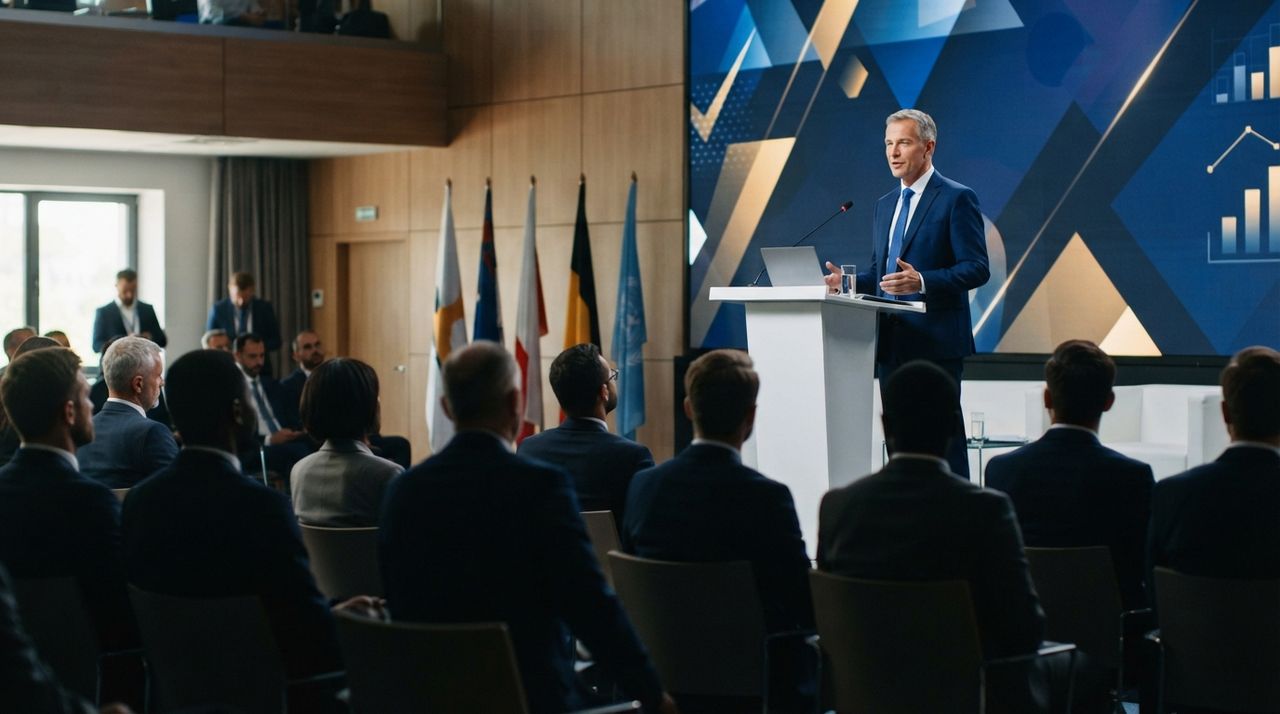
AI-generated illustration
Binali Yıldırım, Chair of the Council of Elders of the Organization of Turkic States, called for the creation of a global children's education fund financed by high-income countries, saying middle- and low-income nations need $100 billion a year to meet the 2030 education targets.
Speaking at the Istanbul Science Summit 2026 in Beyoğlu, Yıldırım said the sum is small against a global gross product of $130-140 trillion and proposed transfers from national incomes, air tickets and hydrocarbon-related taxes to sustain it.
A call made at an Istanbul nutrition summit
Yıldırım attended the Istanbul Science Summit 2026, organized by Yahya Ülker, Chair of the Sabri Ülker Food Research Institute Foundation, in cooperation with The Nutrition Society. The meeting brings together international scientists to discuss childhood nutrition, public health and nutrition education at a hotel in Beyoğlu.
Recalling that he spent nine years in those surroundings building ships that carried cargo on the world's seas, including food for children, Yıldırım said delivering a speech at a gathering on children's education, nutrition and development was something he never imagined at the time.
Unequal chances for children worldwide
Yıldırım said there is a serious imbalance in the world and that, when rich, middle-income and low-income countries are compared, children do not have the same chances. A child's needs are the same regardless of family income or the country of birth, Yıldırım said, adding that this makes the issue a global responsibility.
Yıldırım said 273 million children cannot reach school or take part in education today, and about 650 million people live in absolute poverty, defined as an income below $3 a day. Children in Palestine and Gaza pay the heaviest price of war while they should be growing up, studying and building character, Yıldırım said, arguing that no restriction should ever keep children away from education.
UNICEF was established in 1946 for children, but Yıldırım argued that, like other United Nations bodies, it has lost its effectiveness over the years and only publishes statistics on schooling and nutrition by region. Statistics alone are not a solution, Yıldırım said; the solution is to stop children from paying the price of the world's inequalities.
How the proposed fund would be financed
Yıldırım urged highly developed countries to transfer eight per thousand of their national income into the fund every year. Additional sources could include a small amount added to the tickets of the 5 billion people who travel by air and a share of taxes collected from hydrocarbon-consuming vehicles.
The gap to be closed is $100 billion, Yıldırım said, adding that if a world of 8 billion people cannot raise that amount, there is little point in continuing as before. Middle- and low-income countries need $100 billion annually to reach the 2030 education goals, Yıldırım said, and the figure is not large within a global gross product of $130-140 trillion. The money must be found through sustainable sources so the initiative can begin.
Kindergarten project and past infrastructure work
Yıldırım said the family launched a project in 2016 with Semiye Yıldırım and the Istanbul branch of the Turkish Red Crescent to build 81 kindergartens in 81 provinces. Seventy-three of them have been completed, and more than 15,000 children aged four to six attend them, learning about daily life, forming friendships and preparing for school.
Yıldırım recalled infrastructure projects carried out over the past 25 years, among them the Yavuz Sultan Selim Bridge, the Osmangazi Bridge, Marmaray, the Eurasia Tunnel, the Çanakkale Bridge, the Istanbul-Ankara and North Marmara motorways, Ankara-Niğde and Adana-Mersin roads, built to improve living standards. Those works never produced the excitement of opening the kindergartens, Yıldırım said, recalling the light in the children's eyes.
More than 473 million children live in conflict zones today, Yıldırım said, calling the education fund an indispensable responsibility for children who represent the future.
Childhood nutrition figures presented at the summit
Deputy Health Minister Şuayip Birinci cited World Health Organization data showing that in 2024, 150 million children under five were affected by stunting and 43 million by wasting. Birinci said the figures show that undernutrition and overnutrition occur at the same time worldwide, and that child health begins with the health of the expectant mother and covers the whole of childhood.
Birinci said breastfeeding reduces the risk of obesity by 25%. Turkey ranks seventh among OECD countries for obesity, 9.9% of children in Turkey are obese, and projections indicate that by 2050 one in three children will be obese, Birinci said. Fifty-five per cent of children who are obese remain so in adolescence, and 80% of obese adolescents remain obese in adulthood.
Healthy eating culture is too vital to be left to the commercial expectations of industry, Birinci said, adding that the matter must be treated as a public health issue, a factor in economic development and part of building the future.
Participants and the schedule
The program was attended by Presidential Chief Advisor İsrafil Kışla, Deputy Trade Minister Mahmut Gürcan, Yıldız Holding board member Murat Ülker and Deputy Chair of the Turkish Health Institutes (TÜSEB) Murat Sargın.
Bringing together academics, public health specialists and nutrition researchers from Turkey, the United Kingdom, the United States, Japan, Norway and Pakistan, the Istanbul Science Summit 2026 continues tomorrow.
Key takeaways
- Binali Yıldırım called for a global children's education fund financed by high-income countries.
- Middle- and low-income countries need $100 billion a year to meet the 2030 education targets.
- 273 million children worldwide cannot access school or take part in education.
- WHO data for 2024 show 150 million children under five affected by stunting and 43 million by wasting; 9.9% of children in Turkey are obese.

Join the conversation
Share your thoughts on this story.
Comments
Post a Comment