
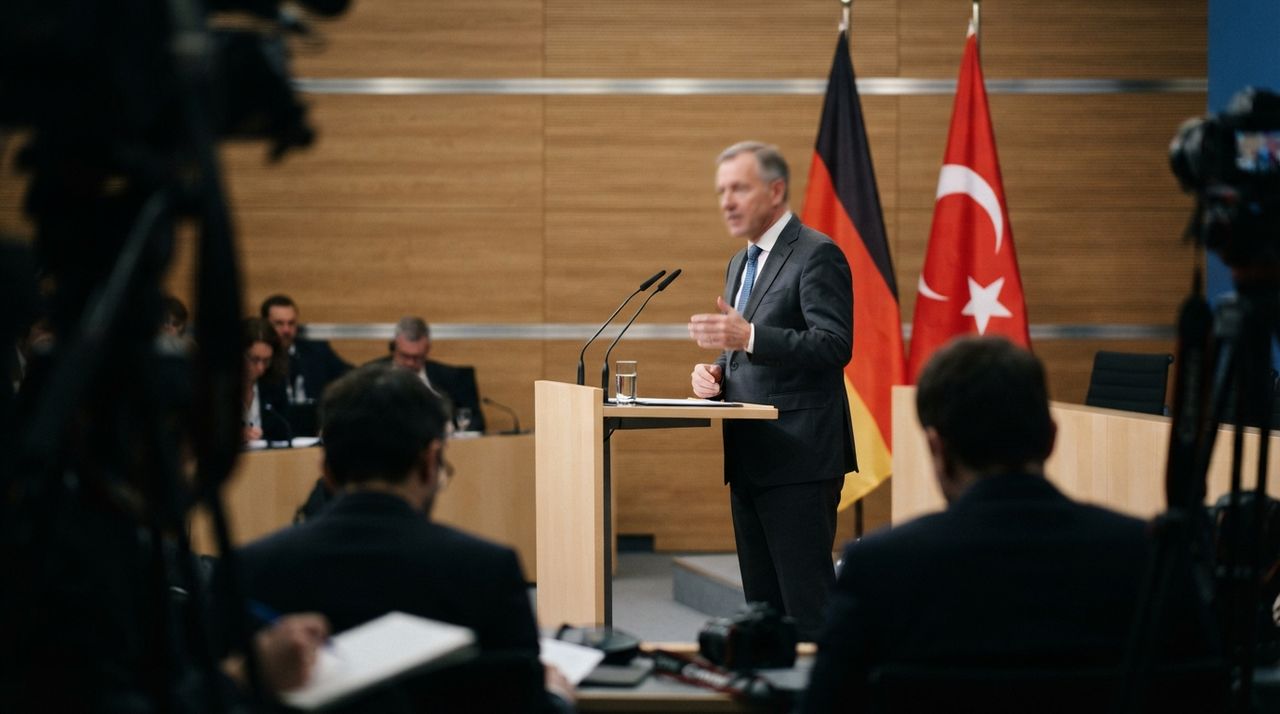
AI-generated illustration
German Chancellor Friedrich Merz said migration from Turkey has made Germany richer culturally, economically and scientifically, speaking at a government event titled "65 Years of Shared History" marking the anniversary of the Germany-Turkey labour agreement.
Merz said the 65-year history of Turkish migration includes successful examples of integration alongside the fight against racism and xenophobia, and warned that hostility toward foreigners is rising in the country.
A daily life of work and sleep
Merz recalled that for the first generation, the rhythm of daily life amounted to little more than working, sleeping, working and sleeping again.
Those workers lived in labour colonies close to factories and industrial sites, in housing estates and in separate dormitories, Merz said. "In the colonies there were simple shelters made of steel near the industrial plants, paint workshops that sometimes worked well, rooms with many beds, shared kitchens and partly curfews," the chancellor said.
Guest workers who stayed and built
Workers who arrived in Germany expected to go home after two years, Merz said. Of those who came between 1961 and 1973, roughly half returned to Turkey while the other half remained. "Guest workers slowly turned into migrants," Merz said, noting that they brought their families and moved into city centres.
Merz said Turkish guest workers contributed to the formation of Germany's industrial structure and that the Ruhr region could not have become so wealthy without the first generation. "They built the infrastructure of the prosperity we live in today, often with extraordinary diligence," Merz said, adding that they shaped Germany's cultural face deeply and continue to do so.
Among the success stories Merz cited were Aras Ören, Deniz Utlu, Fatih Akın, İlkay Gündoğan, Uğur Şahin and Özlem Türeci. The chancellor also recommended a book by Özcan Mutlu published five years ago for the 60th anniversary of the labour agreement, saying it remains worth reading today.
Xenophobia is increasing, Merz warns
Merz said hostility toward foreigners in Germany has not declined but grown, and that this fear is being exploited again for ideological purposes. The chancellor criticised the concept of "remigration", arguing that behind it lies an attack on the modern Germany built together over the past 65 years.
People who integrate into German society must also see their expectations of equal opportunity and belonging met, Merz said. "Everyone in our country must be valued, regardless of their skin colour or their parents' origin," the chancellor said. Merz added that many people from the first generation of Turkish migration are still treated as foreigners despite everything their children and grandchildren have achieved.
Xenophobia poses a threat to a free society, Merz said, recalling dark episodes of racist violence in Germany's recent past. The chancellor pointed to the racist attacks in Mölln and Solingen in the 1990s, the far-right National Socialist Underground (NSU) terror cell that carried out killings for years, and the racist attack in Hanau. Eight people of Turkish origin were among the NSU's victims, Merz said. Those experiences show that vigilance in society must increase, the chancellor said, warning that social progress can be lost unless it is actively and resolutely defended.
Ambassador Turan calls for progress on visas
Turkey's Ambassador to Berlin, Gökhan Turan, said Turkey approaches its relations with Germany through the idea of "vefa", meaning loyalty and faithfulness. Turan noted there have been periods when the friendship between the two countries was tested. "At times we have held different views and at times faced difficult issues. But beyond all these tests, we are two countries that have managed to stay together guided by shared reason and mutual understanding, and to overcome difficulties together," Turan said.
Turan said the long journey that began in Sirkeci, filled with unknowns, turned over time into a real story woven into the social fabric of both countries, taking root and touching the lives of millions. The agreement enabled Turkish citizens to play an important role in Germany's development, Turan said, adding that Turkish children who once arrived as guest workers now hold influential positions in politics, the economy, art, sports and education.
Turan called progress in Turkish-German ties extremely valuable at a time of crises, uncertainty and increasingly heavy tests, and said the close dialogue between "our President and the Chancellor" and the contacts based on mutual trust give strength to efforts to carry bilateral relations further. Turan said progress is needed in certain areas, above all visa liberalisation, to make better use of the potential in human and economic ties, and voiced strong confidence that Germany's support will continue, particularly within European Union processes.
A journey that began with a labour agreement has become a lasting story that touches the fate of both countries, Turan said. "The Turkey-Germany Labour Agreement, whose 65th year we are marking, shows that the friendship between the two countries is not merely a bond inherited from the past, but a living and dynamic partnership renewed every day," Turan said.
Key takeaways
- Chancellor Friedrich Merz said Turkish migration has enriched Germany culturally, economically and scientifically at an event marking the 65th anniversary of the Germany-Turkey labour agreement.
- About half of those who came between 1961 and 1973 returned to Turkey; the rest stayed, brought their families and helped build Germany's industrial base, Merz said.
- Merz warned that xenophobia is increasing and criticised the "remigration" concept as an attack on modern Germany, pointing to the Mölln, Solingen, NSU and Hanau attacks.
- Turkey's Ambassador to Berlin, Gökhan Turan, urged progress on visa liberalisation and said confidence in Germany's support within EU processes remains strong.

Join the conversation
Share your thoughts on this story.
Comments
Post a Comment