
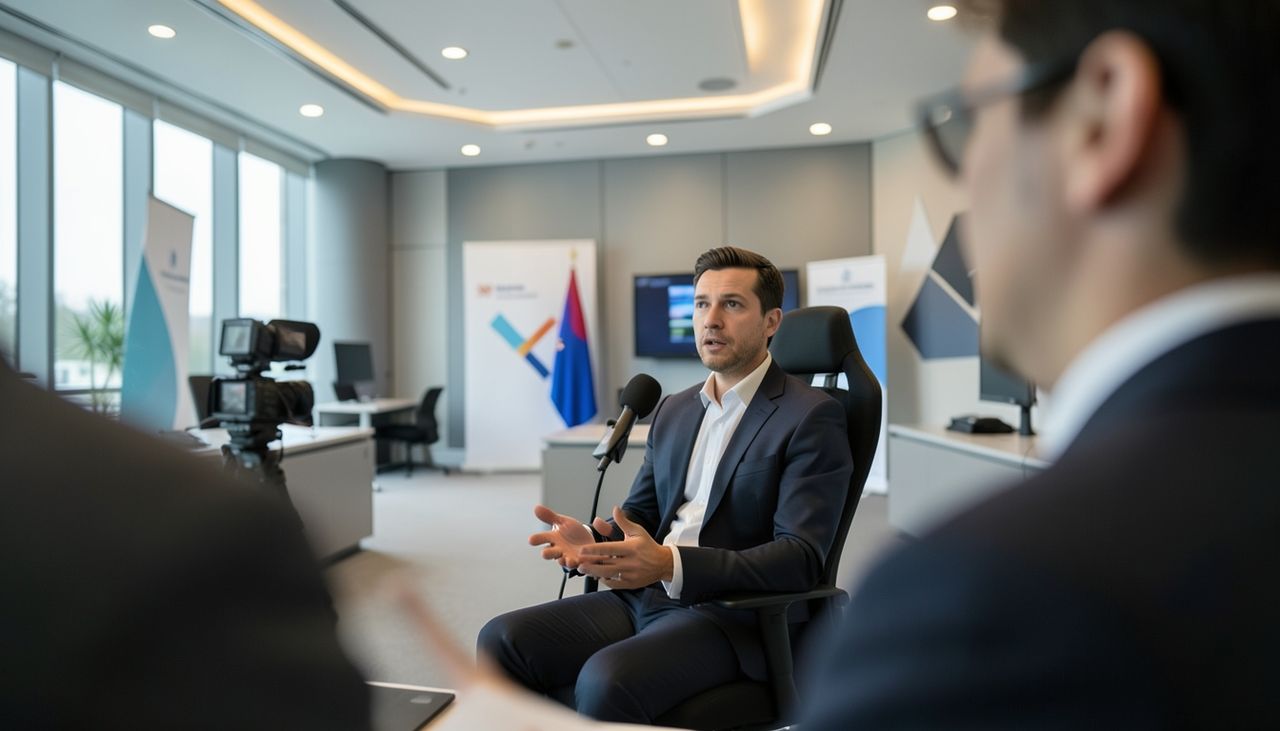
AI-generated illustration
Halid el-Cabir, executive director of the Qatar-based Middle East Council on Global Relations, said the lack of concrete progress in US-Iran talks keeps alive the risk that war could resume in the region.
Speaking to Anadolu Agency, Cabir also assessed the Makkah Agreement between Türkiye, Saudi Arabia and Pakistan, Gulf states' security partnership with Washington, and recent statements by Israeli officials targeting Qatar.
Mediation efforts stall as both sides hold their ground
Cabir said the region has been living with uncertainty for some time. "We are in neither a state of war nor a state of peace between the US and Iran. If the US and Iran cannot reach an agreement, war could begin again," Cabir said.
Efforts to mediate were carried out first by Pakistan and later joined by Qatar, but Cabir said the parties' persistence in their current positions is making a solution harder. The US is holding firm on the conditions it has set, while Iran's most important cards are the closure of the Strait of Hormuz and the use of affiliated militia groups, Cabir said.
The involvement of the Houthis and the obstruction of ships transiting the Bab al-Mandeb Strait have made the situation worse, Cabir argued, adding that regional actors are being worn down politically, militarily, in security terms and economically. Gulf states face serious difficulties in oil and liquefied natural gas transport, Cabir said, warning that an escalation and the entry of other parties into the conflict could enlarge the crisis.
Makkah Agreement could become a wider regional structure
Cabir described the Makkah Agreement among Türkiye, Saudi Arabia and Pakistan as an important step toward developing a common approach to regional threats. Qatar, Bahrain and Kuwait have welcomed the initiative, Cabir said, calling coordination between Saudi Arabia, Türkiye and Pakistan important for a shared view of threats and for security and stability. "This is a step that deserves support and follow-up," Cabir said.
Cabir said the agreement could expand in the future with the participation of other countries. "If the umbrella created by the Makkah Alliance expands in the future and turns into a regional structure, I think Qatar would be among the first countries to join," Cabir said.
Cabir also viewed positively Egypt's solidarity with Saudi Arabia and Gulf states, saying support against threats from the Iran-backed Houthis could lay the ground for broader regional cooperation initiatives. According to Cabir, a more comprehensive cooperation network bringing together the Makkah Alliance with Arab and Gulf countries could emerge.
Strategic partnership with Washington seen continuing
Asked how the recent fighting has affected confidence in US security guarantees, Cabir said the strategic partnership between Gulf states and Washington will continue. The relationship spans nearly half a century, Cabir said, and regional countries have benefited substantially from US-provided defense and security systems.
"Despite all the criticism of how this war has been handled, the US continues to be the biggest guarantor of the region's security when compared with China, Russia and other actors," Cabir said.
Cabir argued that China, despite being among the countries most affected by any closure of the Strait of Hormuz, has not been able to exert decisive weight in stopping the war, and stressed the importance of diplomatic efforts. The US and Iran must accept that resolving the crisis and ending the war is in everyone's interest, Cabir said.
Israeli statements on Qatar tied to election agenda
On statements by Israeli officials targeting Qatar, Cabir linked the remarks to the election agenda in Israel. "I do not think they have any value. These are statements connected to the elections in Israel. The Israelis are trying to attack Qatar with their rhetoric," Cabir said.
Cabir said Qatar's position on the Palestinian cause and regional issues is clear, pointing to Doha's mediation role on the war in Gaza and on hostages. Qatar has also demonstrated its mediation capacity on files other than Gaza, Cabir said, adding that the statements by Israeli officials are not of a kind to be taken seriously.
Key takeaways
- Cabir warned that war could restart if the US and Iran fail to reach an agreement.
- Iran's main leverage is closing the Strait of Hormuz and using affiliated militias, Cabir said.
- The Makkah Agreement between Türkiye, Saudi Arabia and Pakistan could widen into a regional structure, with Qatar possibly among the first to join.
- Cabir said the US remains the biggest guarantor of regional security despite criticism of its handling of the war.

Join the conversation
Share your thoughts on this story.
Comments
Post a Comment