
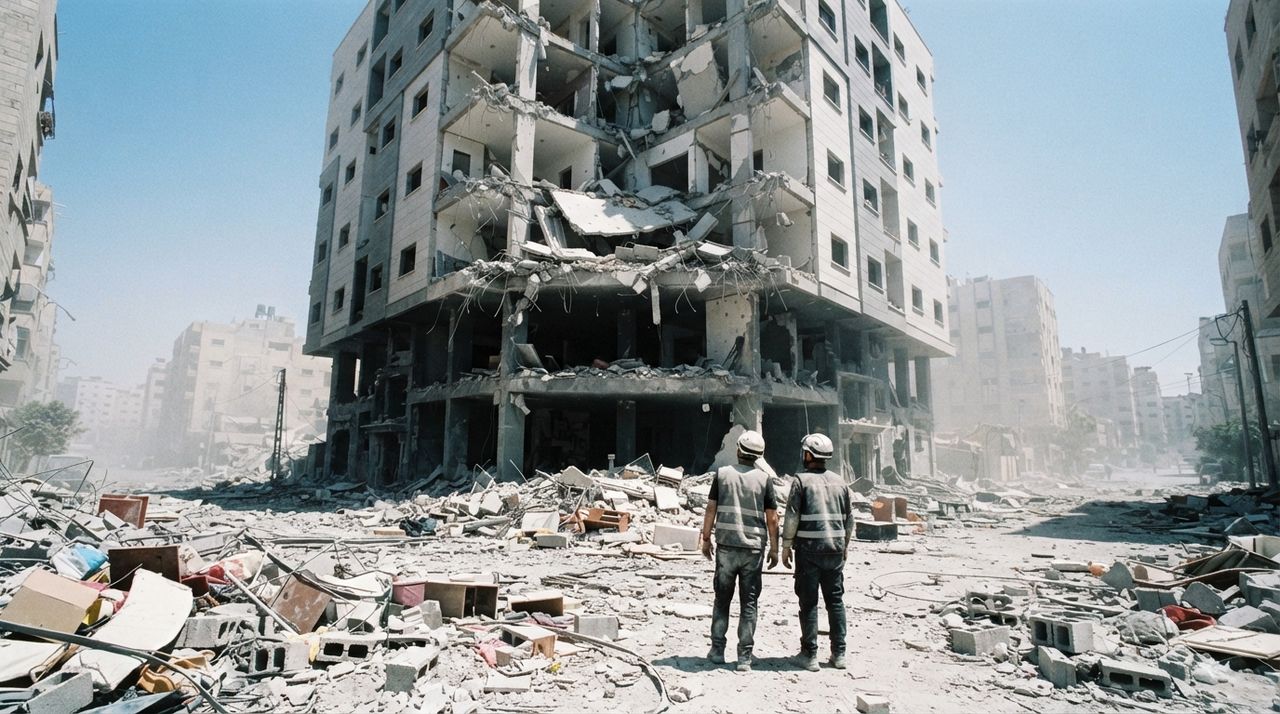
AI-generated illustration
Israeli and US officials are accused of planning a large-scale military attack on Iran around Israel's 27 October parliamentary elections and the US congressional midterms on 3 November, according to reports in international media and impressions gathered through diplomatic contacts. Leaked plans, a strike halted at the last minute and a previously unannounced visit by US Defense Secretary Pete Hegseth have raised fears of a wider Middle East war.
The Israeli military planned heavy air strikes on Iranian power plants, energy infrastructure, public buildings and nuclear sites for 10 October, the Financial Times reported, citing security sources. The plan was shelved after US President Donald Trump refused to allow a war ahead of the midterms that would push up global oil prices and draw US forces into direct combat.
A strike halted at the last minute
The Financial Times, citing security sources, reported that the crisis came to the brink of armed conflict in the first week of October. The Israeli military drew up a wave of heavy air strikes against Iran on 10 October targeting power plants, energy infrastructure, public buildings and nuclear facilities.
The operation was stopped at the last minute because Trump would not permit a war before the midterms that would drive up global oil prices, trigger inflation and put US forces directly into conflict. White House Deputy Press Secretary Anna Kelly also indicated that the United States would not launch any military operation against Iran on any date before the midterm elections.
Netanyahu renews regime-change language
Israeli Prime Minister Benjamin Netanyahu has faced heavy domestic criticism over allegations that warnings from the United Arab Emirates, Egypt and the Shin Bet internal security service were ignored before 7 October. With his far-right coalition trailing in the polls, Netanyahu is working to spread the pressure, and is said to have put the 10 October strike on hold because of Trump's opposition.
On 19 October Netanyahu released footage of a phone call with Trump filmed in front of a fighter jet. Referring to strikes on Iran, Netanyahu said: "We have a job to finish and we will finish it together." Trump replied over the speakerphone that Netanyahu was "a great fighter" and that "we will prove that very soon; you're the man I want by my side."
At Tel Hai University on 20 October and at a military graduation ceremony on 21 October, Netanyahu repeated his threats, announcing that he had ordered the army, the Mossad intelligence service and all security units to completely overthrow the government in Tehran. Defense Minister Yisrael Katz separately alleged that Iran was trying to carry out attacks to influence the 27 October election results, saying: "We detect your attempts, we are ready to foil them and to hit you with all our strength. If Iran attacks Israel, Iran burns."
Hegseth visit and flights toward Iran's border
Pete Hegseth paid an unannounced "surprise" visit to Israel on 19 October, eight days before the elections. According to local media, Hegseth met Netanyahu and military commanders at Ovda Air Base and was presented with an updated "Iran target list" prepared by Israeli intelligence, including civilian and energy infrastructure that was not hit in previous conflicts.
Axios reported that shortly after the visit Israeli warplanes flew sorties as far as the Iranian border. Israeli and US officials argued the flights were not unusual and were meant to deter Iran, saying dozens of fighter jets and refuelling aircraft took part and flew through Syrian and Iraqi airspace on a route consistent with a possible attack scenario.
Israeli Chief of Staff Eyal Zamir cancelled all leave in the military for the election period and put the units on the highest level of alert.
Reports point to an early November timeline
Attack plans leaked to the New York Times suggest the strike on Iran may have been postponed to the beginning of November, when the US military is reported to be completing its deployment in the Middle East with three carrier strike groups, thousands of Marines and air defence fleets.
The planning is said to focus on the "Kazma Mountain" nuclear facility near the Natanz complex, reportedly built tens of metres underground. Trump indicated on 16 October that the 10-ton GBU-43/B (MOAB), known as the "mother of all bombs", could be used against Iranian nuclear sites. Military experts counter that the weapon cannot penetrate granite and that the MC-130 transport aircraft carrying it would be an easy target for Iranian air defences.
Opposition voices pushed back on the plans. Opposition leader Yair Lapid told Israeli state broadcaster KAN: "Based on the information I have, there is no reason to attack Iran or anywhere else before the elections." Lapid said he was not against strikes on Iran but argued that the remarks from Netanyahu and Katz were meant to raise tensions for political gain before the vote. Gadi Eisenkot, leader of the Yashar Party and seen as Netanyahu's main rival, wrote on X that "Katz is laying the groundwork for the next catastrophe and blaming his political rivals before it has even happened," adding that the current government does not know the meaning of responsibility.
Danny Citrinowicz, former head of the Iran desk in the research division of Israeli military intelligence, called a pre-election war "complete madness." Citrinowicz said Iran has preserved its arsenal despite earlier Israeli strikes, that Israel and the United States face serious shortages of air defence missiles, that Tehran cannot be brought down from the air, and that the absence of a US military presence in Iraq has strengthened Iran-aligned militias. A new conflict, Citrinowicz added, would set the entire Gulf region on fire.
US pulls out diplomats as Tehran warns of wider war
The US State Department cited attacks by the Iran-backed Houthis in Yemen and high security risks in the region as it called on all non-essential diplomatic personnel and their families in Saudi Arabia to leave the country immediately.
Mehdi Mohammadi, adviser to Iranian Parliament Speaker Mohammad Bagher Ghalibaf, dismissed as "fiction" the idea that the United States could complete a new wave of attacks on Iran within 72 hours, arguing that Iran would decide when the war ends and recalling that Trump said in February that a war would last two weeks.
Analysts in Tehran said that if Kazma Mountain or energy facilities were struck, Iran's retaliation would not be limited to commercial shipping: the Strait of Hormuz would be closed and data centres, undersea fibre-optic internet cables and Aramco refineries in Saudi Arabia would be targeted to deliberately drive up global energy prices.
Vali Nasr, an Iran specialist at Johns Hopkins University, wrote on X that all signs pointed to the United States being dragged into war again. Nasr warned that a new round of conflict could cause far greater and lasting destruction for the entire Middle East and the global economy, saying: "Washington and Israel want to take Iran out with heavier blows, but the chances of that succeeding are quite low. There will be massive destruction before any end is in sight."
Key takeaways
- The Israeli military planned strikes on Iranian power, energy, public and nuclear sites for 10 October, but the plan was halted after Trump refused to allow a war before the US midterms.
- Netanyahu ordered the army, Mossad and all security units to overthrow the government in Tehran, as his far-right coalition trails in polls before the 27 October vote.
- US Defense Secretary Hegseth held an unannounced 19 October visit to Israel and was shown an updated Iranian target list; Israeli jets then flew sorties toward Iran's border.
- The US ordered non-essential diplomatic staff and families in Saudi Arabia to leave, while Tehran advisers warned of retaliation including the closure of the Strait of Hormuz.

Join the conversation
Share your thoughts on this story.
Comments
Post a Comment