
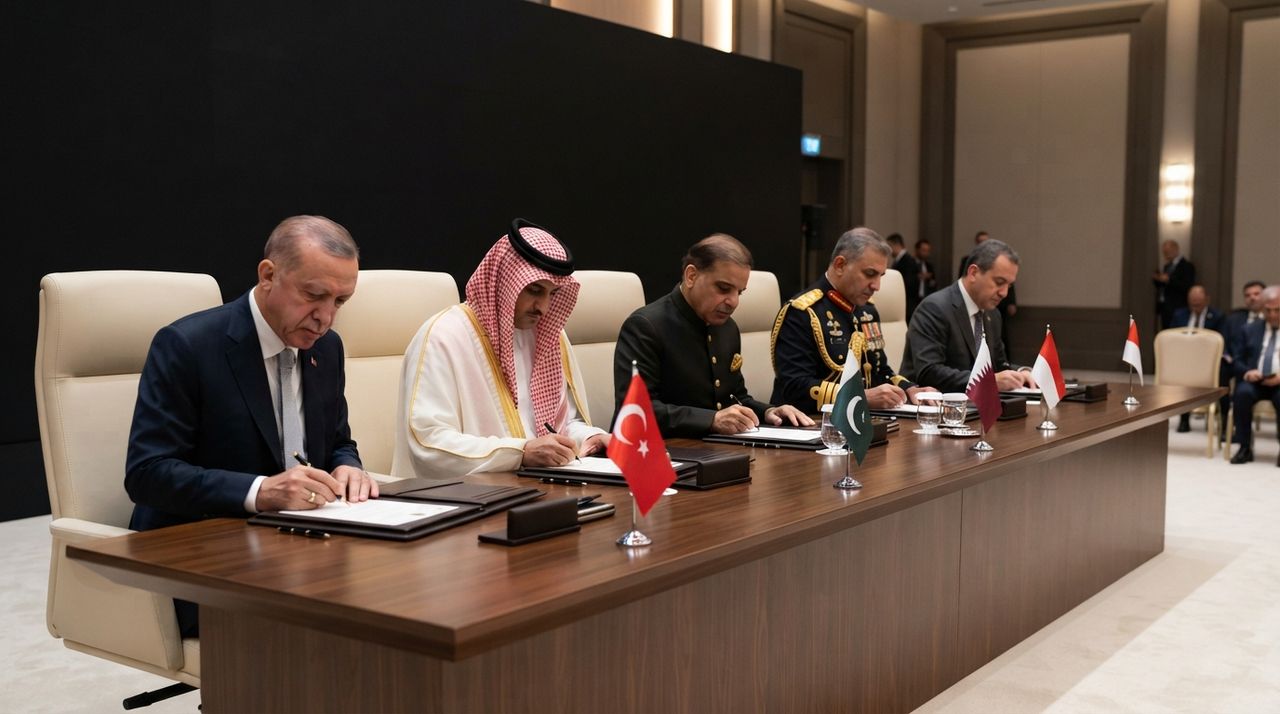
AI-generated illustration
The defence ministries of Türkiye, Qatar, Indonesia and Pakistan signed a multilateral memorandum of understanding, called the "Badr Memorandum", in Doha today, Türkiye's Ministry of National Defence said. The agreement is intended to strengthen joint cooperation and develop strategic partnerships among the four countries.
The document was signed by Turkish National Defence Minister Yaşar Güler, Qatari Deputy Prime Minister and Minister of State for Defence Affairs Sheikh Saud bin Abdulrahman bin Hasan Al Sani, Indonesian Deputy Defence Minister Yusuf Jauhari and Pakistani Defence Minister Khawaja Muhammad Asif. Haluk Görgün, head of Türkiye's Presidency of Defence Industries, also attended the ceremony.
Agreement signed in Doha
Türkiye's Ministry of National Defence announced that the memorandum was signed in the Qatari capital today. It described the deal as a step that reflects a commitment to strengthening joint cooperation and developing strategic partnerships among Türkiye, Qatar, Indonesia and Pakistan.
The ministry said the memorandum carries the name "Badr", the Arabic word for full moon. The name was chosen because the four countries complement one another through the agreement, which the ministry said has major military and economic significance. Haluk Görgün, head of the Presidency of Defence Industries (SSB), attended the signing ceremony.
Goals of the memorandum
The ministry said the memorandum aims to encourage cooperation in military production, strengthen the military capabilities of the four countries, and support collaboration in technical military training, research and development. The initiative is also expected to help create solutions and industrial branches aligned with the development of modern defence systems.
The agreement has considerable economic value for the signatories, the ministry said. Cooperation and integration will be achieved by drawing on each country's military production capabilities, defence industry capacities will be developed, and the needs of allied and friendly countries can then be met. The memorandum is also meant to broaden the scope of military cooperation among the participants, deepen ties in the defence industry sector and strengthen multilateral collaboration in support of security, stability and shared goals.
Joint production and technology sharing
The SSB said the memorandum targets joint projects in military production by the four countries and increased cooperation in technical training and research and development. For Türkiye, the document was signed by Minister Güler and SSB head Haluk Görgün. Qatar was represented by Sheikh Saud bin Abdulrahman bin Hasan Al Sani, Pakistan by Khawaja Muhammad Asif and Indonesia by Yusuf Jauhari.
Görgün said the memorandum carries strategic importance for Türkiye's approach to cooperation with allied countries. Türkiye does not limit its international defence industry partnerships to the supply of platforms and systems, Görgün said, adding: "We see the Badr Memorandum as a strategic cooperation framework that brings together our countries' competencies in the defence industry and expands opportunities for joint production and technology development."
Görgün said the engineering, design, production and system integration capabilities that the Turkish defence industry has reached in recent years offer significant opportunities for international partnerships. "Sustainable cooperation in the defence industry is based on technology sharing, joint development and strengthened local production capabilities," Görgün said. "We value partnerships that go beyond off-the-shelf procurement models and develop countries' own human resources and industrial infrastructure. We believe the Badr Memorandum will help turn the complementary capabilities of Türkiye, Qatar, Pakistan and Indonesia into concrete projects."
Defence exports exceed $30 billion
Görgün pointed to the capacity the Turkish defence industry has reached in recent years and said the sector had recorded more than $30 billion in exports over the past four years covering the 2023-2026 period, in line with the vision of President Recep Tayyip Erdoğan. That amount corresponds to more than 55 percent of the sector's total exports over the past 14 years, Görgün said.
"In 2025 we raised our exports by 48 percent to above $10 billion. In the last 12 months we exceeded the $11 billion level for the first time," Görgün said, adding that defence industry diplomacy had been effective in this result and that multilateral cooperation such as the Badr Memorandum aims to advance technology development capacity and exports further.
Görgün stressed the importance of technological independence and a sustainable production infrastructure in the defence industry, and said Türkiye prioritises mutual gain and strategic capacity development in its international cooperation. "The current security environment requires countries to have strong, sustainable and technology-focused industrial ecosystems that can meet their defence needs," Görgün said. "We see the technologies we develop as elements that strengthen defence and deterrence and contribute to regional peace and stability. We aim for the partnerships we establish with friendly and brotherly countries to build lasting capabilities in line with this understanding."
Key takeaways
- Türkiye, Qatar, Indonesia and Pakistan signed the multilateral "Badr Memorandum" in Doha today.
- The deal aims to boost cooperation in military production, technical training, research and development.
- Turkish defence exports exceeded $30 billion in the past four years, including over $10 billion in 2025.
- SSB head Haluk Görgün said the agreement will turn the four countries' complementary capabilities into concrete projects.

Join the conversation
Share your thoughts on this story.
Comments
Post a Comment