
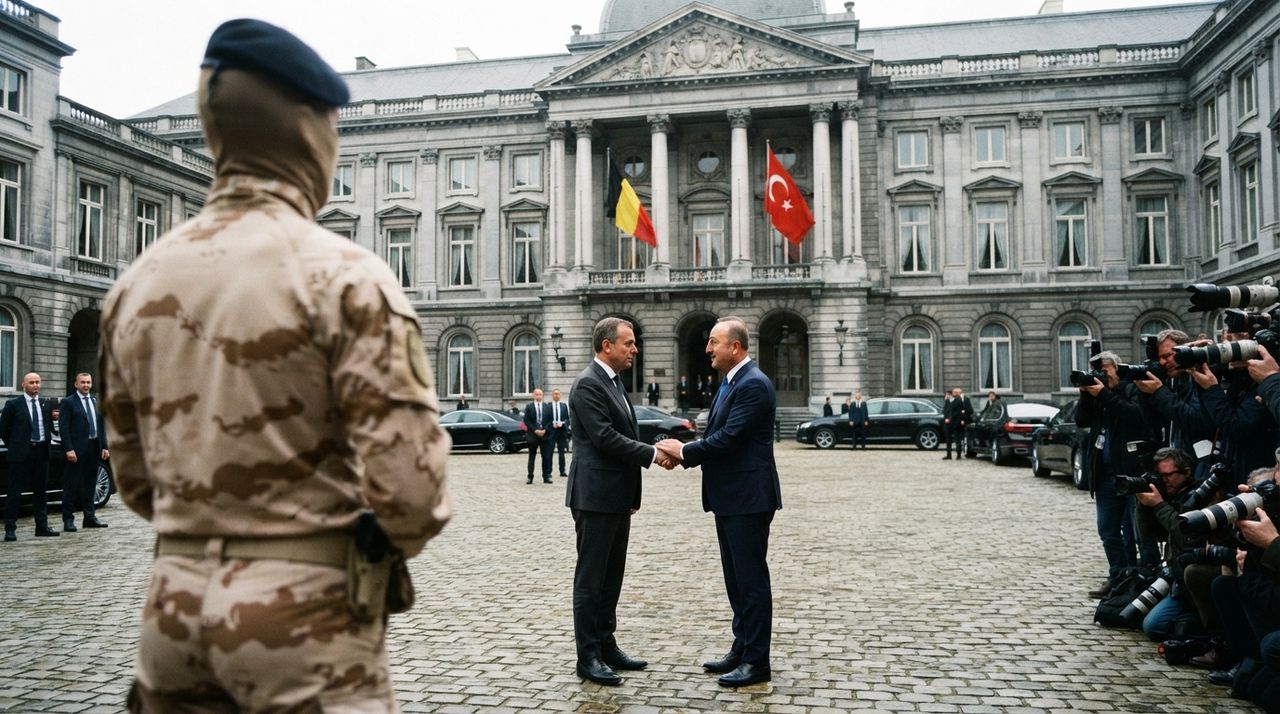
AI-generated illustration
Interior Minister Mustafa Çiftçi, attending the fourth meeting of Turkish and Belgian foreign affairs, justice and interior ministers in Brussels, called on Belgium to stop allowing terrorist and criminal groups to use its territory against Turkish citizens and to act on Ankara's extradition requests.
Çiftçi said new-generation crime networks based abroad threaten Turks in Belgium, and reported that a joint action plan signed with the Belgian Federal Police will deepen cooperation against terrorism, drug and weapons smuggling, migrant smuggling and human trafficking.
Seven ministers meet at Egmont Palace
Interior Minister Mustafa Çiftçi assessed his Brussels contacts in an interview with an Anadolu Agency correspondent on the sidelines of the fourth Turkey-Belgium meeting of foreign affairs, justice and interior ministers. The gathering was held at Egmont Palace in the Belgian capital, in the 188th year of diplomatic relations between the two countries. Çiftçi noted that the last meeting in this format took place in Ankara in 2016, and said that seeing seven ministers come together again after 10 years was in itself a sign of meaningful political will.
Çiftçi attended alongside Foreign Minister Hakan Fidan and Justice Minister Akın Gürlek, meeting their Belgian counterparts Bernard Quintin, Annelies Verlinden, Maxime Prevot and Anneleen Van Bossuyt on issues directly affecting Turkey's security and citizens' safety. He said nearly 300,000 Turkish citizens living in Brussels, working and contributing to the Belgian economy, form the strongest bond between the two countries. "Real friendship requires standing side by side in good times and fighting together against crime networks that target our peace," Çiftçi said.
Crime networks reach Turkish citizens in Belgium
Çiftçi said a significant share of new-generation crime groups run their activities through foreign connections, threatening Turkish citizens in Belgium and attacking their workplaces and homes. He cited Oğuz Arkaya, the owner of the Brüksel Hanımeli pastry shops, who he said was threatened in June 2026 by the Daltonlar gang before a bomb was detonated at the house. Threats have also reached relatives of a diplomat serving at the consulate general, which Çiftçi said showed the gravity of the matter.
Ankara assesses that five people who lead or belong to these crime networks and are of particular interest to Turkey are currently in Belgium. Çiftçi said Turkey is seeking their extradition through Interpol units and law enforcement channels in coordination with the Justice Ministry, adding that a bomb left at a citizen's door should be treated as one left at the door of the state.
Joint action plan signed with Belgian federal police
Çiftçi described the clearest sign of Turkey's resolve as the 2027-2028 Joint Action Plan signed by the General Directorate of Security and the Belgian Federal Police. The plan is meant to strengthen cooperation against terrorism, organized crime, drug and weapons smuggling, migrant smuggling and human trafficking, through reciprocal expert meetings, joint training and closer professional contacts between the security units of both countries.
The minister said the plan is not the name of a protocol but the name of a joint promise by two states against crime. He cited Quintin as saying that crime networks are becoming increasingly international, which makes faster information sharing, expertise exchange and joint training necessary, and Verlinden as saying that organized crime knows no borders. Since crime networks ignore borders, Çiftçi said, cooperation between agencies must do the same.
Ankara renews pressure over fugitives and terror groups
Çiftçi placed the day's message in the wider frame of what the public calls the "Cross-Border Trap", Turkey's security diplomacy aimed at those who flee abroad thinking they have escaped the state. He said that this year alone Turkey brought back 714 fugitives from 44 countries, including 170 leaders and members of organized crime groups, and that red notices have been issued for 969 people. No place in the world is a safe harbor for crime groups, he said, and crossing a border only delays arrest.
On terrorism, Çiftçi said the presence in Belgium of members of PKK, DHKP-C, MLKP, TKP-ML and FETÖ, and the use of the country as a base, is incompatible with the spirit of alliance. He said PKK, DHKP-C and MLKP continue financing, recruitment and propaganda even without carrying out armed acts in Belgium, and urged that the PKK's "dissolution rhetoric" not be exploited and that negative episodes such as the past Ariadna ruling not be repeated. On FETÖ, he said the group uses Belgium as a sanctuary through associations and schools under FEDACTIO, and that Turkey believes crimes including fraud, bribery, bid rigging and money laundering would surface if these institutions were closely monitored. He said 33 FETÖ members on the ministry's wanted list are assessed to be in Belgium, and asked that their abuse of the asylum system with false information and documents be prevented.
Çiftçi also raised the foreign terrorist fighter issue against ISIS, saying Turkey is the only NATO country fighting the group face to face on the ground, and offered full support for returning such fighters to their countries of origin. He noted that the DHKP-C-linked Grup Yorum formation is scheduled to hold a concert in Liege on 19 December 2026, and pointed to the Fehriye Erdal file as a reminder that state pursuit never expires. None of Turkey's extradition requests to Belgium on terrorism charges between 2016 and 2026 have been accepted, he said, adding that requests concerning mostly PKK and FETÖ members are either rejected or left unanswered, which leaves members of terrorist organizations feeling safe in Belgium.
Migration, visas and the message to an ally
Çiftçi said migration and visas were also discussed in a friendly framework. Turkey, he noted, is among the countries most affected by migration flows because of its geography, hosting 3.6 million foreigners, about 2.2 million of them Syrians. He said the Coast Guard Command at sea and law enforcement units on land dismantle migrant smuggling networks at source and have largely blocked irregular migration. Resolving visa problems faced by citizens, jointly fighting irregular migration and speeding up extradition processes are in the interest of both countries, he said, welcoming Van Bossuyt's request that her administration see Turkey's migration management practices on the ground.
Çiftçi said security for Turkey begins before a crime is committed, not after, and quoted Prevot as saying that European security cannot be seriously addressed without engaging with Turkey. Turkey will continue every form of cooperation in line with international law and the spirit of the NATO alliance and expects the same resolve from friendly and allied countries, Çiftçi said, closing with the words: "An ally's soil cannot be a terrorist's shelter."
Key takeaways
- Interior Minister Mustafa Çiftçi attended the fourth Turkey-Belgium ministerial meeting in Brussels, a decade after the last one was held in Ankara.
- A 2027-2028 Joint Action Plan signed by the General Directorate of Security and the Belgian Federal Police targets terrorism, organized crime, smuggling and human trafficking.
- Turkey says it brought back 714 fugitives from 44 countries this year and holds red notices for 969 people.
- None of Turkey's extradition requests to Belgium on terrorism charges between 2016 and 2026 have been accepted, Çiftçi said.

Join the conversation
Share your thoughts on this story.
Comments
Post a Comment