
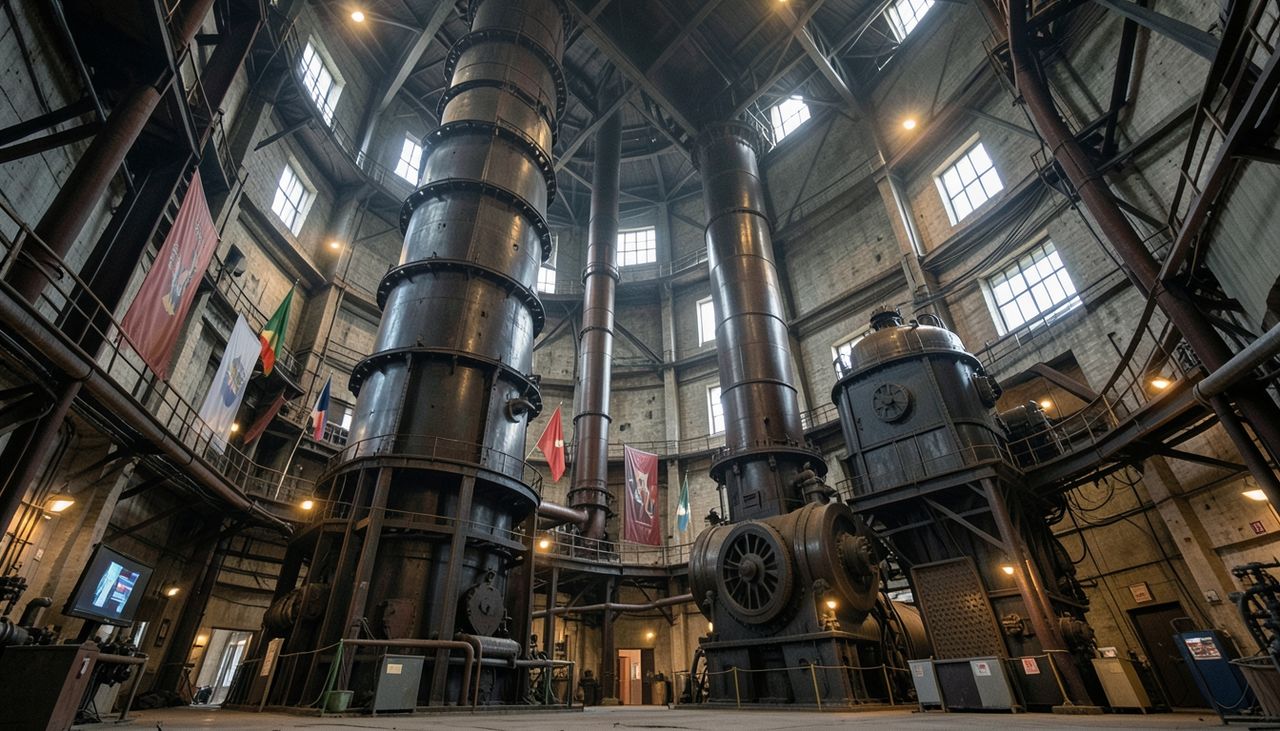
AI-generated illustration
Turkey's first electricity generation began on 15 September 1902 in Tarsus, where a system hooked up to a water mill lit the town's streets and a few homes, according to a review by Anadolu Agency of archive documents, congress minutes and legislation records.
The journey that started with that local setup grew through coal-fired plants built in the late Ottoman period and power stations commissioned in the early Republic years, reaching an installed capacity of 32.8 megawatts and annual output of 44.5 million kilowatt-hours by 1923.
First generation in Tarsus and Istanbul
The first electricity production within Turkey's present borders was carried out on 15 September 1902 in Tarsus, at a site called Bentbaşı on the Berdan River. A device connected by belt to a water mill in the town generated enough power to light Tarsus' streets and several houses.
Istanbul's first major move toward electrification came in 1910. The Ottoman Anonymous Electricity Company, founded in 1911 with support from banks, was granted a 50-year generation concession. Because the city had no suitable water source for hydropower, a coal-fired thermal plant was built instead.
The Silahtarağa power plant entered service on 11 February 1914. Electricity was supplied to the trams first and to the city a few days later. With a capacity of about 15 megawatts, the facility became the Ottoman Empire's first city-scale plant. The number of subscribers stood at 2,055 in 1914.
Cities gain electricity in the early Republic years
When the Republic was proclaimed in 1923, Turkey had 38 power plants with a combined installed capacity of 32.8 megawatts. Total annual generation was calculated at 44.5 million kilowatt-hours, while per capita electricity consumption was around 3 kilowatt-hours.
Expanding access to electricity was among the development goals of the early Republic. In 1925, Adana, Artvin, İnebolu, Akşehir, Mersin and Trabzon were among the cities that got electricity. In 1926, power use began in Aksaray, Ayvalık, Bursa, İzmit, Konya, Kütahya, Malatya and Sivas.
Ankara's first power plant was set up in Bentderesi in 1925 with a 35-kilowatt direct current dynamo. Electricity was used first in the municipality building and a handful of homes. Generation and consumption in the capital then rose, with the Ankara Electricity Turkish Anonymous Company increasing output from 4.34 million kilowatt-hours in 1929 to 6.07 million in 1931, as its subscribers grew from 2,709 to 4,766.
Silahtarağa reshaped the city
Amed Gökçen, director of the santralistanbul Energy Museum at Istanbul Bilgi University, said Silahtarağa turned into a factory that also shaped the fate of a city.
Gökçen said the arrival of electricity in the city was more than a technological novelty. "The arrival of electricity in Istanbul produced a wholesale change in the city's infrastructure, superstructure and architecture, in the people who came and went, and in the working population," Gökçen said.
Gökçen said the Silahtarağa venture was never limited to lighting streets, adding that "from the very beginning there is a huge political infrastructure behind this factory's ability to draw international capital here, to convert technological infrastructure here, to allow the Ottoman Empire to reach technological facilities, household appliances and devices that Europe had long had, and, more importantly, to make all of this available not only to the state but also to citizens."
Key takeaways
- Turkey's first electricity was produced on 15 September 1902 in Tarsus, lighting streets and a few homes via a water mill.
- The Silahtarağa plant began operating on 11 February 1914 with about 15 megawatts, serving trams and then the city; it had 2,055 subscribers that year.
- By 1923 Turkey had 38 plants, 32.8 megawatts of installed capacity and 44.5 million kilowatt-hours of annual output.
- Ankara's first plant opened in 1925 in Bentderesi with a 35-kilowatt direct current dynamo.

Join the conversation
Share your thoughts on this story.
Comments
Post a Comment