
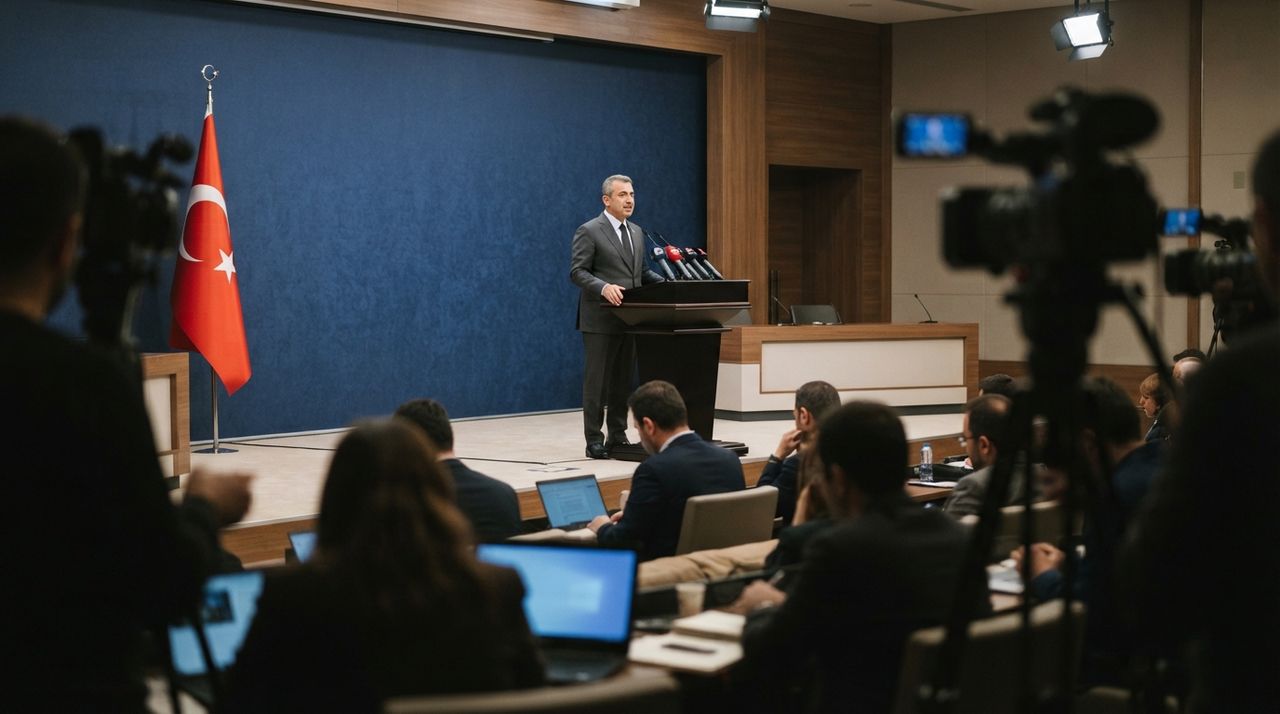
AI-generated illustration
Transport and Infrastructure Minister Abdulkadir Uraloğlu said the Development Road Project is expected to contribute about $55 billion to the economy over a 10-year period and create jobs for an average of 70,000 citizens a year.
Speaking at a conference on changing global transport geopolitics and the project, hosted by the Foundation for Political, Economic and Social Research (SETA) at its Ankara office, Uraloğlu said the corridor running from Iraq's Faw Port to Europe would cut freight transit times and reduce dependence on the Strait of Hormuz.
Global trade corridors are being redrawn
Uraloğlu said global trade corridors are being redrawn today, and that geopolitical developments in recent years have shown how fragile transport systems can be and how easily they can disrupt global trade. Tensions around the Strait of Hormuz and the Russia-Ukraine war have created such fragility, prompting countries to look for safer, shorter, more predictable and sustainable routes, Uraloğlu said.
Turkey's geographic and strategic advantage comes into play at this point, Uraloğlu said. "As a country at the heart of the Middle Corridor, controlling the Turkish Straits and building the Development Road, we are proving clearly both at the table and in the field that there is no corridor without Turkey," Uraloğlu said, adding that the world is now discussing the Trans-Caspian Middle Corridor, the Development Road stretching from the Basra Gulf to Europe, the TRIPP Corridor as a new link of the Middle Corridor and the modern Hejaz railway line.
Uraloğlu described these routes as complementary backbones that bring east-west and north-south lines together in Turkey and carry them to Europe, rather than rivals to one another. Turkey sits at a crossroads where some 1.6 billion people live within a four-hour flight and which is centered on 67 countries with a combined gross domestic product of roughly $50 trillion, Uraloğlu said, calling the country a "geostrategic island of security" thanks to infrastructure investment, crisis-resolution capacity, a constructive diplomatic stance and a trust-building approach.
Middle Corridor links total 2,156 kilometres
Diversifying transport networks is no longer a choice but a necessity, Uraloğlu said, and Turkey is turning that necessity into an opportunity while strengthening regional and international partnerships. The Middle Corridor, the most critical route linking China and Central Asia to Turkey and Europe across the Caspian Sea, is one of the main pillars of this vision, Uraloğlu said.
Lines in Turkey connecting to the Middle Corridor will reach a total of 2,156 kilometres including existing, ongoing and planned routes, according to Uraloğlu. Investments made and planned add up to $47.1 billion, while over a 10-year projection the target is $114 billion in production capacity and an average annual employment effect of 144,000 people, Uraloğlu said.
The Kars-Iğdır-Aralık-Dilucu railway, whose foundation has been laid, will give the Middle Corridor a strategic route, Uraloğlu said.
Transit time to Europe cut to about 25 days
The backbone that will complete the east-west axis in a north-south direction is the Development Road, Uraloğlu said. A new logistics backbone is being created to link the Basra Gulf to Europe through Turkey, starting at Iraq's Faw Port, offering a strategic alternative that will reduce dependence on the Strait of Hormuz for cargo moving from Gulf countries to Europe. "If we had completed this project, the world would be talking less about the Strait of Hormuz," Uraloğlu said.
The route from Faw Port through Turkey to Europe would shorten transit to about 25 days, compared with 45 days via the Cape of Good Hope route and 35 days via the Southern Corridor, Uraloğlu said. The project aims to create a new trade and logistics corridor along the Asia-Gulf-Iraq-Turkey-Europe line, support Iraq's economic reconstruction and strengthen Turkey's central position in east-west and north-south connectivity networks, Uraloğlu said, describing it as a strategic lever that can reshape regional power balances and economic ties.
Uraloğlu said the project could also reduce Iraq's dependence on oil revenues, generate income from transit trade and increase its geopolitical weight in the international system. Memoranda signed on 28 July in the presence of President Recep Tayyip Erdoğan and Iraqi Prime Minister Ali al-Zeydi have made this vision concrete, Uraloğlu said, adding that the agreements are planned to pass through both countries' parliaments before construction begins.
New connections reaching Europe
Uraloğlu cited a memorandum of understanding on rail and road transport via the Fishhabur-Ovaköy border gate, and said a framework memorandum on the development of transport infrastructure inside the Republic of Iraq in exchange for natural resources is the strongest expression of a "two countries, one corridor" approach between the two sides.
The Development Road goes beyond rail and road to become an integrated, multimodal logistics and economic development drive, covering power transmission lines, fibre optic infrastructure and oil and natural gas pipelines, Uraloğlu said. Integration of the Baku-Tbilisi-Kars railway with the Middle Corridor and existing energy lines will reinforce Turkey's position in Eurasia connectivity networks, Uraloğlu said. The project will also deepen bilateral economic ties by creating a kind of "commercial destiny partnership" between Turkey and Iraq, Uraloğlu said.
"For our country alone, we foresee that the project will contribute about $55 billion to our economy over a 10-year period and, through the placement of production and logistics centres, create employment for an average of 70,000 citizens a year," Uraloğlu said. The Hejaz Railway Cooperation Memorandum of Understanding signed recently with Saudi Arabia also strengthens this vision, Uraloğlu said, by reviving the historic Hejaz railway with a modern approach and building new links from the Gulf to Turkey and on to Europe.
A connection of 2,511 kilometres is being discussed in total, including the 1,681-kilometre Kapıkule-İstanbul-Eskişehir-İslahiye line in Turkey along with the sections in Syria, Jordan and Saudi Arabia, Uraloğlu said. Strengthened regional ownership, managed security risks, diversified financing and complementarity with existing connectivity initiatives will allow the Development Road to become a lasting strategic initiative that plays a role in reshaping the regional order, Uraloğlu said.
SETA report frames the project as shared ground
SETA General Coordinator Nebi Miş said the foundation follows developments in the Middle East closely in its work and conducts comprehensive research, and that the report presented at the event, titled "Development Road Project: From Economic Corridor to Strategic Power", was prepared with this in mind.
Miş said the transformation in the international system is also changing the sources of power for states, and that one of the Middle East's fundamental problems is the political and security fragmentation of a geography with broad economic possibilities. The region falls short of its potential, Miş said. "The Development Road offers concrete common ground that can reduce this fragmentation. Iraq's reconstruction needs, Turkey's production and logistics capacity, the Gulf's investment power and its search for access to global markets all converge around the same project," Miş said.
Key takeaways
- The Development Road is expected to add about $55 billion to Turkey's economy over 10 years and create 70,000 jobs a year on average.
- The route from Iraq's Faw Port through Turkey would cut transit to Europe to about 25 days, down from 45 days via the Cape of Good Hope and 35 days via the Southern Corridor.
- Middle Corridor lines in Turkey will total 2,156 kilometres, with $47.1 billion in investments and a $114 billion production capacity target over 10 years.
- Memoranda signed on 28 July before President Recep Tayyip Erdoğan and Iraqi Prime Minister Ali al-Zeydi are to be passed through both parliaments before construction starts.

Join the conversation
Share your thoughts on this story.
Comments
Post a Comment