
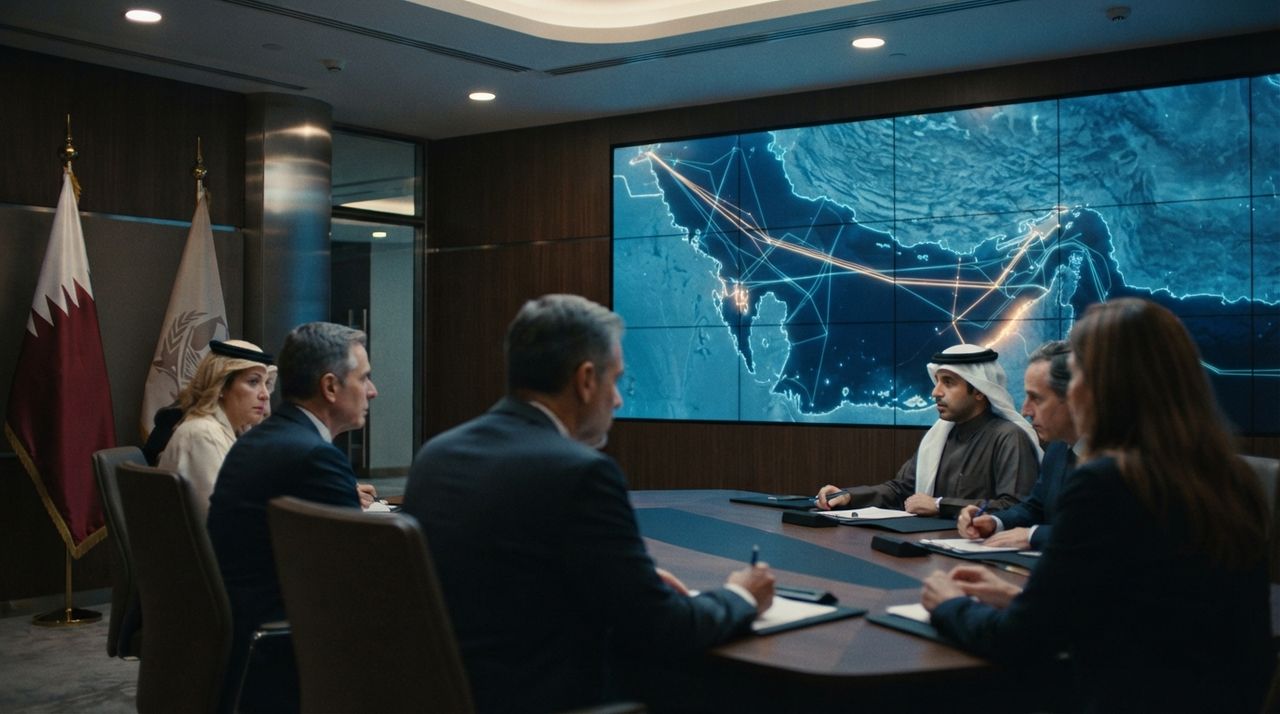
AI-generated illustration
Qatar called on Iran on Wednesday not to target undersea internet cables running through the Strait of Hormuz, warning that severing them would damage Iran's own population as well as every country in the region. Ibrahim al-Hashimi, head of the Communication and Media Department at Qatar's Foreign Ministry, made the appeal at a weekly press briefing in Doha.
The warning came in response to remarks by Brigadier General Hossein Mohibbi, spokesperson for Iran's Islamic Revolutionary Guard Corps, who said the day before that seven main internet cables pass through the strait and hinted that new targets could be announced. Al-Hashimi also said mediation efforts with Pakistan and contacts between the United States and Iran are continuing without interruption.
Response to Iranian cable threat
Al-Hashimi reacted to Mohibbi's suggestion that internet cables crossing the Strait of Hormuz could be hit, asking Iran to consider who would suffer most from such an action. "The Iranian side should ask itself this question: who will lose the most if the internet cables are cut? The United States or Israel, or the countries of the region and the Iranian people?" al-Hashimi said.
Such a step would harm all regional states, including Iran, and the threats and statements should stop immediately, al-Hashimi said. The security of the Strait of Hormuz is inseparable from the security of the region, al-Hashimi added, calling on Iran to respect international law provisions on freedom of navigation and keep the strait open, and to halt attacks in the area that harm the region and its people.
Cables carry regional traffic
Mohibbi said the day before that seven main internet cables pass through the Strait of Hormuz and that internet and commercial data flows depend on them, signalling that new targets could be identified. The undersea cables carry internet traffic and commercial data communications between Asia, the Middle East, Europe and Africa.
Mediation and US-Iran contacts
Al-Hashimi also discussed Qatar's mediation efforts, carried out together with Pakistan, aimed at resolving the crisis between the United States and Iran. Talks and an exchange of messages between the two sides are continuing, al-Hashimi said. "Talks, visits and the exchange of messages between the United States and Iran with the participation of mediators continue without interruption. We are working tirelessly to end the tension," al-Hashimi said.
Diplomatic initiatives to lower tensions in the region have not stopped, al-Hashimi said, adding that the crisis cannot be resolved by military means. "A peaceful solution reached at the negotiating table is the only solution that will protect the security and stability of the region," al-Hashimi said. Prolonging the crisis harms the entire world, not only regional states, and a diplomatic solution should be accelerated to keep global costs from rising further, al-Hashimi said.
Asked whether there is any deadline for reaching an agreement between the United States and Iran, al-Hashimi said: "We hope to reach a solution today. As mediators, we must be optimistic." Qatar's priority is to bring the parties back to the negotiating table and prevent further escalation in the region, al-Hashimi added.
Macron visit to Doha
Al-Hashimi also referred to French President Emmanuel Macron's visit to Doha today, saying that bilateral relations as well as cooperation in energy and defense will be discussed during Macron's contacts in the city.
Key takeaways
- Qatar warned that cutting undersea internet cables in the Strait of Hormuz would hurt Iran's population and all regional states.
- The IRGC spokesperson said the day before that seven main internet cables cross the strait and hinted at possible new targets.
- Al-Hashimi said US-Iran talks, visits and message exchanges with mediators continue without interruption.
- Qatar and Pakistan are mediating between Washington and Tehran, with no deadline set for an agreement.

Join the conversation
Share your thoughts on this story.
Comments
Post a Comment