
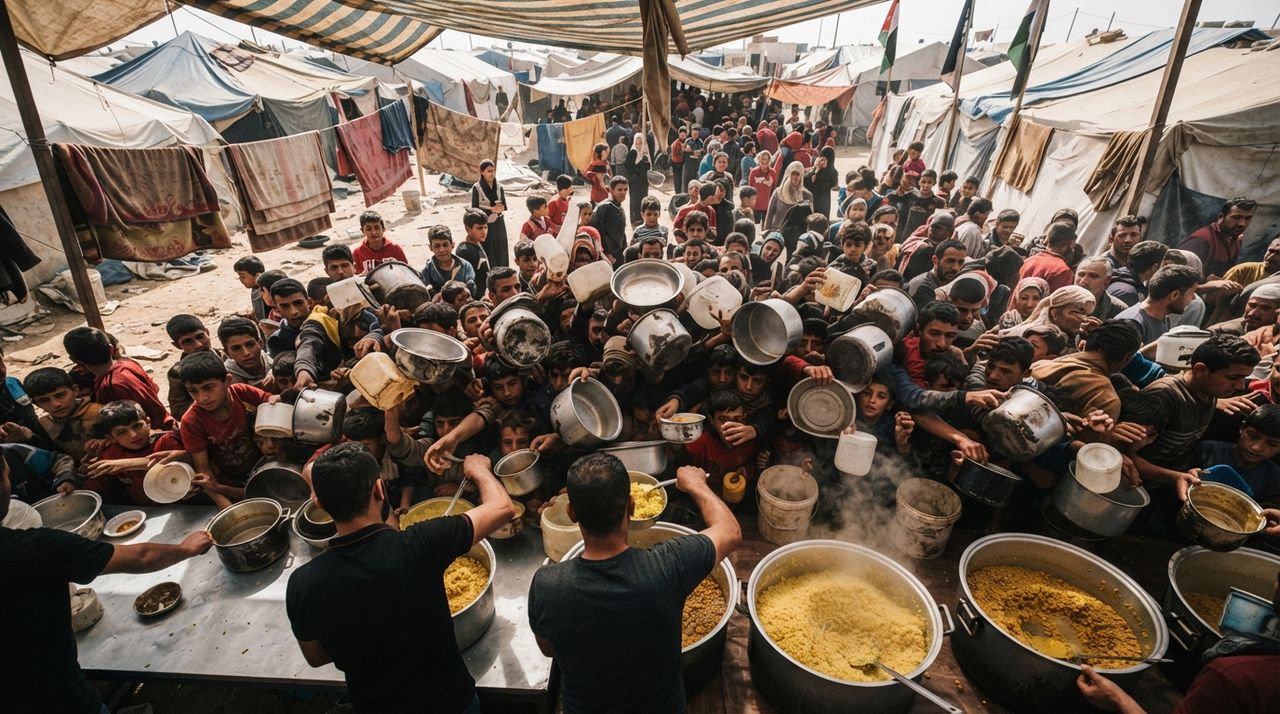
AI-generated illustration
The Palestinian Cabinet warned that a cut in food assistance to about half a million Palestinians in Gaza threatens the continuity of the humanitarian aid system and could deepen the hardship already facing vulnerable families.
The World Food Programme said the reduction is driven by funding shortages, and the government called on the United Nations, donor states and Arab and Islamic countries to release the resources needed to keep aid flowing.
Government calls for funding and pressure on Israel
In a statement, the Cabinet said the halt in assistance "threatens the continuity of the humanitarian aid system" and points to greater suffering for poor families, widows, orphans, the elderly and people with disabilities. The decision also carries a risk of rising rates of malnutrition among children and pregnant women, the statement said.
The government reported a meeting between the Palestinian Minister of Social Development and Carl Skau, Acting Executive Director of the WFP, on the risks created by withdrawing support from families in need. The two sides reviewed joint efforts to secure financing for Palestinians in the Gaza Strip and the West Bank.
The statement also urged the UN and donor countries to fund the aid, and to press Israel to open the border crossings and guarantee the entry of humanitarian supplies. Arab and Islamic states and the international community were asked to provide urgent financial and humanitarian relief.
WFP reduces the number of people it assists
Since a ceasefire was announced in Gaza in October 2025, the WFP has been delivering food and humanitarian aid to about 1.6 million people a month. The agency said yesterday that the number of people receiving its assistance will drop to 1.1 million this month, leaving 500,000 without access to what it described as life-saving help.
Hot meal distribution has been cut from 250,000 to 150,000 a day, and Palestinians living near the Yellow Line, which is under Israeli army control, will now receive hot meals every other day instead of daily. In the occupied West Bank, the WFP reduced the number of people it assists from 400,000 to 200,000 because of the funding shortfall.
Acute food insecurity across Gaza
According to the WFP, about 1.4 million people, equal to 67 percent of Gaza's population, face acute food insecurity. Around 200,000 people are living in Phase 4 (Emergency) conditions, where emergency food aid is required to prevent deaths from hunger.
Only one fifth of children eat a sufficiently varied diet, and access to health, water, sanitation and hygiene services is severely constrained. The agency said more than 80 percent of Gaza's residents are unemployed, and that many families cannot afford fresh vegetables, fruit and protein-rich foods even when these are available in the market.
Shelter centres and housing repairs
The Cabinet announced that preparations have been completed for 23 shelter centres for displaced Palestinians in the Gaza Strip. Work by the government and its partners covers sheltering the displaced, repairing damaged homes and clearing rubble.
The Minister of Public Works and Housing said about 700 tents made of reinforced plastic had been procured for distribution to farmers. Roughly 800 partially damaged housing units have been repaired so families can return, and repairs are continuing with the UN Development Programme on about 1,000 more homes.
West Bank attacks during the olive harvest
The Cabinet said more than 350 attacks by Israelis seizing Palestinian land have been documented in the occupied West Bank since the olive harvest season began. It warned that the assaults, targeting farmers, agricultural land and property and also reaching foreign solidarity activists and diplomatic missions, are on the rise.
The statement described the attacks as part of a systematic policy against Palestinians and their land during the harvest period. Despite the violence and various obstacles, farmers have managed to gather about 50 percent of the olive crop, and the national harvest campaign is continuing with civil society groups, security units, local bodies and foreign solidarity activists.
Key takeaways
- The WFP is cutting food assistance in Gaza from 1.6 million to 1.1 million people this month, leaving 500,000 without access to aid.
- Hot meal distribution drops from 250,000 to 150,000 a day, with meals near the Yellow Line now served every other day.
- The Palestinian Cabinet warned the cuts threaten the humanitarian aid system and could raise malnutrition among children and pregnant women.
- About 1.4 million people in Gaza face acute food insecurity, and more than 350 attacks have been documented in the West Bank since the olive harvest began.

Join the conversation
Share your thoughts on this story.
Comments
Post a Comment