
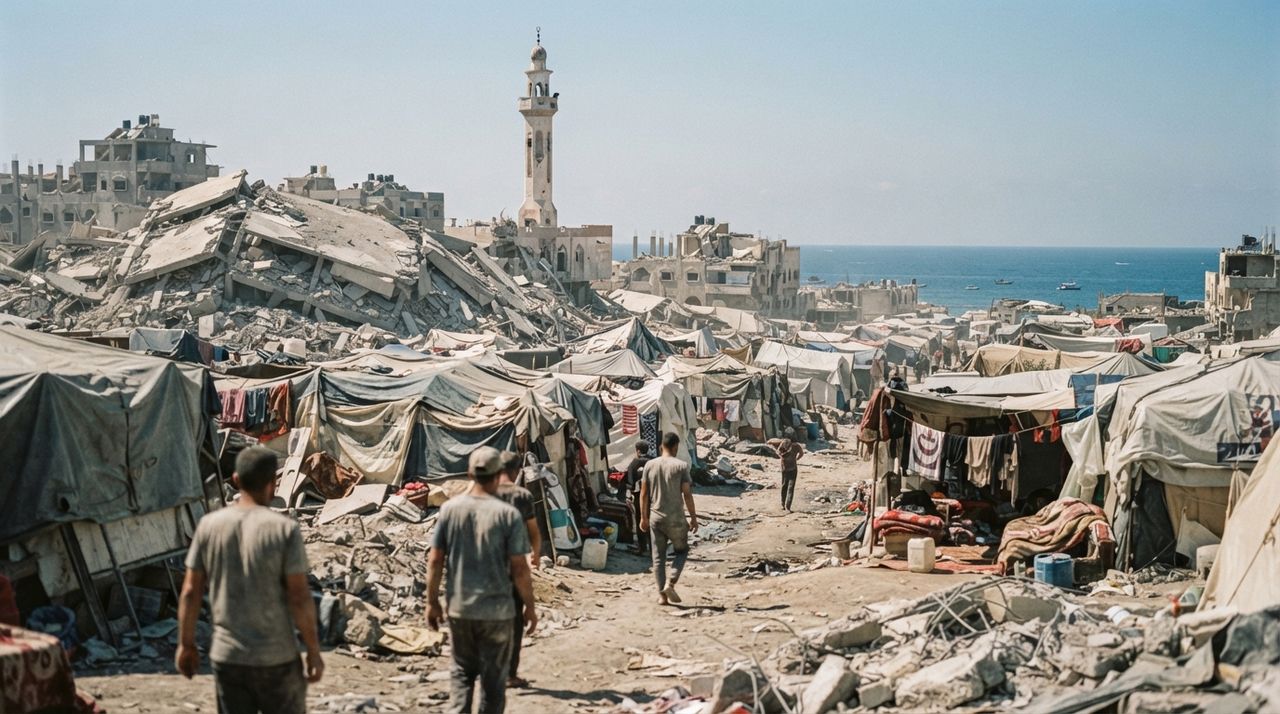
AI-generated illustration
Yahya Shunnar, president of the Palestine Monetary Authority, said the reconstruction of the Gaza Strip should be led by the Palestinian administration, with the banking and private sectors driving recovery and rebuilding projects. Shunnar also confirmed that Palestine's local banking sector is ready to lead that work.
Shunnar spoke at a meeting in Bangkok between Arab central bank governors and World Bank Group President Ajay Banga, according to the official Palestinian news agency WAFA.
Reconstruction must stay under Palestinian leadership
Shunnar said the reconstruction process has to remain entirely in the hands of the Palestinian administration and should rest on the capacity of the banking and private sectors.
The integrity of the banking sector and the full financial and economic link between the occupied West Bank and the Gaza Strip must be maintained so that resources are directed toward national priorities, Shunnar said.
Costs above 71 billion dollars
World Bank and international estimates put the cost of recovery and reconstruction at more than $71 billion, Shunnar said, calling for the removal of restrictions on the return of excess cash liquidity so financing flows can move without disruption.
Shunnar invited the World Bank Group to lead international efforts to gather support, widen the scope of financing through existing funds, and mobilize guarantee and risk-sharing mechanisms of the International Finance Corporation (IFC) and the Multilateral Investment Guarantee Agency (MIGA).
Thirteen banks operating in the Palestinian market
Under the Paris Economic Protocol, signed in 1994 as an additional protocol to the Oslo Accords, the Palestine Monetary Authority serves as the banking sector's supervisory and regulatory body and as the official financial adviser to the Palestinian administration.
Thirteen banks operate in the Palestinian market: seven local and six foreign, the latter made up of five Jordanian banks and one Egyptian bank.
Correspondent ties with Israeli banks
Two Israeli banks, Discount and Hapoalim, currently handle Palestinian banks' relations with the Israeli banking system. Those ties mainly cover the sending and receiving of cash transfers for commercial payments.
Three years ago, the Israeli government granted an exemption to shield those two banks from lawsuits filed in the United States accusing the Palestinian administration and Palestinian banks of transferring money to "terror groups". The exemption is renewed every year, and without it Israeli banks face litigation risk both in Israel and in US courts.
Since Israel launched attacks on the Gaza Strip in October 2023, the renewal period for the correspondent banking arrangement has been shortened from one year to three months.
Attacks continue despite ceasefire
A ceasefire agreement was announced on 10 October 2025, yet WAFA reported that Israel has continued its attacks on the Gaza Strip through daily bombardments and is blocking agreed amounts of humanitarian aid from entering the territory, where about 2.4 million Palestinians live in catastrophic conditions.
Key takeaways
- Yahya Shunnar said Gaza's reconstruction should be led by the Palestinian administration and built on the banking and private sectors.
- Recovery and reconstruction costs are estimated at more than $71 billion, according to World Bank and international figures cited by Shunnar.
- Shunnar urged lifting restrictions on the return of excess cash liquidity to keep financing flows unimpeded.
- The renewal period for the correspondent banking arrangement with Israeli banks was cut from one year to three months after October 2023.

Join the conversation
Share your thoughts on this story.
Comments
Post a Comment