
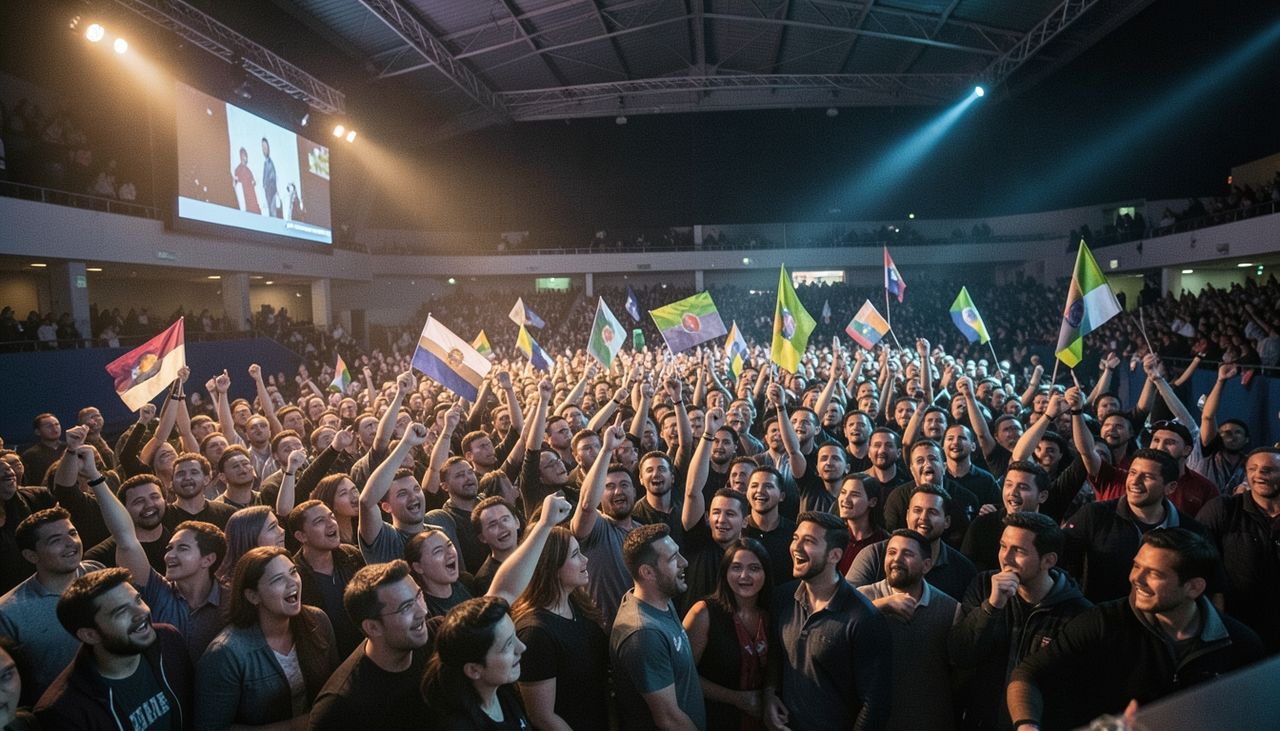
AI-generated illustration
Luiz Inacio Lula da Silva has been elected to a fourth term as Brazil's president, narrowly winning the runoff with 51.78% of valid votes against 48.22% for his rival, Senator Flavio Bolsonaro, according to data from Brazil's Superior Electoral Court (TSE). With 99.98% of ballot boxes counted, the Workers' Party (PT) candidate secured the result after trailing in the first round.
Lula da Silva, 80, told supporters in Sao Paulo that he would serve all Brazilians despite the country's political divisions, and stressed respect for the constitution. The new four-year term is scheduled to begin on 5 January 2027.
Runoff result and victory speech
Figures from the TSE showed 99.98% of ballot boxes opened in the second round, with Lula da Silva taking 51.78% of valid votes and Flavio Bolsonaro 48.22%.
In the first round on 4 October, Lula da Silva won 45.16% of valid votes, while Senator Bolsonaro finished first with 47.03%. Lula da Silva became the first candidate in Brazil since 1985 to place second in the opening round and go on to win the runoff.
Speaking in Sao Paulo after the result, the president-elect said he would govern for every Brazilian even though the country remains politically divided. "No one has to love the elected president, but he was elected to govern for everyone," Lula da Silva said, underlining the importance of respect for the constitution.
From factory worker to the presidency
Lula da Silva was born on 27 October 1945 in the northeastern state of Pernambuco. He grew up in poverty, moved to Sao Paulo with his family and started working at a young age. After vocational training as a metalworker, he lost a finger in a workplace accident.
During the military dictatorship he joined the union movement and later led the metalworkers' union in Sao Bernardo do Campo, an industrial centre near Sao Paulo. National recognition came through the major strikes he led in the late 1970s, and in 1980 he founded the Workers' Party, bringing together union members, left-wing intellectuals and opponents of military rule.
Elected to Congress in 1986, he ran unsuccessfully for the presidency in 1989, 1994 and 1998 before winning in 2002 and taking office in January 2003. During his first two terms exports and economic growth rose, and social programmes such as Bolsa Familia transferred money to millions of low-income households. Poverty fell significantly, but his administration also faced corruption scandals involving senior officials and lawmakers.
Barred by the constitutional limit of two consecutive terms, Lula da Silva handed power after the 2010 election to Dilma Rousseff, a political ally who had served as energy minister and later as cabinet chief of staff in his government.
Prison sentence and return to politics
His career was derailed by the wide-ranging Lava Jato (Car Wash) corruption investigation, which tried politicians and business figures on bribery and money laundering charges. Convicted on corruption and money laundering counts, Lula da Silva entered prison in April 2018 and was unable to contest that year's presidential election. He spent 580 days behind bars before being released in November 2019.
In 2021 the Supreme Court annulled his convictions, ruling that the court handling the cases had no jurisdiction, and also found that the presiding judge at the time, Sergio Moro, had acted with bias in one of the trials. The rulings restored his political rights.
Lula da Silva won the 2022 election, narrowly defeating then President Jair Bolsonaro with about 50.9% of valid votes, and took charge of the country for a third time. A week after his inauguration in January 2023, supporters of Bolsonaro attacked Congress, the Supreme Court and the presidential palace in an attempt to overturn the election result.
Third term priorities and campaign pledges
In his third term, Lula da Silva focused on poverty reduction, social spending, public investment and environmental protection while trying to maintain fiscal stability. The government expanded social assistance programmes and took steps to strengthen wages and employment, but the cost of living, government spending and violent crime weighed on his popularity.
The administration struggled to pass legislation in a Congress dominated by centre and conservative parties. In his fourth-term campaign, Lula da Silva pledged to continue Bolsa Familia, expand the supply of affordable housing and strengthen public health and education. His economic promises included higher taxes on top incomes, continued infrastructure investment, support for domestic production and further increases in the minimum wage.
He also backed a bill to cut the working week from 44 to 40 hours without loss of pay. The measure took effect on 16 October as a constitutional amendment and is to be implemented gradually over 14 months. On the environment, he promised to end deforestation by 2030 while supporting oil and natural gas development.
Winning the election does not mean controlling Congress. To deliver on tax reform, social spending, public security measures and environmental legislation, the Lula da Silva government will have to negotiate with other parties.
Foreign policy and regional context
Lula da Silva has pursued closer cooperation with emerging economies through BRICS, deepened ties with China and argued for a more active diplomatic role for Brazil internationally. He has criticised Israel's military operations in Gaza, voiced support for the Palestinian state and called for international conflicts to be resolved through negotiation.
Relations with Washington deteriorated after President Donald Trump imposed tariffs on Brazilian goods and openly backed former President Jair Bolsonaro. Lula da Silva accused the United States of interfering in Brazil's internal affairs and made national sovereignty one of the main themes of the campaign.
The victory comes at a time when conservative governments hold power in several Latin American countries, including Chile, Colombia and Peru, and some of them have sought closer ties with Trump. Lula da Silva's new four-year term is due to start on 5 January 2027.
Key takeaways
- Lula da Silva won the runoff with 51.78% of valid votes against 48.22% for Senator Flavio Bolsonaro, with 99.98% of ballot boxes counted.
- He becomes the first candidate since 1985 to finish second in the first round and still win the presidency.
- Lula da Silva pledged to govern for all Brazilians and stressed respect for the constitution in his victory speech.
- The new four-year term begins on 5 January 2027, and his government will need support from other parties to pass its agenda in Congress.

Join the conversation
Share your thoughts on this story.
Comments
Post a Comment