
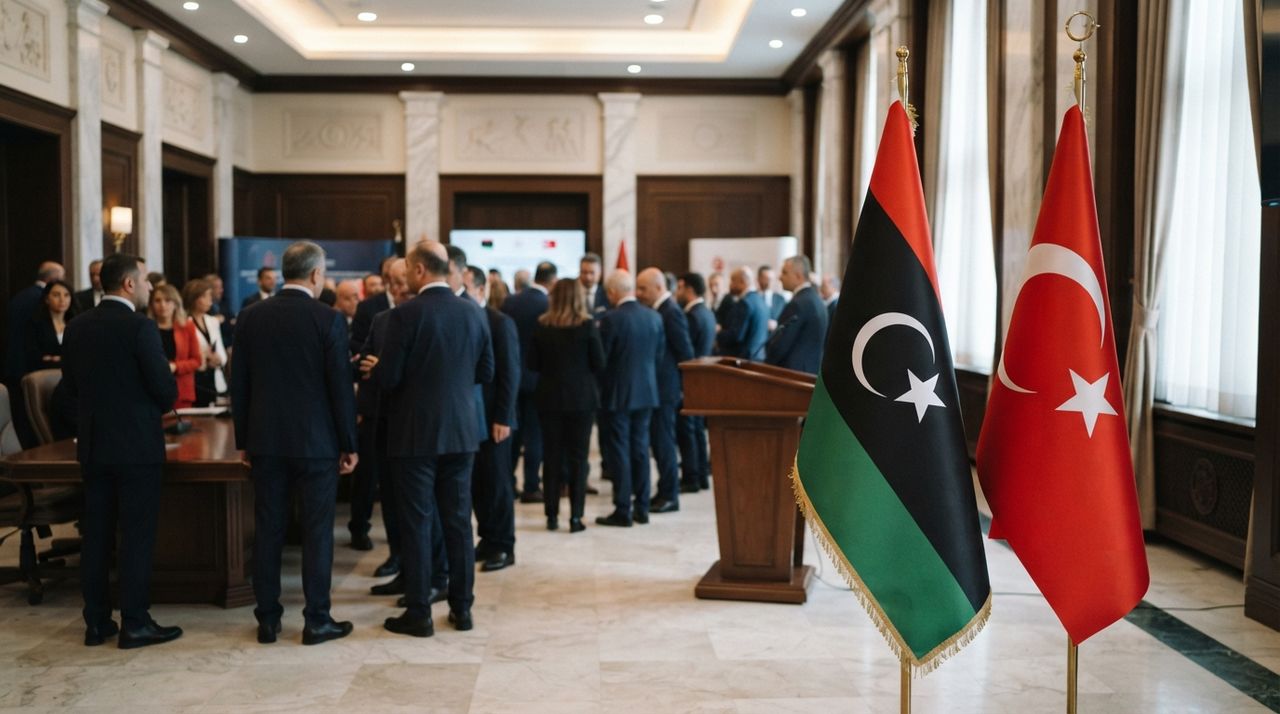
AI-generated illustration
Libyan politicians have voiced full support for the House of Representatives' approval of the memorandum of understanding signed by Turkey and Libya in 2019 on the delimitation of maritime jurisdiction areas. They said the vote, taken unanimously, clears earlier legal objections and completes the constitutional process.
According to the politicians, the memorandum is no longer an accord endorsed only by the government in Triplus, but has become part of official Libyan policy. They argued the decision strengthens Libya's hand in the Eastern Mediterranean and opens wider energy cooperation with Turkey.
House vote removes legal obstacles
The approval by the House of Representatives, Libya's legislature, cleared up previously raised legal points and wrapped up the constitutional procedures attached to the deal.
Libyan politicians stressed that the vote changed the status of the agreement. It is no longer limited to being an accord ratified by a single government in Tripoli, they said, but forms part of official Libyan policy.
Representative Rabia Eburas told an Anadolu Agency reporter that the ratification matters both for Libya and for the region. Eburas said the House approved the memorandum unanimously, adding: "The House's approval of the memorandum now carries the message that this file is no longer limited to a single government in Tripoli, but has become part of official Libyan policy."
Eburas said the decision increases Libya's bargaining power in the Eastern Mediterranean and offers Turkey a broader partnership in the energy sector than before.
New doors open in hydrocarbons and energy
One of the main gains from the approval, Eburas said, is that it gives Turkey a wider political and legal framework to carry out exploration and seismic work in Libyan offshore areas with hydrocarbon potential.
Eburas noted that the Libyan National Oil Corporation (NOC) and the Turkish Petroleum Corporation (TPAO) signed a memorandum of understanding in June 2025 to conduct geophysical surveys and two-dimensional seismic exploration in four offshore blocks with a combined length of close to 10,000 kilometers.
If the file is managed well, Libya could benefit from increased investment, development of the oil services sector, job creation and diversified revenue sources, and could possibly strengthen its position as a supplier of gas to European markets, Eburas said.
Eburas also said the memorandum approved by the House does not target Greece or any other country. It gives Libya a stronger negotiating position and offers real guarantees for adopting the coordinates and maps produced by technical committees set up by Libya and Turkey.
Approval may reshape Eastern Mediterranean balances
Eburas said the vote has greatly strengthened Libya's political standing and fully removed claims that House approval was missing. According to Eburas, the approval is of a kind that will reshape balances in the Eastern Mediterranean.
"The House's approval is likely to have a clear effect in reshaping balances in the Eastern Mediterranean," Eburas said. "It consolidates the rapprochement between Libya and Turkey and gives Ankara broader geographical and political depth in the Eastern Mediterranean, against regional arrangements covering Greece, Cyprus, Egypt and Israel to varying degrees. It could also push Athens to intensify its contacts with Libya and the European Union, and encourage Egypt to reassess its options in a way that protects its interests on the Mediterranean and its security-related interests."
The Libya-Turkey maritime agreement gives Libya significant strategic leverage, the representative said, but its real value will be determined by the Libyan state's ability to unify its institutions, manage its resources transparently and turn the agreement from a political declaration into economic and strategic arrangements that are implementable and command the widest possible acceptance.
Libya needs Turkey's seismic research experience
Fethi Shibl, chairman of the Libyan Political Parties Union and general chairman of the People's Voice Party, one of the country's leading political parties, said the newly installed House of Representatives' leadership acted in Libya's interest by approving the memorandum signed by the two countries.
"Today we cannot forget Turkey's role in Libya; it helped us a great deal during the February Revolution, and Turkey's position in particular played a positive role during the attacks on Tripoli in 2019," Shibl said.
Shibl pointed to Libya's need for Turkey's experience in seismic research. "Economically, we believe the agreement with Turkey will benefit Libya. Libya today in particular does not have the technical and logistical means to drill for oil and gas extraction in deep waters, and we need to develop and expand our resources. That is why we regard parliament's approval as a good step in that direction," Shibl said.
Shibl said the ratification will bring gains for both countries: "Billions of cubic meters of natural gas or billions of barrels of oil on the seabed; this will be a major return for both Turkey and Libya at the same time." On the development of relations between Turkey and Libya, Shibl said it is no concern of other countries, adding: "Turkey is a Muslim people, we are Muslims, and so increased cooperation between the Turkish and Libyan peoples concerns us. As for the Greeks, that is their business; if the agreement is also documented before the UN and gains international status, and Greece wants to object to it, the international courts are open."
Ratification is a strong investment between the two countries
Sami al-Sayed, general chairman of the Libyan Independent Democrats Party, said the memorandum of understanding had been pending before the House of Representatives since 2019 and that its approval today is a positive step by the new House leadership. Al-Sayed expressed hope that the approval would be beneficial for both Turkey and Libya.
"Ratifying this agreement will be of great benefit to Libya and Turkey at the economic level, because in the end this is an investment in oil and natural gas," al-Sayed said.
Al-Sayed stressed that Greece and Egypt could also take part in the delimitation of maritime jurisdiction areas, allowing mutual benefit among all the countries concerned. "Libya today is a sovereign state and its maritime borders and territorial waters are protected; no one has attempted to violate Libya's territorial waters. Therefore this agreement is not only protection, it is an investment between the two countries and a documentation and strengthening of relations between Libya and Turkey. Greece may have made agreements with other countries along this route, or it does not want Libya and Turkey to have such a strategic and massive project linking their borders, because it wants to act contrary to this route," al-Sayed said.
Key takeaways
- The House of Representatives approved the 2019 Turkey-Libya maritime jurisdiction memorandum unanimously, completing the constitutional process.
- Representative Rabia Eburas said the vote moves the deal from a Tripoli government accord to official Libyan policy and raises Libya's bargaining power in the Eastern Mediterranean.
- NOC and TPAO signed a memorandum in June 2025 for geophysical and two-dimensional seismic work in four offshore blocks totaling about 10,000 kilometers.
- Fethi Shibl and Sami al-Sayed backed the vote, pointing to Libya's lack of deep-water drilling capacity and to gains for both countries.

Join the conversation
Share your thoughts on this story.
Comments
Post a Comment