
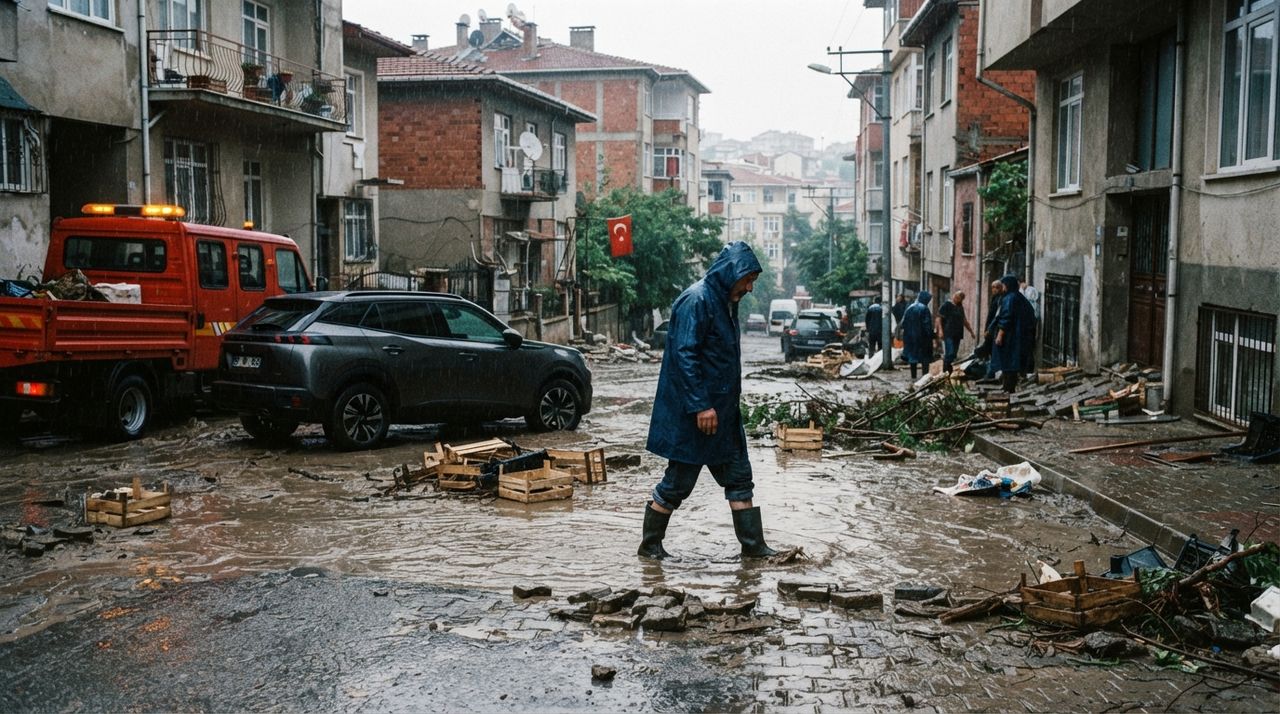
AI-generated illustration
The heavy rainfall that hit Istanbul, particularly its northern districts, resulted from the combination of Black Sea water temperatures reaching about 19.5 to 20 degrees Celsius, cold air moving in from the Balkans and a northeasterly wind carrying moisture over the sea, according to Prof. Dr. Mikdat Kadıoğlu of Istanbul Technical University.
Preliminary 24-hour data as of 14 October at 23.03 showed 230.3 kilograms of rain per square meter in Beykoz, close to 3.5 times the city's average rainfall for the entire month of October. Kadıoğlu said such events become disasters through poor land use, construction on riverbeds and inadequate infrastructure.
Rainfall far above the monthly average
Prof. Dr. Mikdat Kadıoğlu, a faculty member in the Department of Climate Science and Meteorological Engineering at Istanbul Technical University (ITU), told an AA reporter that the events in the city's northern districts created a situation the region could not handle on its own.
Citing preliminary 24-hour rainfall data as of 14 October at 23.03, Kadıoğlu said 230.3 kilograms of rain per square meter fell in the Beykoz district, nearly 3.5 times Istanbul's average total rainfall for October of 66.3 kilograms.
Kadıoğlu explained that rainfall is measured as the height of water collected per square meter: 1 millimeter equals 1 liter, or 1 kilogram, of water per square meter, and 100 kilograms forms a layer 10 centimeters deep where water cannot run off or soak in. The amount recorded in Beykoz equals roughly 24 tons of water falling on a 100-square-meter roof.
Because the intense rain fell over a short period in the northern districts, Kadıoğlu said a single yellow warning for the whole city cannot convey where the risk lies or how severe it is.
Three factors combined, climate change attribution needed
Kadıoğlu said the downpour was driven by the Black Sea reaching water temperatures of about 19.5 to 20 degrees Celsius, combined with cold air arriving from the Balkans and a poyraz wind carrying moisture across the sea. Warm seas feed moisture into the atmosphere and can sustain heavy rainfall, he said.
Linking a single rainfall event directly to climate change requires a dedicated attribution study, Kadıoğlu said, adding that climate change can increase the intensity of extreme weather. Even without climate change, a building constructed on a riverbed would still have flooded, a basement electrical panel would still have supplied power and an underpass would still have filled with water, Kadıoğlu said. "Climate change enlarges the danger somewhat; we enlarge the disaster," Kadıoğlu said, adding that El Niño cannot be cited as the direct cause of the Istanbul rainfall.
Extreme rain alone does not cause a disaster
On concrete and asphalt surfaces, almost all rainfall turns into surface runoff instead of soaking into the ground, flowing by gravity to the lowest points, riverbeds, underpasses and basements, Kadıoğlu said.
Kadıoğlu said excessive rainfall does not cause a disaster by itself, and that wrong land use, construction in riverbeds, insufficient infrastructure and delayed administrative decisions increase the damage. "Rain is a hazard. A disaster is the result when that hazard meets our city, which is unprepared, wrongly sited and wrongly operated," Kadıoğlu said, describing what happened in Istanbul as a disaster on a local scale. "Let us not call it a natural disaster. Rain is natural; a disaster is human-made," Kadıoğlu said.
Reopening streams and separating sewer lines
Kadıoğlu said Istanbul's floods are shaped by the structure of the catchment and human intervention as well as weather, and that converting riverbeds into roads, parking lots and housing raises the risk. In much of Istanbul, rainwater and wastewater systems operate combined, Kadıoğlu said, warning that sewage can back up during heavy rain and that water entering basements creates health risks.
Infrastructure fixes should not be limited to laying larger pipes, Kadıoğlu said. Covered streams turned into roads, parking lots and housing should be reopened, fill narrowing riverbeds removed, roof water stored, and parks and squares designed to hold water temporarily during storms. Rainwater and wastewater lines should be separated, flood maps prepared, and construction in risky areas barred unless those maps are respected.
Kadıoğlu also recommended raising electrical panels and generators above flood levels, limiting basement use in risky areas, installing water barriers at parking entrances, preparing a "flood building regulation" based on flood hazard maps, publishing maps that let residents check their address-level risk, and installing barriers in underpasses that close automatically when water reaches 15 centimeters, along with early warning systems along streams.
Key takeaways
- Beykoz recorded 230.3 kilograms of rain per square meter in 24 hours, nearly 3.5 times Istanbul's October average of 66.3 kilograms.
- The event combined Black Sea temperatures of about 19.5 to 20 degrees Celsius, cold Balkan air and a moisture-carrying poyraz wind.
- Kadıoğlu said climate change can intensify extreme weather but that a single event needs an attribution study, and that El Niño is not the direct cause.
- Recommended measures include reopening covered streams, separating rainwater and wastewater lines, flood maps and automatic underpass barriers.

Join the conversation
Share your thoughts on this story.
Comments
Post a Comment