
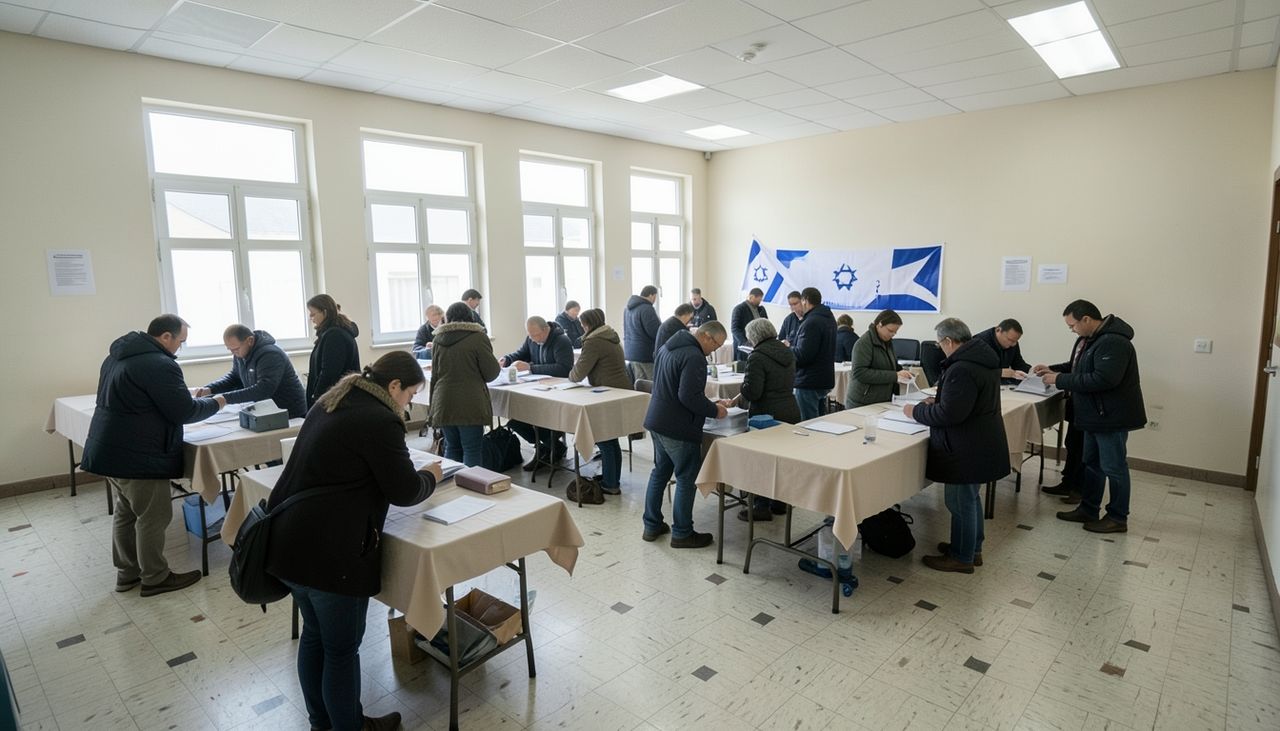
AI-generated illustration
Israeli voters head to the polls tomorrow to choose the members of the 26th Knesset, the first general election held on schedule since 1988, closing the four-year term of the government led by Prime Minister Benjamin Netanyahu.
The vote is the first national election since the Israeli military's attacks that caused massive destruction in the Gaza Strip, the occupation of southern Lebanon, and the war Israel launched against Iran together with the United States. Some 7.3 million eligible voters are expected to cast ballots at 18,000 ballot boxes set up in 12,018 polling stations across the country.
Voting hours, staffing and budget
Polls open at 07:00 local time tomorrow and close at 22.00. Even after the ballot boxes are closed, every voter waiting inside a polling center when it shuts is still entitled to vote.
The Central Elections Committee has assigned 100,000 staff to the vote and installed 15,000 cameras at polling stations for security. The election budget stands at 690 million shekels, roughly 220 million dollars.
Who can and cannot vote
Israel uses proportional representation and treats the whole country as a single constituency, so voters choose parties rather than individual candidates. Thirty-seven parties and lists are competing for seats in the 120-member parliament for a four-year term, and only those clearing the 3.25 percent electoral threshold enter parliament; ballots cast for parties below the threshold are not counted.
Palestinian citizens of Israel, numbering about 1.2 million and making up roughly 21 percent of the population, are eligible to vote. So are the more than 750,000 Israeli settlers living in the occupied West Bank and East Jerusalem, who frequently attack Palestinians and their property and seize Palestinian land.
By contrast, about 6 million Palestinians living in occupied East Jerusalem, the occupied West Bank and the blockaded Gaza Strip hold no Israeli citizenship and cannot vote, despite being directly affected by Israeli government policies. Most Israelis living abroad are also barred from voting, and those who do have the right must travel to Israel to reach a polling station. Israeli diplomats and state representatives abroad are exempt from that restriction.
Voting by soldiers and commanders at 850 centers, including in Syrian, Lebanese and Palestinian territories held under Israeli occupation, began on Oct. 20.
Blocs, parties and front-runners
Israeli opinion polls point to a contest between the far-right coalition led by Netanyahu and the Zionist opposition bloc, with neither side seen winning a majority on its own in the 120-seat Knesset.
Netanyahu, Israel's longest-serving prime minister, has spent 19 years in office with interruptions and is seeking to return to the premiership while standing trial on corruption charges. The bloc includes Finance Minister Bezalel Smotrich's Religious Zionism party, National Security Minister Itamar Ben-Gvir's Jewish Power party, Aryeh Deri's ultra-Orthodox Shas party, Yitzhak Goldknopf's ultra-Orthodox United Torah Judaism party and Ofer Winter's Israel's People party.
Gadi Eisenkot, a former chief of general staff and leader of the Yashar party, is the opposition bloc's most likely candidate for prime minister in polls. Surveys show Yashar finishing first and Eisenkot as the most preferred candidate for premier among voters. The opposition also includes the Beyahad (Together) party of former prime ministers Naftali Bennett and Yair Lapid, Avigdor Liberman's Israel Our Home and Yair Golan's Democrats party. Benny Gantz, who served as chief of general staff and defense minister, withdrew the Blue and White party he leads from the race.
The Ahi party, which represents ultra-Orthodox Jews, decided not to run after Netanyahu promised a deputy minister post for its leader, Rabbi Yosef David Abargel, and pledged that Haredi yeshiva students would not be conscripted.
Two lists represent Palestinian citizens
Palestinian citizens of Israel, counted at about 20 percent of the electorate, are represented by the Joint List and the United Arab List, known as Raam. The Joint List, formed by the Hadash, Taal and Beled parties, is led by Yusuf Jabarin. Beled leader Sami Abu Shehade pulled out of the race shortly before the High Court of Justice was due to hear a petition seeking to bar him from running.
Raam, led by Mansur Abbas, is remembered for the pivotal role it played in coalition bargaining after the March 2021 elections. By supporting the Bennett-Lapid change government with four lawmakers, it became the first Arab party to sit in an Israeli coalition.
Raam and the Joint List are expected to land in a similar position of leverage after tomorrow's vote. Arab parties have said they will work to bring down the Netanyahu government, in which far-right and racist figures hold important posts, while leaving the door open to joining a government. The opposition bloc led by Eisenkot, however, says it will not negotiate a government with Arab parties, a stance analysts attribute to Netanyahu's repeated campaign claim that the opposition would cooperate with those parties.
How a government would be formed
Once polls close, attention turns to coalition scenarios among the parties that win seats. After seat allocation is finalized on the basis of vote shares and official results are announced, President Isaac Herzog will meet representatives of every party entering the Knesset and collect their nominations for prime minister.
The president is not required to hand the mandate to the largest party, but to the leader judged most likely to secure the support of 61 lawmakers. That person gets 28 days to form a government, extendable by 14 more if needed. If the attempt fails, the president consults again and can give the task to someone else in the Knesset, who then has 28 days. If a government still has not been formed, any Knesset member has 21 days to collect 61 signatures; if successful, that person has two weeks to form a government. If not, the Knesset is dissolved and the country must hold another election within three months.
Throughout every scenario, the sitting prime minister stays on in a caretaker capacity. If the opposition fails to form a government, Netanyahu could therefore remain as caretaker prime minister for up to six more months even without winning the election. No party has ever secured a majority on its own in Israel, so signing coalition agreements matters most; a cabinet that reaches agreement takes office after winning a vote of confidence in the Knesset, while failed talks would send the country back to an early election.
Key takeaways
- Israel votes tomorrow to elect the 26th Knesset, its first general election held on schedule since 1988
- About 7.3 million eligible voters can cast ballots at 18,000 ballot boxes in 12,018 polling stations, on a budget of 690 million shekels
- Polls show Netanyahu's far-right coalition racing the Zionist opposition bloc, with neither seen winning 61 seats alone
- Some 6 million Palestinians in occupied East Jerusalem, the occupied West Bank and blockaded Gaza are barred from voting

Join the conversation
Share your thoughts on this story.
Comments
Post a Comment