
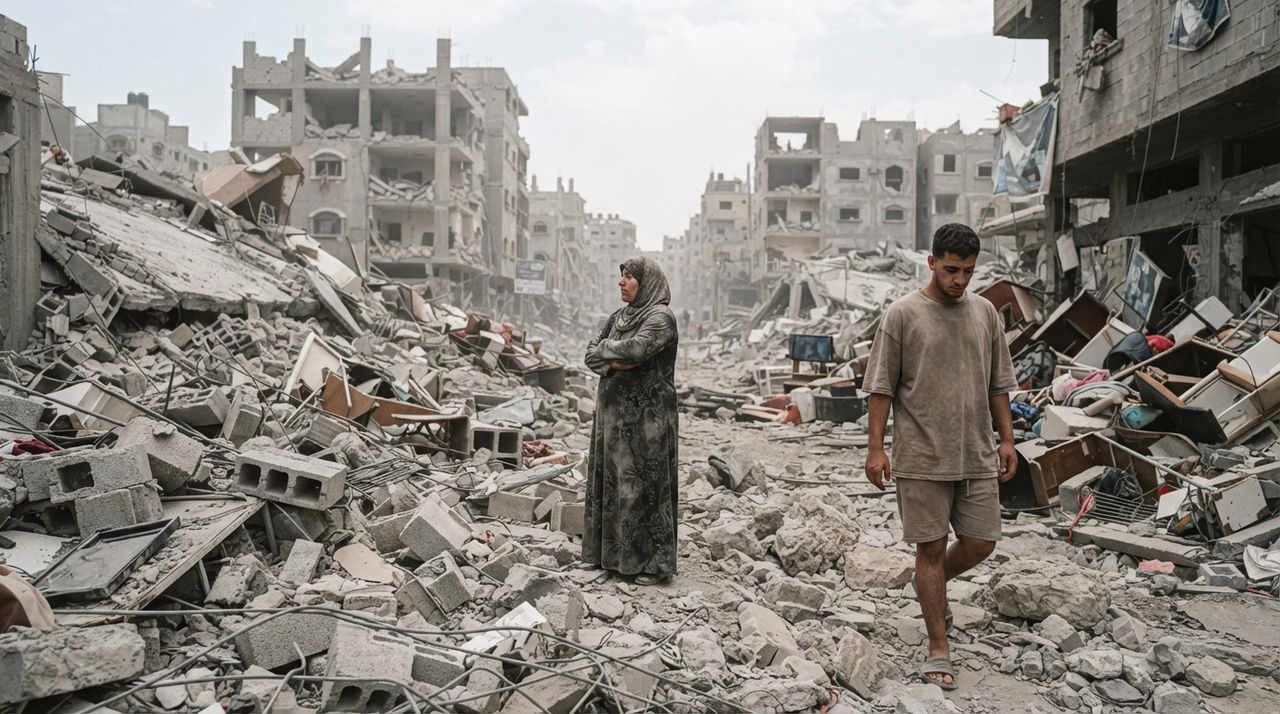
AI-generated illustration
Ten Israeli soldiers who served in Gaza after the October 2023 Hamas attack have described to the German magazine Der Spiegel what they say were orders to shoot unarmed people, tolerance of civilian deaths in drone strikes, the systematic demolition of homes and the use of Palestinian detainees as human shields.
The magazine said it compared the accounts with other testimonies and independently verifiable information and found them credible. Most of the soldiers asked to remain anonymous, fearing negative consequences.
Der Spiegel says it verified the accounts
Der Spiegel published interviews with 10 Israeli soldiers who were deployed in Gaza after the October 2023 Hamas attack. Some remotely operated drones; others selected targets for airstrikes. The magazine said it tried to verify their statements as far as possible, checked them against other testimonies and independently verifiable information, and concluded that the accounts were credible.
Most of the soldiers asked that their identities not be disclosed, Der Spiegel reported, saying they feared negative consequences. The magazine also reported that the Israeli military still controls about two thirds of Gaza despite a ceasefire being in force, and continues to carry out regular strikes on targets in the territory.
Orders to 'shoot everyone you see'
A soldier identified as Itay, who was deployed in northern Gaza and served there intermittently for about a year, said that in the first weeks of the war there was effectively no rules of engagement. "The word 'civilians' was almost never used. The rule was: shoot everyone you see. At least that is how it was in our sector," Itay said.
According to Itay, males of conscription age were eventually treated as terrorists, with the age range interpreted broadly. Men aged 16 to 60 were covered, as were people younger or older than that bracket. Itay said the unit killed a large number of Palestinians and that most of those killed were believed to be unarmed.
An infantry soldier identified as David, who served in central Gaza and Khan Younis from October 2023, said some units received "orders to open fire on everyone." David said a commander told soldiers not to shoot at women and children but to shoot to kill at males of military age. During a night patrol, the unit encountered two men on bicycles, saw that they were unarmed and opened fire anyway. Soldiers also fired at two men loading a truck and at two other people, and later realized that more than one person had been killed. David said the commander later claimed those killed were not civilians but Hamas members, and that such incidents became familiar over time. David said the unit killed a large number of unarmed men in Gaza simply because they were males of military age and were present in the unit's area.
Categories for expected civilian deaths in drone strikes
A soldier identified as Yair, who served as a drone pilot in Gaza, said the rules for attacks were widened and that people classified as hostile could be targeted regardless of what they were doing at the time. Yair said drone strikes were subject to categories based on the expected number of civilian deaths: the lowest category allowed only the target to be killed, while other categories allowed for 5, 10 and up to 20 civilians.
A reservist identified as Yaakov, who served about 250 days in Gaza, said some residential areas were systematically demolished to create a security zone. About two thirds of the Khirbat al-Khuza'a area was ordered destroyed, Yaakov said, and some soldiers celebrated after houses were blown up with explosives. "It looked like we were demolishing houses not only for military reasons but for revenge," Yaakov said.
Yaakov said a wide area in the Netzarim corridor was completely razed while serving there, and that the foundations of homes belonging to tens of thousands of former residents were no longer visible. The unit killed between 160 and 170 people in more than 80 days in the area, Yaakov said, and all were recorded as terrorists, though in most cases the bodies were not examined. Some people were targeted merely for moving suspiciously; three people walking together were interpreted as moving in military formation and were killed in a drone strike.
Palestinians used as human shields, soldier says
A reservist identified as Shaul, who served in a medical unit in Gaza, alleged that Palestinian men were used as human shields during military operations. Shaul said Palestinians referred to as "mosquitoes" were blindfolded, handcuffed and sent into tunnels and houses wearing little more than underwear and shoes.
Shaul said those individuals, carrying Israeli military uniforms and cameras, were sent ahead into areas considered dangerous so that they, rather than Israeli soldiers, would be harmed in any ambush or explosive trap.
Key takeaways
- Der Spiegel published interviews with 10 Israeli soldiers who served in Gaza after the October 2023 Hamas attack, and said it found their accounts credible.
- Soldiers described an early-war rule to "shoot everyone you see" and the killing of unarmed Palestinian men treated as terrorists by age bracket.
- One soldier said drone strikes were categorized by allowed civilian deaths, from the target alone up to 20 civilians.
- Reservists alleged homes were demolished for revenge and that Palestinians were sent ahead into tunnels and houses as human shields.

Join the conversation
Share your thoughts on this story.
Comments
Post a Comment