
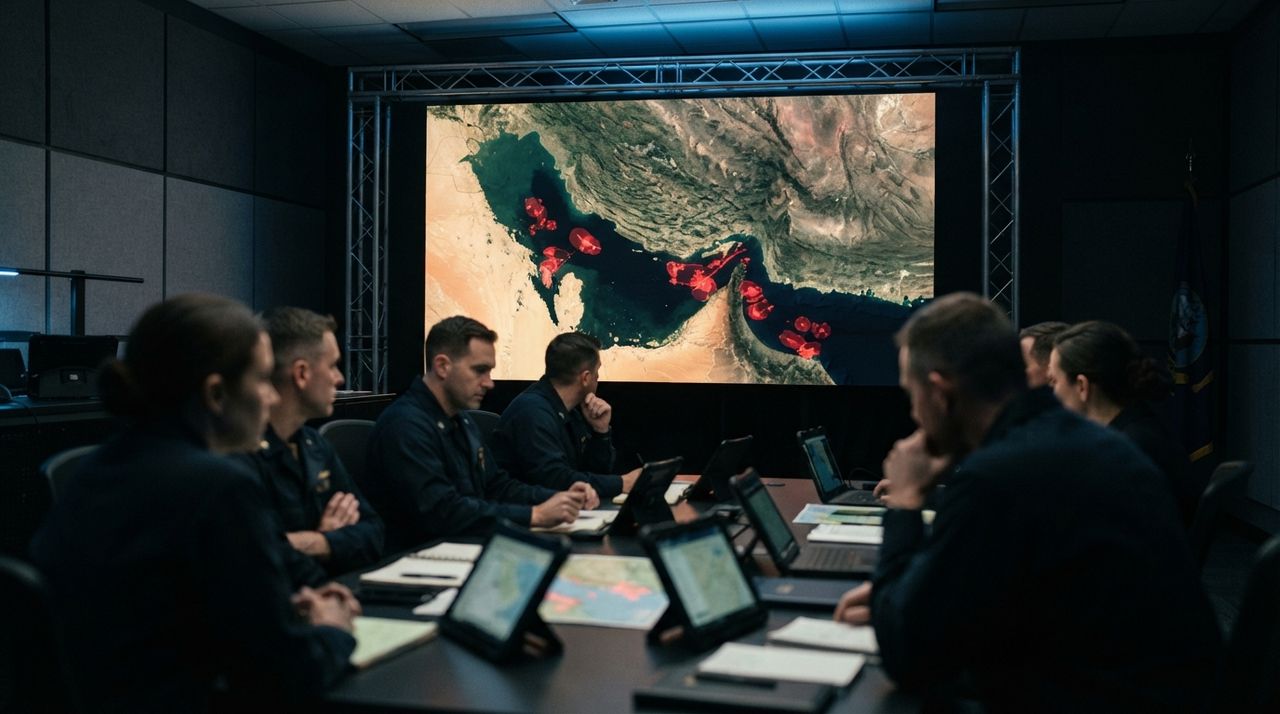
AI-generated illustration
Brigadier General Hossein Muhibbi, spokesperson for Iran's Islamic Revolutionary Guard Corps, publicly identified seven major communications cables running beneath the Strait of Hormuz as potential targets, moving the dispute over the waterway from energy security into the realm of global data and financial networks.
The fiber-optic lines carry internet access for Gulf states, financial transactions tied to trillions of dollars in oil and gas trade, and some logistics data networks used by military bases. Officials in Tehran and Iranian state-linked media have also threatened to impose tax and licensing requirements on US technology companies or to interrupt data flows.
Seven cable systems run through the strait
Contrary to the common view that the internet relies on wireless networks and satellites, more than 97 percent of global data traffic travels through physical cables laid on the seabed. The worldwide network exceeds 1.5 million kilometers in length, enough to circle the planet more than 37 times, and is protected by a layered armor design.
Optical fiber strands at the core carry data as light pulses at the speed of light. Steel wires above that core give the cable resistance to deep-water pressure and tension, while a copper sheath supplies continuous power to signal amplifiers placed every 60 to 100 kilometers along the route. A high-density polyethylene layer provides waterproofing, and an outer steel armor protects the cable in shallow water from dragging ship anchors and trawler nets.
Data from the TeleGeography and Submarine Networks databases show at least seven main systems along the Strait of Hormuz and the Persian Gulf. FALCON (GCX) links nearly all Arab states in the Gulf to Egypt via the Red Sea and to India in the east, and is one of the few lines that also passes through Iranian territorial waters.
AAE-1 (Asia-Africa-Europe-1), a 25,000-kilometer consortium cable, connects Asia and Europe through the Gulf and is described as the Middle East's busiest data artery. Gulf Bridge International (GBI) joins Gulf states to one another and forms the submarine leg of a northern corridor that reaches the Mediterranean and Europe overland through Iraq, and it too transits Iranian waters. Tata TGN-Gulf links Gulf Cooperation Council countries to the global network through Mumbai and carries heavy corporate, financial and stock exchange traffic.
SEA-ME-WE 5 runs from Singapore across the Indian Ocean, the Gulf, the Red Sea and the Suez Canal to Marseille, France. 2Africa (Pearls branch), built under Meta's leadership and described as the world's largest submarine cable project, also covers Gulf states; its main backbone has been laid, but shore landing work is reported to have been suspended because of regional tensions. Oman-Iran (POI) connects the Iranian ports of Chabahar and Jask directly to Oman and serves as a bilateral telecom bridge used by Tehran for regional data flow.
Gulf connectivity depends heavily on the chokepoint
Damage to the lines under the strait could affect regional actors unevenly. The Red Sea and the Bab el-Mandeb Strait carry roughly 90 percent of data flow between Asia and Europe, while the Strait of Hormuz accounts for less than 1 percent of global bandwidth. Even so, it functions as the main digital exit for the Gulf's oil-producing states.
The United Arab Emirates, Qatar, Bahrain and Kuwait have invested billions of dollars in recent years in data centers and artificial intelligence facilities as they seek to move away from oil-based economic models. Infrastructure belonging to Microsoft, Google Cloud, AWS, Oracle and the UAE-based G42 has expanded in the region, yet more than 90 percent of these countries' internet links to the outside world still depend on submarine cables running beneath the Strait of Hormuz and the Red Sea.
That reliance makes the narrow waterway the single point where a failure or an attack could disable the Gulf's digital economy. A simultaneous break in the cables would also strike regional trade and finance directly. Transactions on markets based in Dubai, Abu Dhabi and Doha could slow to a standstill, while global oil and gas contracts, international fund transfers carried over SWIFT and cross-border banking could face severe disruption. A communications crisis on this scale would generate direct financial losses of hundreds of millions of dollars a day in addition to logistical problems in the physical flow of energy trade.
Beyond the Gulf, the cables serve South Asia and India in particular. Deep interruptions could slow financial data flows between Asian centers such as Singapore and Europe, and could directly affect India's multibillion-dollar global information technology, software and outsourcing operations that serve customers worldwide.
Iran's own traffic is carried over land networks
In this equation, Iran has a more protected infrastructure than its neighbors. Roughly 60 to 70 percent of the country's internet traffic is carried by terrestrial fiber-optic networks arriving through Turkey, Azerbaijan and Armenia.
That land-based backup means a large-scale submarine cable sabotage or outage in the Strait of Hormuz would impose a far heavier economic cost on the Arab states to the south than on Tehran.
Debate over whether Iran could sever the cables
The strait's average depth of 50 to 100 meters leaves submarine cables far more exposed to physical interference than those on deep ocean floors. Mustafa Ahmed, a senior researcher at the Habtoor Research Center in the UAE, told CNN that the Revolutionary Guard Corps, equipped with combat diver teams, small submarines and underwater unmanned vehicles, poses a serious threat to the cables, and that an intervention could trigger an intercontinental digital crisis.
International technical specialists are skeptical that such sabotage could be carried out. Doug Madory, an internet infrastructure expert at the network analysis firm Kentik, told The Guardian that the Strait of Hormuz is monitored continuously by the US Navy and allied aircraft, that Iran does not possess advanced covert technology able to cut the cables undetected, and that an overt operation would turn into what Madory called "a suicide mission."
Transit fee and licensing demands raised by Tehran face legal and technical obstacles of their own. Dina Esfandiary, head of Middle East at Bloomberg Economics, said the threats form part of a strategy to display Iran's influence over Hormuz and to build deterrence against a possible attack.
Repair capacity seen as the larger vulnerability
Industry representatives say the most concrete danger lies less in cutting a cable than in disabling the repair process. Alan Mauldin, research director at TeleGeography, said only one of the five maintenance ships that normally operate in the area remains inside the Persian Gulf.
Madory noted that cable breaks already occur frequently because of technical faults and ship accidents, and that repair vessels must remain stationary for days to carry out delicate work. If Iran were to target or threaten those civilian ships, Madory said, no company would enter the area because of security risks and insurance barriers, turning a fault that could be fixed in a few days into a digital crisis lasting months. Specialists say recent developments around the strait show that seabed fiber-optic cables have become strategic targets in modern conflict alongside oil tankers and pipelines.
Earlier cable failures have already disrupted internet access. When the British cargo ship Rubymar sank after being hit by a Houthi missile off Yemen in February-March 2024, the vessel's anchor dragged along the seabed and severed the AAE-1, Seacom and TGN lines, cutting roughly 25 percent of internet traffic between Asia and Europe; repairs took months.
During heightened tension between Russia and NATO, fiber-optic cables in the Baltic Sea and infrastructure such as Nord Stream and Balticconnector were disabled by suspicious vessel movements, sabotage and dragging anchors. In January 2008, several international submarine cables broke at the same time off Alexandria, Egypt, causing internet access across the Middle East and India to fall by about 70 percent, with data flow and physical repairs taking weeks to return to normal.
Key takeaways
- An IRGC spokesperson named seven submarine communications cables beneath the Strait of Hormuz as potential targets.
- More than 90 percent of Gulf states' outside internet links depend on cables running beneath Hormuz and the Red Sea.
- About 60 to 70 percent of Iran's internet traffic travels over land fiber networks through Turkey, Azerbaijan and Armenia.
- Experts say blocked repairs, rather than a direct cut, are the likeliest route to a months-long regional outage.

Join the conversation
Share your thoughts on this story.
Comments
Post a Comment