
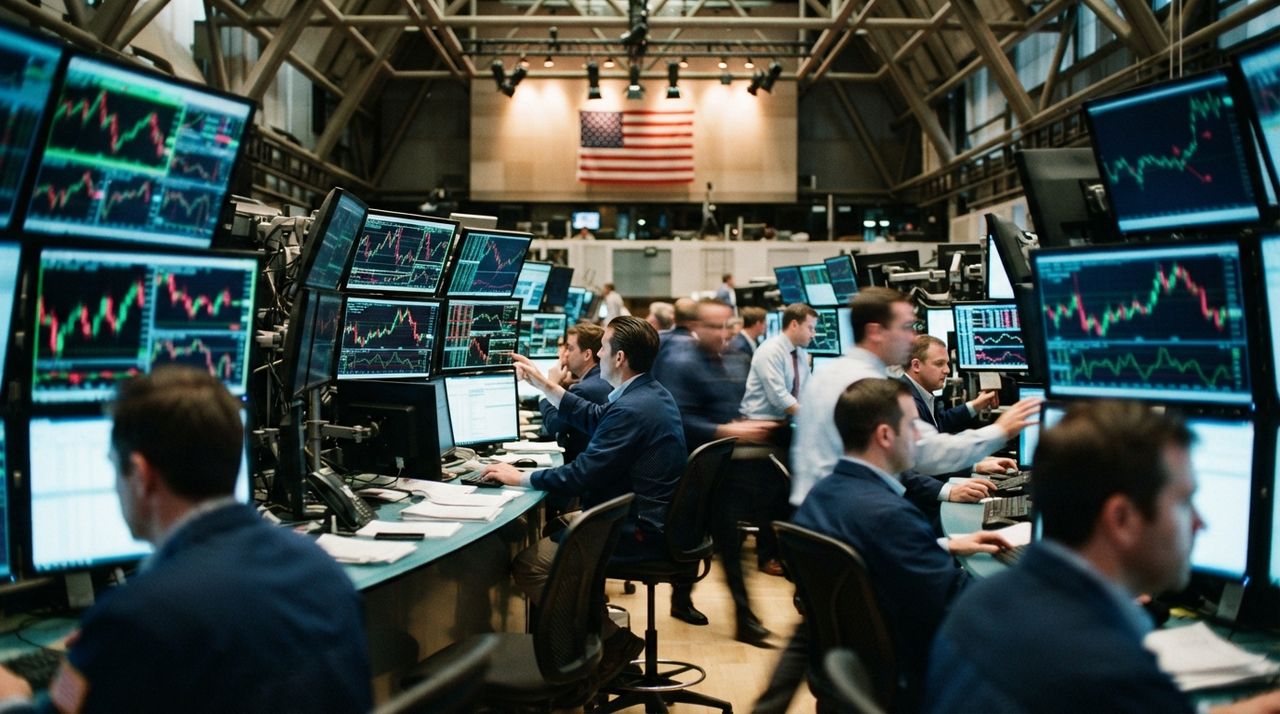
AI-generated illustration
Global stock markets ended the week mixed as US inflation data, Middle East tensions and developments in artificial intelligence shaped trading, while investors turned their attention to a dense calendar of data releases and major corporate earnings next week.
Rising energy costs pushed US annual inflation to its highest level in four months, strengthening expectations that the Federal Reserve could raise interest rates again. Even so, bond yields and the dollar index fell over the week, and shares in AI-linked technology companies came under pressure.
US inflation surprise lifts rate-hike expectations
Geopolitical risks linked to the Middle East and the Russia-Ukraine war kept energy costs elevated, and US annual inflation reached its highest reading in four months. A breakdown of the data showed that rising energy prices continued to play a large role in the increase in the consumer price index.
After the stronger-than-expected inflation figures, money markets priced in a total of three Fed rate increases through the end of next year. Bond yields and the dollar index still closed the week lower. Selling in technology and semiconductor shares pushed investors toward government bonds, driven by concern that high rates could weigh on AI investment, one of the main engines of the US economy, and the growth that follows from it. Some forecasts suggested the Fed may not tighten as much as expected.
Reports of progress in chip development by Chinese chipmaker CXMT added to selling pressure on global technology shares. Assessments of whether its chips could be produced more cheaply than existing alternatives raised concern that competition in the sector could intensify and that the profitability of large technology companies could suffer. These factors were among the reasons investors cut positions in AI-focused technology stocks.
Fed officials keep their options open
Fed Chair Kevin Warsh gave no guidance on decisions at coming meetings during an event held as part of the International Monetary Fund and World Bank annual meetings in Bangkok, and stressed the central bank's determination to deliver price stability. "I do not prejudge meetings. I do not think it is right to say now what we may do at the meetings we hold for the rest of this year," Warsh said.
New York Fed President John Williams said a view had not changed that the Fed may need to raise rates once more this year, but did not believe more would be required afterwards. Williams said the economy was influenced by many different factors, so the Fed would keep watching the data, adding: "I still believe disinflationary forces are at work. My inflation forecast for next year is for inflation to fall significantly." Cleveland Fed President Beth Hammack said adopting a restrictive monetary policy stance would be appropriate to bring inflation back to 2 percent.
The US 10-year Treasury yield ended the week down 15 basis points at 5.09 percent. The dollar index fell 0.4 percent on the week to 101.8, ending a four-week rising streak. Expectations of a "hawkish" path at coming meetings weighed on gold, with the ounce down 0.7 percent to $4,165. Brent crude for December delivery rose 4.75 percent over the week to close at $109.69 a barrel.
Wall Street mixed as bank earnings roll in
US share markets posted a mixed week. The S&P 500 fell 1.95 percent and the Nasdaq dropped 4.48 percent, while the Dow Jones rose 0.67 percent. The producer price index rose 1.3 percent on a monthly basis and 6.3 percent annually in September, above expectations, marking the fastest monthly increase since March 2022 and the fastest annual rise since December 2022. The jump in producer prices after the consumer price data added to concern about persistent price pressures.
Morgan Stanley beat expectations for third-quarter profit and revenue. Bank of America booked a $1.2 billion administrative fine, and its third-quarter profit fell 17 percent to $6.9 billion, with both profit and revenue missing forecasts. JPMorgan Chase reported profit and revenue below expectations, while Goldman Sachs posted third-quarter revenue up 23 percent from a year earlier to $18.7 billion. Wells Fargo's net profit rose 6 percent to $5.95 billion, from $5.59 billion a year earlier, and Citigroup's climbed 40 percent to $5.2 billion, from $3.8 billion.
European shares gain on energy and defense
European stock markets moved higher, supported by upbeat corporate results and buying in energy and defense shares. European Central Bank President Christine Lagarde said the solution to heading off a fiscal crisis in France lay in the country's own fiscal policies, remarks that backed forecasts that the French economy could recover. The euro, which had lost value on fears the situation in France could spread across the region, strengthened against the dollar on a weekly basis for the first time in four weeks, gaining 0.3 percent to 1.1240.
In the chip sector, Dutch semiconductor equipment maker ASML raised its outlook after confirming that strong demand for AI would continue, yet its shares fell 7.7 percent on the week amid broader developments in global AI and technology. Euro area consumer prices rose 0.6 percent monthly and 2.5 percent annually in September, in line with expectations, and German inflation came in at 0.6 percent monthly and 3.3 percent annually. UK growth in August reached 0.1 percent on a monthly basis and 2.1 percent annually, above forecasts.
Over the week the FTSE 100 gained 3.09 percent, the DAX 2.14 percent, the CAC 40 1.97 percent and Italy's MIB 30 0.21 percent.
Asian technology slide hits Kospi hard
Asian stock markets fell sharply this week as technology shares were sold off and doubts grew over the sustainability of AI companies' investment. South Korea's tech and semiconductor-heavy Kospi index recorded its steepest weekly decline in 18 years. Shares of SK Hynix lost 24.33 percent, Samsung Electronics 17.75 percent and LG Electronics 15.36 percent.
Chinese data were also in focus. The country's trade surplus reached $133.5 billion in September, its highest level since January 2025. Producer prices rose 5 percent year on year, the fastest pace since June 2022 and above the 3.8 percent forecast, driven by higher energy prices. Consumer prices increased 0.9 percent annually, accelerating moderately from August but still below expectations, pointing to weak domestic demand.
On a weekly basis the Kospi fell 14.46 percent, the Hang Seng 0.10 percent, the Nikkei 225 5.37 percent and the Shanghai Composite 2.56 percent.
Borsa Istanbul falls ahead of the TCMB decision
Borsa Istanbul was dominated by selling, with the BIST 100 index closing the week down 4.44 percent at 11,721.72 points. Treasury and Finance Minister Mehmet Şimşek said the government planned to complete by the beginning of 2027 the legal regulations needed to strengthen the fight against capital market crimes, including coordinated transactions by funds.
Central Bank of the Republic of Turkey Governor Fatih Karahan gave a presentation on Turkey's macroeconomic outlook and monetary policy at the IMF and World Bank meetings in Bangkok. Karahan said capital outflows had not caused a notable weakening in domestic residents' preferences for lira-denominated assets. "Domestic residents' preference for the lira generally continues its strong trend," Karahan said. The dollar closed the week at 49.5140 lira, 0.5 percent above the previous weekly close.
Economists surveyed by AA Finance expect the central bank to cut its policy rate by 100 basis points to 36 percent in October. Next week the real sector confidence index and capacity utilization are due on Wednesday, followed by the rate decision and the consumer confidence index on Thursday. Elsewhere, PMI readings for October, US housing data and results from Meta and Tesla are among the events investors will watch.
Key takeaways
- US annual inflation hit a four-month high on rising energy prices, while bond yields and the dollar index still ended the week lower.
- South Korea's Kospi posted its sharpest weekly fall in 18 years as AI and chip shares were sold off across Asia.
- Brent crude for December delivery rose 4.75 percent to $109.69 a barrel and gold fell 0.7 percent to $4,165 an ounce.
- Economists surveyed by AA Finance expect the TCMB to cut its policy rate by 100 basis points to 36 percent this month.

Join the conversation
Share your thoughts on this story.
Comments
Post a Comment