
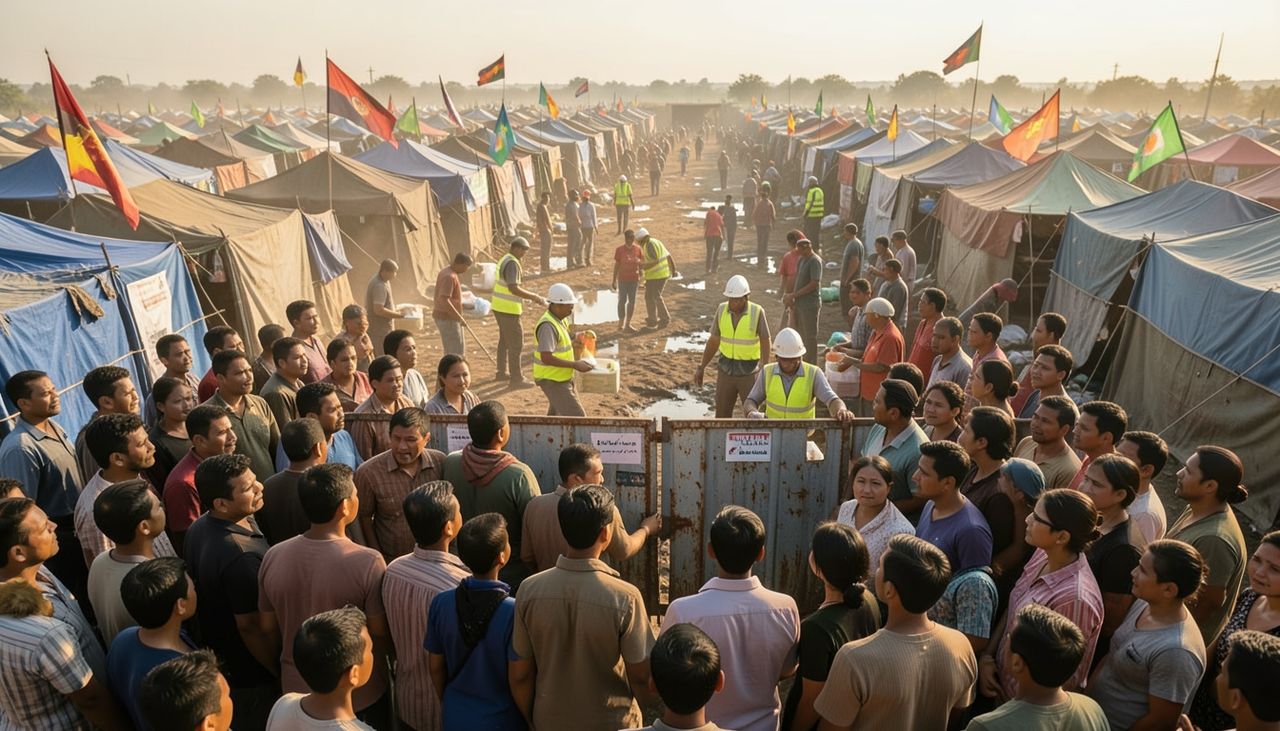
AI-generated illustration
Israeli attacks on the Gaza Strip, tighter restrictions on the entry of goods and humanitarian aid, and a widening of controlled territory are deepening the humanitarian crisis in the enclave, even as a ceasefire with Hamas remains in force. Tomorrow's Knesset election campaign has been used to spread extremist rhetoric against Palestinians, the source material says.
The World Food Programme has cut its assistance by roughly a third because of a funding shortfall, leaving about 500,000 Palestinians without food support, while Gaza hospitals have run out of oil for their generators and the Israeli army keeps moving the boundary it controls westward.
The World Food Programme (WFP) announced on 19 October that it would reduce its aid in the Gaza Strip by about a third because of insufficient funding. The decision left roughly 500,000 Palestinians without food support. The number of people receiving assistance fell from 1.6 million in September to 1.1 million in October. Food package contents were also reduced, with families given one package instead of two and less wheat flour distributed.
Daily hot meal distribution dropped from 250,000 to 150,000, and families in hard-to-reach areas such as those near the "Yellow Line" can now receive meals only every other day. The WFP attributed the cuts to funding shortfalls, saying financing for its operations in the Palestinian territories in 2026 has fallen below half the level of previous years. The agency said it needs $450 million to continue its work in Gaza and the occupied West Bank from October through March 2027.
United Nations data show about 1.4 million people in Gaza, roughly two-thirds of the population, face high levels of food insecurity. The Gaza government's Media Office warned on the same day that the cuts are accelerating hunger and accused Israel of waging a war of starvation. The Palestinian government said on 20 October that malnutrition is rising among children and pregnant women and called for funding and the reopening of border crossings.
Although the announced reason for the aid reductions is a lack of funds, Israeli restrictions on the entry of goods and assistance into Gaza make it harder to meet humanitarian needs. The UN Office for the Coordination of Humanitarian Affairs (OCHA) said in a report published on 19 October that difficulties in delivering aid persist because of inspection procedures, the limited capacity of border crossings and coordination conditions.
The same report confirmed that markings defining the boundary near the Shujaiya junction were moved, and warned that more families in the area could be displaced. Restrictions on aid and commercial goods entry continue to make it harder to meet basic needs across the territory.
Gaza's Health Ministry announced on 21 October that the oil needed to run hospital generators has run out, warning that life-saving health services could stop if the remaining generators break down. Hospitals are reported to need more than 2,500 litres of oil a month to compensate for general power cuts and run generators for long hours.
Mazin el-Araişi, the ministry's director of general engineering and maintenance, said on 13 September that the amount of oil allowed into Gaza is not enough to operate and maintain the generators. Hospitals have relied on generators since Israel cut electricity to Gaza in October 2023. The territory's only power plant went out of service when its fuel ran out, and Israeli attacks destroyed much of the power lines and distribution networks.
Generators keep operating theatres, intensive care units, incubators, ventilators and dialysis machines running. Their shutdown would directly threaten the lives of patients, especially those who need intensive care.
The Israeli army continues to shift the boundary markers known as the "Yellow Line" westward, expanding the area it controls despite the phased withdrawal foreseen in the ceasefire agreement. The line marks the boundary the army pulled back to in the first phase of the deal, separating areas under Israeli control from areas where Palestinians are allowed to remain.
When the ceasefire took effect, about 53% of the Gaza Strip remained under Israeli control, and that area has since expanded gradually. On 10 October, Israeli forces advanced tens of metres in the Shujaiya neighbourhood east of Gaza City and moved the concrete blocks marking the Yellow Line westward, displacing dozens of Palestinian families. The expansion of controlled territory limits Palestinian access to homes, farmland and service facilities and complicates humanitarian operations.
Israeli Prime Minister Binyamin Netanyahu acknowledged on 24 June that the army controls about 70% of the Gaza Strip. During a visit to Gaza on 2 September, Netanyahu said Israel would not withdraw from the Yellow Line.
According to the latest figures from Gaza's Health Ministry, 1,559 Palestinians have been killed and 5,608 wounded in Israeli attacks carried out since the ceasefire that took effect on 10 October 2025. The bodies of 845 people were recovered from under the rubble in the same period.
The total death toll from Israel's offensive on the Gaza Strip, which began in October 2023, has reached 74,555, with 175,727 people wounded. The continuing attacks, restrictions on aid entry and the expansion of controlled territory make it harder for Palestinians to reach shelter, food and health services.
In Israel, extremist rhetoric against Palestinians has become campaign material ahead of tomorrow's Knesset elections. National Security Minister Itamar Ben-Gvir, leader of the far-right Otzma Yehudit (Jewish Power) party, published an AI-generated propaganda video depicting the Gaza Strip completely destroyed in 2030.
Key takeaways
- The WFP cut Gaza aid by about a third due to funding shortfalls, leaving roughly 500,000 Palestinians without food support.
- Gaza hospitals have exhausted the oil needed for generators, putting life-saving services at risk of stopping.
- The Israeli army moved the "Yellow Line" westward on 10 October, displacing dozens of families in Shujaiya despite the ceasefire.
- 1,559 Palestinians have been killed since the ceasefire took effect on 10 October 2025, Gaza's Health Ministry says.

Join the conversation
Share your thoughts on this story.
Comments
Post a Comment