
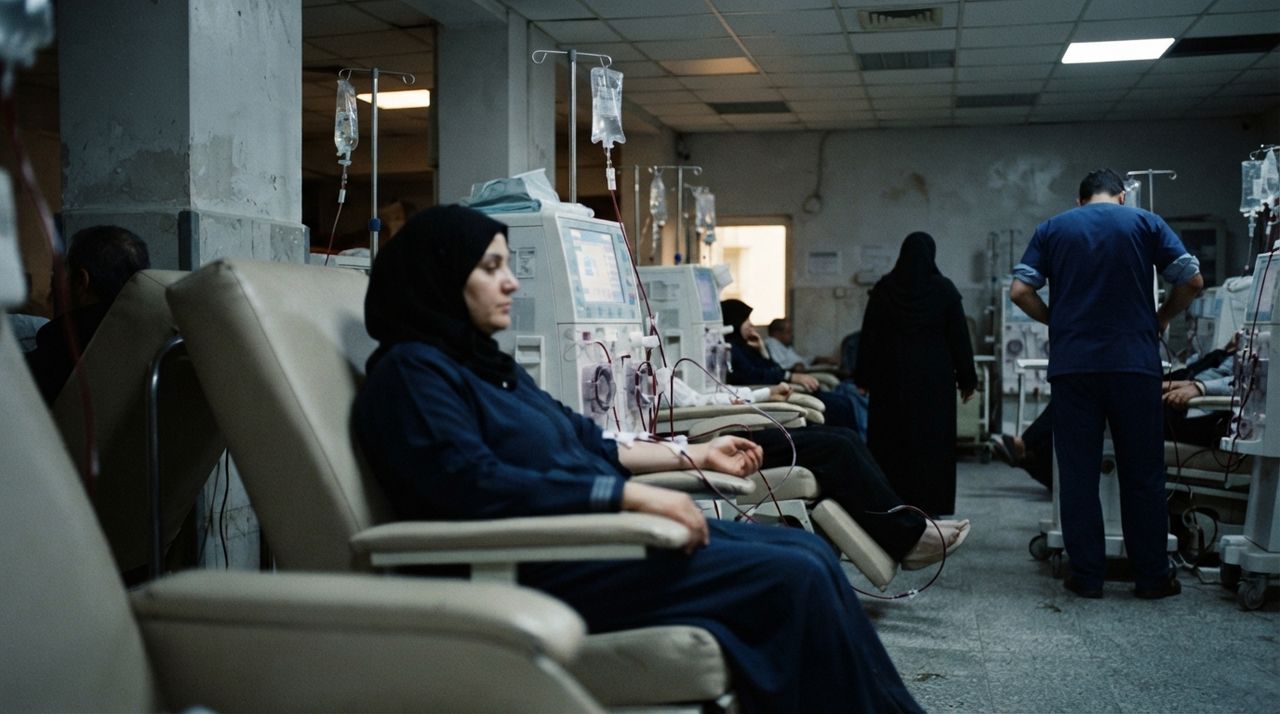
AI-generated illustration
Hospitals across the Gaza Strip are close to shutting down emergency services as generator fuel, engine oil and spare parts run out, the Health Ministry in Gaza said. With the main electricity grid destroyed by Israeli forces, backup generators are now the only power source for operating rooms, neonatal units and intensive care wards.
Around 70 percent of generators at Gaza health facilities are out of service for reasons including oil shortages, and the monthly fuel need of more than 2,500 litres is not being met, according to the ministry.
Nasser Hospital runs on a single generator
At Nasser Hospital in Khan Younis, in southern Gaza, the blockade has left the facility unable to find the oil and spare parts needed to maintain its generators. That raises the risk of blackouts in critical areas such as operating rooms, newborn units and intensive care.
Engineer Hamd al-Neccar, head of the hospital's mechanical department, told Anadolu Agency (AA) that generators have become the sole source of electricity in Gaza hospitals since what he called a genocide began. "Since the start of the war these generators have been Nasser Hospital's beating heart. We get no power from the main grid, so we depend entirely on them," al-Neccar said.
Oil secured through international organizations arrives late, al-Neccar said, and the hospital is forced to recycle used oil that has lost its properties. "That wears down the generators' internal parts, causes overheating and shortens their lifespan," al-Neccar said. One generator was shut down after exceeding the operating hours set for an oil change, and al-Neccar said a second unit is now running: "If that one stops too, I don't know what we will do. We have operating rooms, incubators and intensive care units. We will try to cut consumption and keep services going with smaller generators."
Monthly fuel need put at 2,500 litres
The Health Ministry in Gaza warned that the fuel needed to keep hospital generators running has been exhausted, and said the shortage is causing the units still working to break down. Without them, power supply to critical departments will be disrupted.
The ministry said hospitals in the Gaza Strip need 2,500 litres of fuel a month to keep their generators going. The limited fuel provided under emergency arrangements does not cover long operating hours, and round-the-clock emergency care pushes consumption higher.
The ministry called on all relevant institutions to meet their humanitarian responsibilities and intervene urgently to secure the fuel and spare parts needed to keep the generators running.
Services suspended in several hospitals
A field hospital run by Medecins Sans Frontieres (MSF) in Deir al-Balah saw its generator fail on 5 August. Surgery was restricted to life-threatening cases, and sterilization and X-ray services were suspended.
The main generator at al-Ahli Baptist Hospital in Gaza City went out of service on 10 September, stopping CT scanning and medical imaging and forcing the postponement of operations.
The UN Office for the Coordination of Humanitarian Affairs (OCHA) said on 19 October that shortages of fuel, engine oil and spare parts threaten vital services, including dialysis and treatment for cancer and chronic diseases.
Patients on life support at risk
In the few hospitals still operating in the Gaza Strip, medical devices in wards treating patients and the wounded run on electricity supplied by generators. Because Israel restricts the entry of humanitarian aid, medicine and fuel, the failure to deliver fuel to hospitals directly endangers the lives of patients and the wounded who depend on those devices.
Since Israel began its attacks on the Gaza Strip in October 2023, targeting schools and hospitals among other sites, more than 74,000 Palestinians have been killed and more than 175,000 wounded, and about 90 percent of infrastructure has been destroyed.
Key takeaways
- Around 70 percent of generators at Gaza health facilities are out of service, the Health Ministry in Gaza said.
- Hospitals in the Gaza Strip need more than 2,500 litres of fuel a month, but stocks have run out.
- Nasser Hospital is recycling degraded engine oil, and only one generator is still running, engineer Hamd al-Neccar said.
- MSF's field hospital in Deir al-Balah, al-Ahli Baptist Hospital and OCHA have all reported suspended or threatened services.

Join the conversation
Share your thoughts on this story.
Comments
Post a Comment