
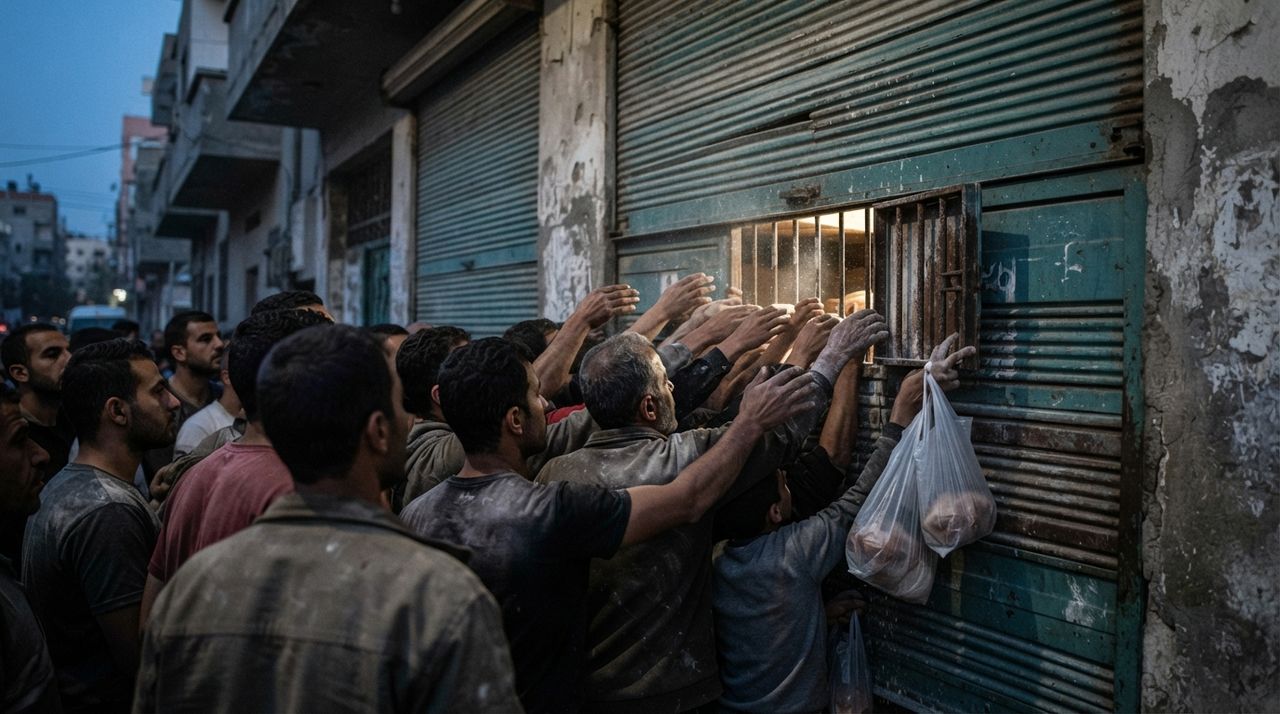
AI-generated illustration
The Ministry of Social Development in Gaza warned that Palestinian lives are under threat after most bakeries in the Strip halted operations because Israel is blocking the entry of flour and other basic food supplies. The ministry said the closures are the outcome of what it called a policy of systematic starvation and the use of food as a weapon against civilians.
Ismail al-Sawabite, director general of the Media Office, said fuel and flour shortages have already forced many bakeries, including two large ones, to close, and that seven remaining World Food Programme-supported bakeries could stop working entirely within 48 hours.
Ministry denounces blocked flour shipments
The Ministry of Social Development issued a written statement on the humanitarian disaster unfolding in the Gaza Strip, warning that the halt in bakery operations is endangering Palestinians. Continuing to block flour and the supplies needed to run bakeries, it said, "is an extension of the policy of systematic starvation and the use of food as a weapon against defenseless civilians."
The ministry said the likely outcome is the collapse of the last line of food defense for families, children and women who are trying to get by on materials delivered by international partners and humanitarian aid programmes. It described Israel's seizure of flour shipments and its blocking of operating supplies as violations of international humanitarian law and the Fourth Geneva Convention.
The ministry called on the United Nations, the international community and human rights organisations to press for the opening of border crossings so flour can enter without conditions, and to focus on delivering aid to those entitled to it in the Gaza Strip. It also urged these bodies to fulfil their responsibilities toward the population and warned of a hunger threat that endangers lives.
Fuel and flour shortages push bakeries toward closure
Ismail al-Sawabite, director general of the Media Office, described the difficulties Palestinians face as a result of Israel's attacks, the blockade on the Gaza Strip and obstacles at the crossings. Speaking to Anadolu Agency (AA), al-Sawabite said that during the 377 days the ceasefire agreement has been in force, Israel has allowed only 33.7 percent of the 226,200 trucks that were due to enter the Strip, a total of 76,297 vehicles.
Goods entering the Gaza Strip cover only 37 percent of the Palestinian population's daily needs, al-Sawabite said, leaving more than 66 percent of basic requirements unmet. On bread production, the official said a large number of bakeries, including two major ones, have been forced to close because of fuel and flour shortages.
Al-Sawabite said the food crisis could deepen further if more bakeries shut down. "The seven bakeries left in the area, supported by the World Food Programme, are at risk of stopping operations completely within 48 hours because the entry of flour trucks and the materials needed to run them is being blocked," al-Sawabite said. Stopping these bakeries would deprive thousands of families of a basic food source, above all displaced people, children and women who depend on humanitarian aid.
Malnutrition and famine deaths among the victims
Al-Sawabite cited Integrated Food Security Phase Classification (IPC) figures showing that about 1.4 million Palestinians are experiencing acute food insecurity. Vegetables, fruit and basic consumer goods are supplied only in very limited quantities, and prices of available products have risen beyond families' purchasing power, forcing them to cut the number of meals they eat. Gazans struggle to obtain baby formula, nutritional supplements and suitable food for older people and diabetes patients.
"According to the records of government institutions, 466 Palestinians, including 157 children, have died from malnutrition and famine since the beginning of what Israel is carrying out as a genocide in Gaza," al-Sawabite said.
World Food Programme cuts assistance
Al-Sawabite pointed to the World Food Programme's decision to stop assistance for about 500,000 people in Gaza because of a funding shortfall, warning that the cut will widen the food gap in the area. Holding Israel responsible for the deepening humanitarian crisis in the Gaza Strip, al-Sawabite called on the international community and mediators to pressure Israel to open the border crossings and secure the entry of humanitarian aid and food supplies.
Al-Sawabite also asked donor countries and UN agencies to restart suspended assistance and mount a humanitarian response to the worsening crisis. The Ministry of Social Development had issued a statement earlier in the day warning that Palestinian lives are at risk because Israel is blocking basic foodstuffs and flour from entering the Strip, leaving most bakeries out of operation.
The ministry had also warned on 19 October, after the World Food Programme announced it would end aid for 500,000 Gazans over a funding shortfall, about the likely fallout. The WFP said the same day that it needs $450 million to keep its operations running in the Gaza Strip and the West Bank between October 2026 and March 2027.
Since Israel began its attacks on the Gaza Strip in October 2023, targeting schools, hospitals, bakeries and other vital structures, the death toll has approached 74,500, the number of wounded has passed 175,600 and close to 90 percent of infrastructure has been destroyed.
Key takeaways
- Most bakeries in the Gaza Strip have stopped working because Israel is blocking flour and operating supplies, the Ministry of Social Development said.
- Seven World Food Programme-supported bakeries could shut down entirely within 48 hours, Media Office director Ismail al-Sawabite said.
- Only 33.7 percent of the 226,200 trucks due to enter during 377 days of the ceasefire were allowed in, covering 37 percent of daily needs.
- 466 Palestinians, including 157 children, have died from malnutrition and famine, according to government records cited by al-Sawabite.

Join the conversation
Share your thoughts on this story.
Comments
Post a Comment