
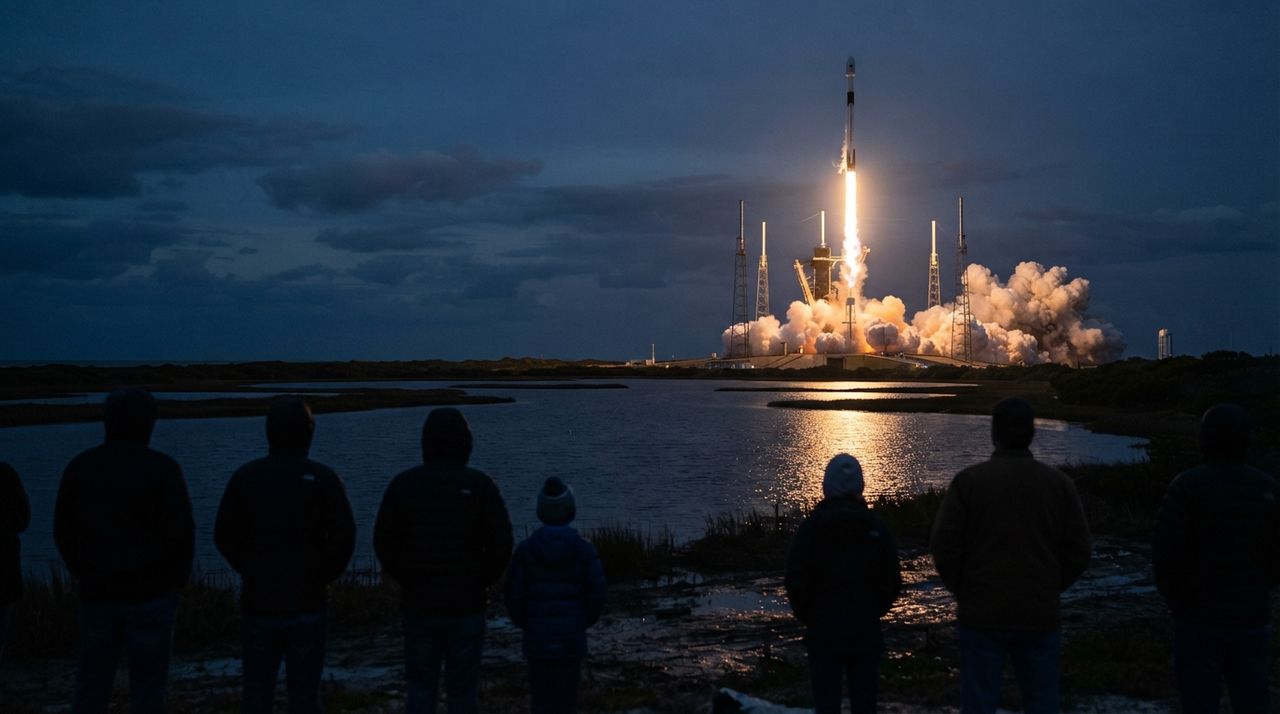
AI-generated illustration
Fergani Space Technologies, founded by Baykar Chairman of the Board and Technology Leader Selçuk Bayraktar, has launched its sixth experimental satellite, FRG-100D4, built with domestically developed engineering.
The satellite lifted off on SpaceX's Bandwagon-5 mission and separated from the launch vehicle about 63 minutes later at 15:07 Turkey time, entering its target orbit at an altitude of 590 kilometres, Baykar said in a statement.
National components flying in orbit
FRG-100D4 carries technology improvements over Fergani's earlier satellites, the company said. Critical parts developed entirely in-house include a reaction wheel, magnetic torque rod, magnetometer, IMU, GNSS receiver, steerable solar panels, a battery pack, a regenerative modem and a phased array antenna.
The satellite also houses an artificial intelligence supported computer for future missions. Verifying this nationally built avionics equipment in space and giving the technology flight history matters for Turkey's full independence in space technology, according to Fergani.
A step toward the Uluğ Bey satellite constellation
FRG-100D4 is the satellite with the highest power generation capacity Fergani has built, and it marks a stage in the localisation of equipment and subsystems. Weighing 160 kilograms, it was sent to space with a higher share of locally produced equipment and improved navigation and wideband communications payloads as a step toward the Uluğ Bey Cluster Satellite System.
Fergani Space aims to complete the Uluğ Bey system, which will consist of more than 200 satellites within five years, entirely with its own resources. Once operational, Turkey would hold an independent navigation and communications network that could be shared with friendly and brotherly geographies. Work on a national launch vehicle is continuing in parallel with the cluster satellites.
Six spacecraft in two years
With FRG-100D4, Fergani Space has sent its sixth satellite to orbit, continuing to strengthen its role in space through work carried out since the beginning of 2025. The company's space programme began with the series' first satellite, FGN-100-D1, launched in January 2025, followed by FGN-100-D2 on 2 November 2025.
The Orbital Transfer Vehicle with a hybrid propulsion system, FGN-TUG-S01, was launched on 28 November 2025. Using its hybrid motor technology, the vehicle performed its first orbital raise manoeuvre in space and successfully separated the FRG-10D1 cubesat it carried, in what Fergani described as an important step for Turkey's in-space logistics capability.
The fifth spacecraft developed by Fergani, FGN-100-D3, was sent to space on 29 March 2026.
Key takeaways
- Fergani Space launched its sixth satellite, FRG-100D4, on SpaceX's Bandwagon-5 mission.
- The 160-kilogram satellite separated about 63 minutes after liftoff and reached a 590-kilometre orbit.
- It carries nationally developed avionics, including a reaction wheel, GNSS receiver and phased array antenna.
- Fergani aims to complete the Uluğ Bey constellation of more than 200 satellites within five years using its own resources.

Join the conversation
Share your thoughts on this story.
Comments
Post a Comment