
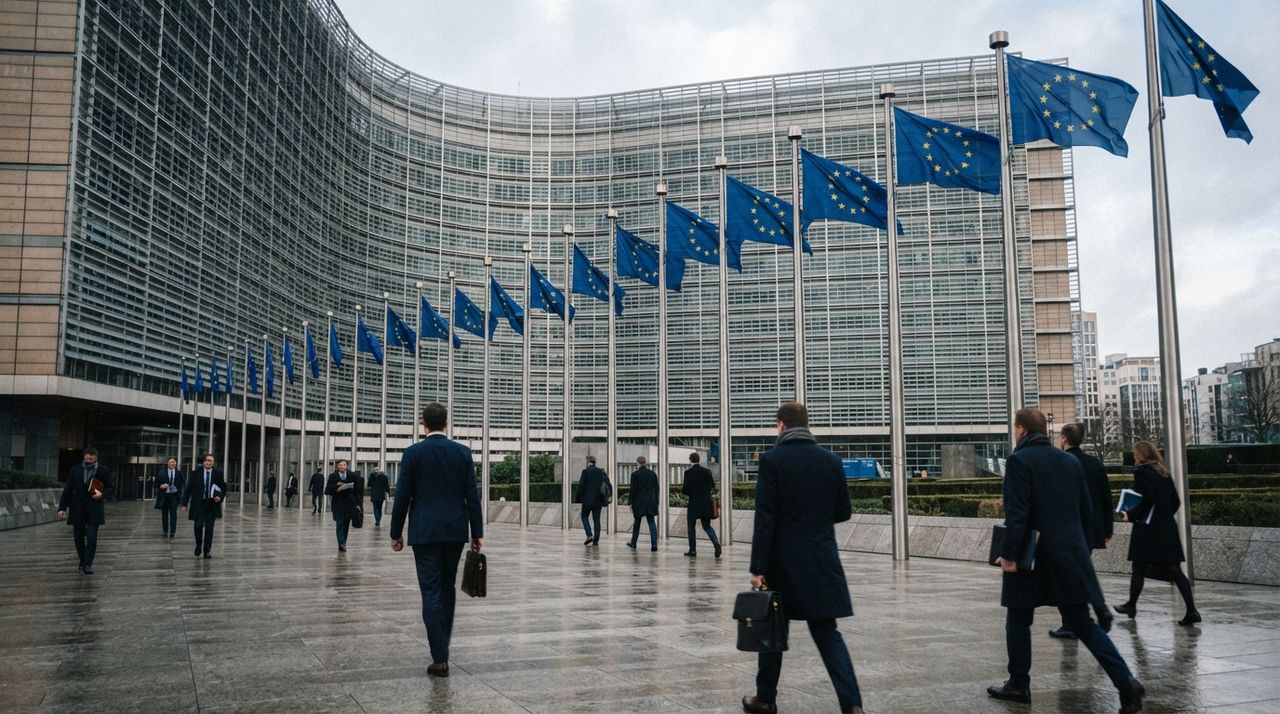
AI-generated illustration
The European Commission said every option, including the EU Blocking Statute, remains on the table in response to US sanctions against the International Criminal Court (ICC).
Commission spokesperson Siobhan McGarry said the bloc is in dialogue with member states about activating the statute and is reviewing all measures it could use to protect the court's work, without naming a date or time for a decision.
Commission weighs measures with member states
Commission spokesperson Siobhan McGarry told a daily press briefing that the US decision to sanction the ICC had also been discussed at the EU Leaders Summit held on October 15-16. McGarry said the Commission is in dialogue with member states about putting the Blocking Statute into effect.
McGarry said the Commission is assessing all the measures it can deploy to protect the court's work, and that no fixed date or time has been set for the Blocking Statute to be triggered. The spokesperson said the EU hopes to find a more suitable solution that would allow the court to continue its vital work, and could not share all the details of the process.
McGarry noted that the Netherlands is playing a leading role in the effort, saying work is under way on steps that could be taken to protect the court if no alternative is found when a six-month period ends. The spokesperson said it was not possible to predict how the process would conclude: "All options are on the table, and the Blocking Statute is one of them."
US moves against the court
US Secretary of State Marco Rubio announced the decision to impose sanctions on the ICC after Navi Pillay, a South African jurist and former judge of the court, won the 2026 Nobel Peace Prize. Rubio said the United States would not allow Americans to be prosecuted by the ICC, warning that the court would either end its threats or the US would dismantle it.
The ICC issued arrest warrants for Israeli Prime Minister Benjamin Netanyahu and former Defense Minister Yoav Gallant in November 2024, a move Washington opposed. In August, the US administration decided to sanction judges and prosecutors, including ICC President Tomoko Akane.
Origins of the Blocking Statute
The Blocking Statute first emerged in 1996, after the United States imposed embargoes on Cuba, Iran and Libya. The legislation was designed to shield European companies doing business with those countries by blocking the enforcement of decisions that foreign courts might issue against them.
Its application was later shelved after the EU and the US negotiated a solution to the dispute. The statute entered into force again on August 7, 2018, after US President Donald Trump decided to withdraw from the nuclear agreement with Iran signed in 2015.
Key takeaways
- The European Commission says all options, including the Blocking Statute, are on the table over US sanctions on the ICC.
- No date has been set for activating the statute, and the Netherlands is leading the search for alternatives.
- Marco Rubio announced the sanctions after former ICC judge Navi Pillay won the 2026 Nobel Peace Prize.
- The Blocking Statute dates to 1996 and was reactivated on August 7, 2018, after the US left the Iran nuclear deal.

Join the conversation
Share your thoughts on this story.
Comments
Post a Comment