
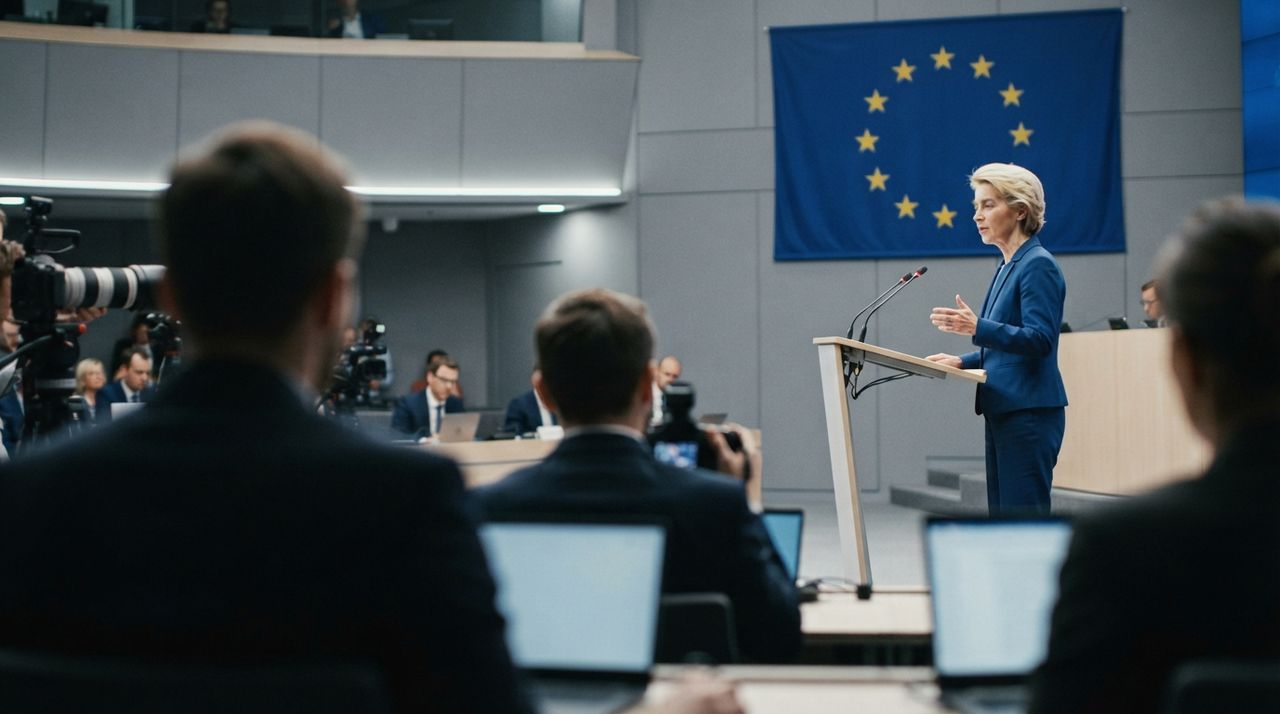
AI-generated illustration
European Commission President Ursula von der Leyen said the EU would delay implementation of its methane rules by one year and extend and broaden a temporary state aid framework to ease the impact of high energy prices.
Speaking at a press conference after an EU leaders summit in Brussels, von der Leyen also outlined plans for joint energy purchasing, refinery talks and stronger trade defences toward China.
Cost of fossil fuel imports rises sharply
Von der Leyen said the cost of fossil fuel imports has risen by 106 billion euros without a single additional molecule of energy being purchased. Natural gas prices have climbed about 140 percent since the end of February, and diesel prices have doubled, von der Leyen said.
Member states have different energy mixes, so there is no single solution to the crisis and steps are needed at both global and European level, von der Leyen said. Oil and diesel reserves will be released onto the market over the next four months under the coordination of the International Energy Agency (IEA), von der Leyen added.
Public aid, methane delay and refinery dialogue
The temporary state aid framework created in February will have its duration extended and its scope widened, von der Leyen said, adding: "We will delay the implementation of the methane regulation by one year."
The EU will also launch a strategic dialogue with European refineries to increase refining capacity and bring prices down, von der Leyen said. The existing structure for joint energy purchasing will be strengthened, building on the mechanism that pools demand and matches buyers with sellers. The aim is for a market operator to use the EU's collective buying power to secure energy supplies on the global market, von der Leyen said.
Nuclear power and renewables in focus
As long as Europe remains dependent on imported oil and natural gas, it will stay exposed to developments beyond its control, von der Leyen said. The shift to affordable, clean energy produced in Europe should continue, with nuclear and renewable sources taking the place of imported fossil fuels in the form of electricity generated within Europe.
Electricity grids must be modernised to deliver cheap energy where it is needed, von der Leyen said. The legislative process to renew the Emissions Trading System (ETS), for which a proposal has been submitted, should be completed quickly, von der Leyen added.
New trade tools proposed toward China
EU leaders discussed economic ties with China and trade imbalances at the summit, and von der Leyen said there was strong unity among them. "China is an important trading partner for the EU, and we agree on that. We want this partnership to be fair, balanced and mutually beneficial. But reaching these goals requires a comprehensive and swift rebalancing," von der Leyen said.
The EU's trade deficit with China reached 1 billion euros per day in 2025, a structural problem that cannot continue, von der Leyen said. Existing trade defence instruments will be used and additional protective measures taken, von der Leyen said, alongside a new tool called "Diversify EU" that will not target a specific country and will help companies reduce risks faster.
A solidarity mechanism for member states facing economic pressure or retaliation is also planned. It would allow rapid restrictions on access to the Single Market where the Union's interests require it. Von der Leyen stressed that the new tools are not a substitute for full use of existing mechanisms and called for the bloc to act together.
Flexibility in the next long-term budget
On negotiations over the EU's next long-term budget, von der Leyen said there is no disagreement on shared priorities and the debate is about how to reach them. Unexpected shocks such as the pandemic, natural disasters, the energy crisis and wars show that the budget must contain flexibility so the EU can respond to crises, von der Leyen said.
The current negotiating document cuts budget flexibility by 50 percent compared with today and locks in 99.5 percent of resources in advance, von der Leyen said, criticising the approach. The world will not stay as it is, von der Leyen said, and enough room for manoeuvre must be preserved to respond to future crises.
Key takeaways
- Fossil fuel import costs have risen by 106 billion euros, with gas prices up about 140 percent and diesel prices doubled since the end of February
- Implementation of the EU methane regulation will be postponed by one year and the temporary state aid framework will be extended and broadened
- The EU's trade deficit with China reached 1 billion euros per day in 2025, and a new "Diversify EU" tool plus a solidarity mechanism are planned
- Von der Leyen criticised the draft long-term budget for cutting flexibility by 50 percent and fixing 99.5 percent of resources

Join the conversation
Share your thoughts on this story.
Comments
Post a Comment