
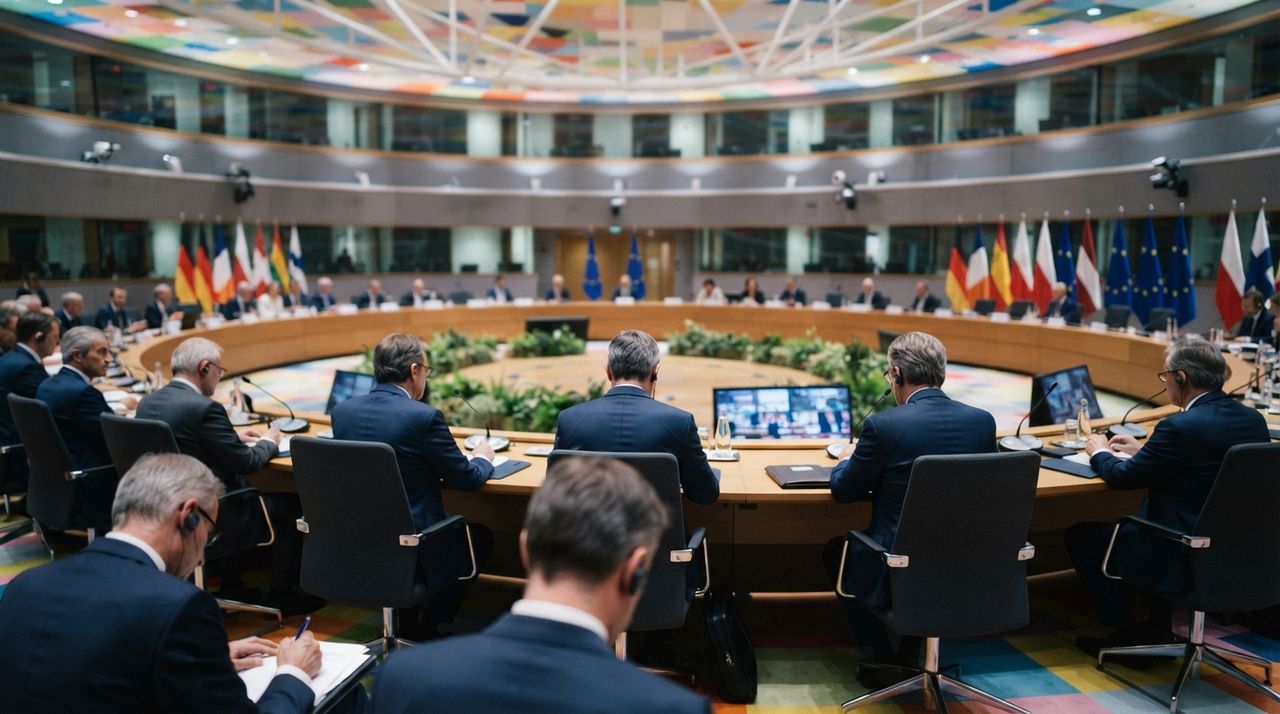
AI-generated illustration
European Union leaders met in Brussels for the second day of their regular summit to discuss backing for Ukraine, European defence, maritime security, developments in the Middle East and migration.
Ukrainian President Volodymyr Zelenskyy was expected to join the opening session, where air defence, interceptor missiles and financing topped the list of priorities as Russian attacks intensified.
Ukraine session centres on air defence and financing
The first session of the day was devoted to the latest situation in Ukraine and the support to be provided to Kyiv. Zelenskyy was expected to take part as Russian strikes grew heavier, with Ukraine's air defences, interceptor missiles and funding needs forming the main priorities of the talks.
Leaders were also expected to consider tighter measures against the Russian "shadow fleet" used to evade sanctions, along with visa restrictions for Russian citizens. EU financing for Ukraine for 2026 was agreed earlier, and how to cover the country's needs in the period after that was also on the agenda.
The question of using frozen Russian assets could come up again in that context, although no concrete progress was expected in the short term.
Maritime security and the Middle East before lunch
Sessions before the working lunch covered hybrid attacks originating from Russia, maritime security and developments in the Middle East. Recent attacks on civilian vessels in the Black Sea and their effect on the sea route that is vital to Ukraine's grain exports were also due for discussion.
Under the Middle East heading, leaders planned to address the consequences of the Iran-US war, Iranian attacks around the Strait of Hormuz and the renewed threat posed by the Houthis in the Red Sea, including the impact on trade and energy flows. The EU's Aspides maritime mission in the Red Sea and the need for ships, as well as an increase in member states' contributions to it, were among the items listed.
The Middle East agenda also covered developments in Iran, Yemen, the West Bank and Lebanon.
Migration taken up at working lunch
Migration was to be discussed over the working lunch, following the crisis in Ceuta, Spain's territory in North Africa. Although arrivals of irregular migrants have fallen, differences persist between member states over the management of border crises, solidarity and tighter migration controls.
On the first day of the summit, leaders had addressed competitiveness, the EU's next multiannual financial framework, and enlargement and reform.
Costa, von der Leyen and Zelenskyy call for pressure on Moscow
European Council President Antonio Costa, European Commission President Ursula von der Leyen and Zelenskyy spoke to reporters in Brussels before the summit's Ukraine session. Costa said EU support for Ukraine was as strong as ever. "Now is not the time to withdraw support from Ukraine or to ease sanctions on Russia. Now is the time to increase our support and our pressure," Costa said, adding that this was needed for Russia to accept a real ceasefire, come to the negotiating table and end the war. "Now is the time for peace. It is not the time to continue the war," Costa said.
Costa told Zelenskyy that support was not limited to wartime, saying Ukraine could count on the EU "not only to support you in the war, but more importantly for your future as an EU member." Costa noted that two more negotiating clusters had opened in Ukraine's EU accession talks this week and said the process should continue, praising the Ukrainian government and parliament for pressing ahead with reforms despite heavy wartime conditions.
Von der Leyen said the frequency of Zelenskyy's visits to Brussels showed the closeness between the two sides and the intensive work on Ukraine's path to EU membership. She thanked the Ukrainian parliament for reforms that allowed two more clusters to open, with the goal of opening the remaining two by the end of the year. On preparations for the coming winter, von der Leyen said Russia was trying every means to destroy energy and water infrastructure, and pledged that the EU would support Ukraine as in previous winters. She said the EU backed a ceasefire initiative by US President Donald Trump to halt attacks on energy infrastructure, but that Russia had not observed it "for even a minute" and had instead intensified its strikes. "We are currently working on the 22nd sanctions package. One thing is absolutely clear: we will not lift any sanctions until Russia stops the war," she said, adding that the talks would cover Ukraine's financial, budgetary and military needs in both 2026 and 2027.
Zelenskyy said EU support since the start of the war had been of critical importance and that Ukraine counted on its continuation. Energy needs came first on the agenda, Zelenskyy said, adding that Ukraine wanted to end the war as quickly as possible. "At the moment we see no signs from the Russian side that they are ready to end this war. That is why we need to prepare a winter package. This is not only about energy, it is also about air defence and financing," Zelenskyy said. Zelenskyy thanked the Ukrainian parliament and government for adopting important reforms under heavy attacks and welcomed the opening of two more negotiating clusters. "We will do everything we can to open the final two clusters by the end of the year. I am confident we will achieve this," Zelenskyy said.
Kallas presses US allies and flags defence gaps
EU High Representative Kaja Kallas told reporters before the second day's sessions that there was no sign Russia was willing to end the war or take part in a ceasefire or peace process, and said work was under way on a new sanctions package to raise pressure on Moscow. "Of course we hope to do this together with all our partners around the world," Kallas said, adding that the EU was also trying to persuade US partners to step up pressure. "If we want to end this war, we have to squeeze the aggressor. Because it is not only about ending this war, it is also about making sure Russia does not start new wars," Kallas said.
Kallas said EU foreign ministers had drawn up a list of Europe's security concerns and demands to be presented to Russia in any talks, and that these should be conveyed to Moscow. Demands from Moscow should not be met in full without securing concessions in return, Kallas said, adding: "But of course, with our American allies, you see this is very difficult at the moment."
Asked about Ukraine's reliance on the Starlink satellite communications system, Kallas said it remained critical for Kyiv and that Europe could not replace its capabilities in the short term. Leaders were also set to discuss Europe's defence readiness, after the European Defence Agency identified critical capability and industrial capacity gaps that need closing. "We must do this as quickly as possible, because we need these capabilities ourselves," Kallas said.
Key takeaways
- EU leaders discussed Ukraine support, maritime security, the Middle East and migration on the second day of the Brussels summit.
- Von der Leyen said the EU is working on a 22nd sanctions package and will lift no sanctions until Russia stops the war.
- Zelenskyy said there are no signs Russia is ready to end the war and called for a winter package covering energy, air defence and financing.
- EU High Representative Kallas urged US partners to increase pressure on Moscow and said Europe must close defence capability gaps.

Join the conversation
Share your thoughts on this story.
Comments
Post a Comment