
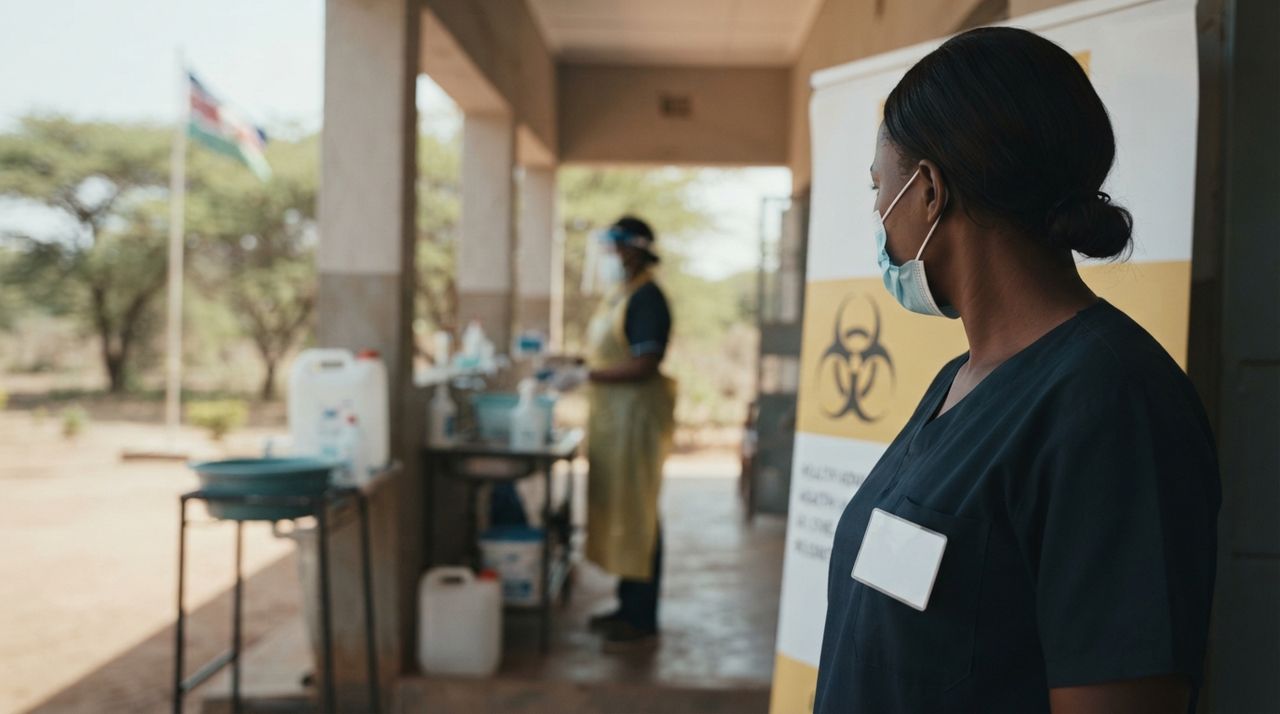
AI-generated illustration
An Ebola outbreak caused by the Bundibugyo virus, first reported in the Democratic Republic of Congo (DRC), has spread to Kenya, Nigeria and Uganda, raising fears that a wider part of Africa could be affected. Nigeria confirmed its first case after a traveller arrived in Abuja from Uganda.
Information compiled by an AA correspondent from the World Health Organization (WHO), Africa CDC, the U.S. Centers for Disease Control and Prevention (CDC) and health authorities in affected countries points to late diagnosis, gaps in contact tracing and difficulties in accessing health care as the main drivers of the spread.
Outbreak crosses borders from the DRC
The DRC has reported about 9,500 confirmed cases and more than 4,600 deaths from the outbreak, which is caused by the rare Bundibugyo virus. Cases have also been detected in Kenya and Nigeria. Uganda had earlier confirmed 20 cases before bringing its outbreak under control.
The spread of the outbreak to three African regions suggests that shortcomings in early diagnosis and cross-border health coordination could raise the risk of new outbreaks in other countries.
Late detection obscures chains of transmission
Research cited in the reports found that an average of only 10.6 contacts were identified per case in the DRC, against a target of at least 20 contacts for each case. Only 15 to 20 percent of newly confirmed cases came from among previously known contacts, indicating that a large share of transmission chains was not detected early.
The CDC reported that these findings are among the important signs that the virus is continuing to spread unchecked in the community. Confirmed Ebola deaths outside treatment centres reached 59 percent, pointing to problems such as patients not reaching health facilities in time, limited treatment capacity and distrust of health services. Laboratory testing was applied to 72 percent of notifications of suspected cases, below the response target of above 90 percent.
According to the WHO, controlling the outbreak requires stronger local surveillance systems, early detection of patients and health teams building trust-based relationships with affected communities.
Nigeria and Kenya cases show the cost of slow diagnosis
The WHO and Nigeria's Health Ministry confirmed Bundibugyo virus in a woman who travelled from Uganda to the Nigerian capital, Abuja. Her symptoms started on 7 October, she sought care at a private health facility on 11 October, and a laboratory test returned a positive result on 20 October. Health authorities placed 44 identified contacts under follow-up.
In Kenya, a person who travelled from the DRC via Uganda to Nairobi died on 5 October. Reviews carried out afterwards confirmed Ebola on 6 October, and new cases were identified among relatives and health workers.
The time between the onset of symptoms and laboratory confirmation shows the importance of early assessment of suspected cases. A single case is not enough to assess the performance of an entire health system, but reviewing travel and contact histories, identifying possible sources of infection and monitoring contacts remain necessary to stop further spread.
Conflict and access problems in eastern DRC
Long-standing security problems in the east of the DRC are among the factors making the outbreak harder to fight. Armed clashes, displacement, limited health infrastructure and difficulties reaching some communities affect the work of health teams in identifying patients and getting them into treatment.
The CDC study found that only 49 percent of affected health zones had teams able to carry out safe and dignified burials, an important measure for reducing infection risks during funeral processes. Trust in health teams among local communities also plays a central role, since people who show symptoms need to seek care, contacts need to join monitoring efforts and protective measures need to be adopted.
Uganda meets response targets, while research on tools continues
A CDC study published in October assessed Uganda's response against a three-stage timeline: seven days from the appearance of the disease to its detection, one day for notification and seven days to complete initial response steps. Uganda detected the disease in six days, notified it in less than one day and completed the first response steps in two days, meeting all three targets.
As of 8 July, Uganda had recorded 20 confirmed cases, of which 15 were classified as cases arriving from the DRC and five as secondary transmissions within the country. By the same date, 831 contacts had been identified and more than 2,337 people from 106 areas had been tested under suspected viral haemorrhagic fever investigations. The rate of case growth slowed markedly as the response progressed, and the WHO later declared the outbreak over in the country.
The Bundibugyo virus is one of the known species of the Ebola virus, and no approved vaccine or specific treatment exists against it, which increases the importance of early diagnosis and supportive care. Vaccine candidates and treatment options are still under study, and vaccines developed against other Ebola species cannot be assumed to work against this one.
Nigeria's Health Minister Muhammad Ali Pate said emergency measures were put in place to prevent the spread of the virus after the country's first confirmed case. The patient, who returned to Nigeria on 7 October after travelling to Uganda, was isolated and is receiving treatment, and health checks at airports and entry points were increased. Following the detection of the first case in Nigeria and the spread of the outbreak across the continent, Africa CDC called an extraordinary online meeting of African health ministers for 28 October.
Key takeaways
- The DRC has reported about 9,500 confirmed cases and more than 4,600 deaths; cases have also been confirmed in Nigeria and Kenya.
- Only 10.6 contacts were identified per case in the DRC against a target of 20, and 59 percent of confirmed deaths occurred outside treatment centres.
- Nigeria confirmed its first Bundibugyo case in a traveller from Uganda, with 44 contacts placed under follow-up.
- Uganda met all three response targets and its outbreak was later declared over by the WHO.

Join the conversation
Share your thoughts on this story.
Comments
Post a Comment