
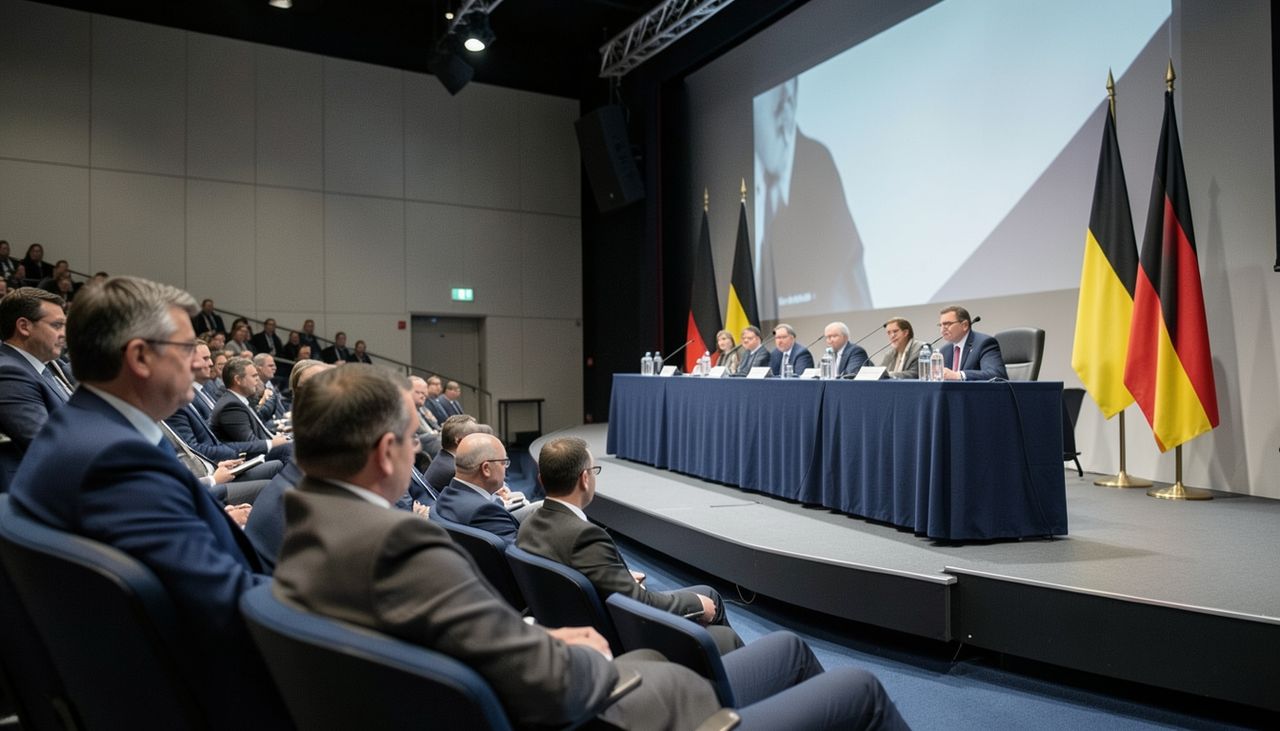
AI-generated illustration
Trade Minister Ömer Bolat said Türkiye stands among the world's leading steel producers and steel trading hubs, supported by a broad production capacity and a strong foreign trade network that spans both exports and imports. Bolat spoke at Steel Networking Summits 2026, held with support from the Steel Exporters' Association (ÇİB).
Türkiye generated 38.1 million tons of crude steel in 2025, ranking seventh in the world and first in Europe, Bolat said, adding that the country exported $17.1 billion of steel to more than 200 countries and ranked as the world's tenth largest steel exporter.
Steel as the base of industry and defense
Bolat described steel manufacturing as a core input for industry, the economy and defense. A strong steel sector is an unavoidable requirement for any country seeking to defend itself and remain standing, the minister said, pointing out that infrastructure, transport, energy, machinery manufacturing and the defense industry all rest on steel.
Bolat noted that the world's large economies took the lead in the global economy by developing their metal, steel and engineering sectors. Metal, engineering and automotive have been tightly linked and formed the backbone of national industries through the last century and up to recent years.
The Istanbul meeting has brought together more than 400 participants from over 80 countries, including upward of 200 international sector representatives and more than 30 senior speakers, Bolat said. "The aim here is to lay out where the global steel sector is heading, to plan for the future and to discuss the trends affecting the steel industry worldwide," he told the summit.
Exports, capacity and scrap-based output
Türkiye's 2025 crude steel output of 38.1 million tons placed the country seventh globally and first in Europe. Bolat said the sector acts as a locomotive for construction, automotive, machinery, energy, transport, shipbuilding and defense industries.
In a global steel trade that reached $615 billion in 2025, Türkiye exported $17.1 billion of steel to more than 200 countries, ranking tenth among steel exporters. Exports to the European Union accounted for 42.3% of that total, which Bolat called the clearest proof of the sector's international competitiveness.
Turkish steel is in demand in the European market, where high standards apply, Bolat said. He added that 78% of production capacity rests on scrap-based electric arc furnace technology: while producing 27.5 million tons of crude steel, the sector imported 18.8 million tons of steel scrap, making Türkiye a major scrap importer as well.
EU quotas, carbon rules and the green transition
Decisions taken by the United States and the European Union on the steel sector have affected trade considerably, Bolat said, arguing that such measures harm not only exporting countries but also investors in industries that depend on inputs and final consumers.
Restrictions imposed unilaterally, without sufficient consultation and negotiation with trade partners, do not offer a lasting solution, Bolat said, and they also limit the efficient circulation of scrap-based, low-carbon steel, damaging green transition goals for steel and industry. Türkiye and its government defend transparent, rules-based, fair and free trade as a means of raising global prosperity, he added.
The EU plans to narrow steel quotas by 50% from 1 July 2026, and the Carbon Border Adjustment Mechanism (CBAM) took effect at the start of 2026. Between January and September 2026, Türkiye's exports of CBAM-covered steel products to the EU fell 1.7%, while exports to countries outside the bloc rose 10%. Iron and steel exports to the EU as a whole were down 6.7%.
Bolat said the priority is to support the green transition while ensuring exporters do not face disproportionate costs and extra trade barriers. The ministry works with exporters on every development tied to the Green Deal Action Plan and climate policies, and it launched a Green Deal Compliance Project two and a half years ago under which firms receive advisory services for the transition.
Trade ties and economic growth figures
The EU is Türkiye's largest trading partner, and Türkiye is the EU's fifth largest, Bolat said. More than 30 years of customs union have integrated the two sides' industries so tightly that supply chains cannot be broken even by decisions taken at the top, he said. Annual Türkiye-EU trade stands at $233 billion, or €204 billion, and over the last five years the two-way volume has reached €900 billion, more than $1 trillion.
The Turkish economy posted average annual real growth of 5.35% over the last 24 years, Bolat said, with positive growth in the last 16 years except for 2009 and in the last 24 quarters. Growth in the first half of this year was 2.5%, with 2.6% in the first quarter and 2.3% in the second, supported by strong net exports of goods and services. National income has climbed from $238 billion to $1.7 trillion over that period and is expected to close the year near $1.8 trillion, with per capita income exceeding $20,000.
Goods exports rose from $36 billion in 2002 to $273.2 billion in 2025 and stood at $283.7 billion on an annualized basis as of September, while imports over the year to September reached $380 billion, Bolat said, adding that Türkiye contributes to world trade through both. Including $125 billion in services exports, total exports come to $409 billion, or 25% of national income, and total foreign trade reaches $860 billion.
Summit in Istanbul weighs sector's global agenda
Steel Networking Summits 2026 is being held in Istanbul with ÇİB support, bringing together stakeholders from the international steel ecosystem to focus on how global trade affects the sector. The agenda covers the new era in steel trade, global economic developments, trade wars, the green transition and artificial intelligence. The summit ends tomorrow.
ÇİB Board Chairman Uğur Dalbeler said the sector is passing through a complex period shaped by geopolitical developments, excess capacity and energy scarcity. Global trade is becoming more regional, Dalbeler said, affecting long-term plans, investments, competitiveness and confidence in the industry's future. Excess capacity is a fundamental structural problem: more capacity means more exports, which triggers more protectionism and fragments the industry further.
Fighting unfair competition is not the same as restricting international competition, Dalbeler said, adding that broad trade restrictions hurt compliant and efficient producers and that preserving a fairer, more transparent, rules-based trading system matters more than ever.
Turkish Steel Producers' Association Board Chairman Fuat Tosyalı said the rules of the global steel industry are being rewritten, including where and with which technologies and energy sources production takes place. Steel is not an ordinary industrial branch, Tosyalı said: "If you have no steel, you have no independence." The pandemic exposed fragile supply chains, followed by wars, geopolitical tensions, energy crises and trade wars. Because no country can meet all its needs alone in such an energy-intensive, raw material-dependent sector, future competitiveness will turn on matching the right resources with the right technologies in the right geographies, Tosyalı said.
Key takeaways
- Türkiye produced 38.1 million tons of crude steel in 2025, ranking seventh worldwide and first in Europe.
- Steel exports reached $17.1 billion to more than 200 countries, making Türkiye the tenth largest exporter, with 42.3% shipped to the EU.
- EU steel quotas will shrink 50% from 1 July 2026, and Türkiye's CBAM-covered steel exports to the bloc fell 1.7% in the first nine months of 2026.
- The Istanbul summit has drawn more than 400 participants from over 80 countries and ends tomorrow.

Join the conversation
Share your thoughts on this story.
Comments
Post a Comment