
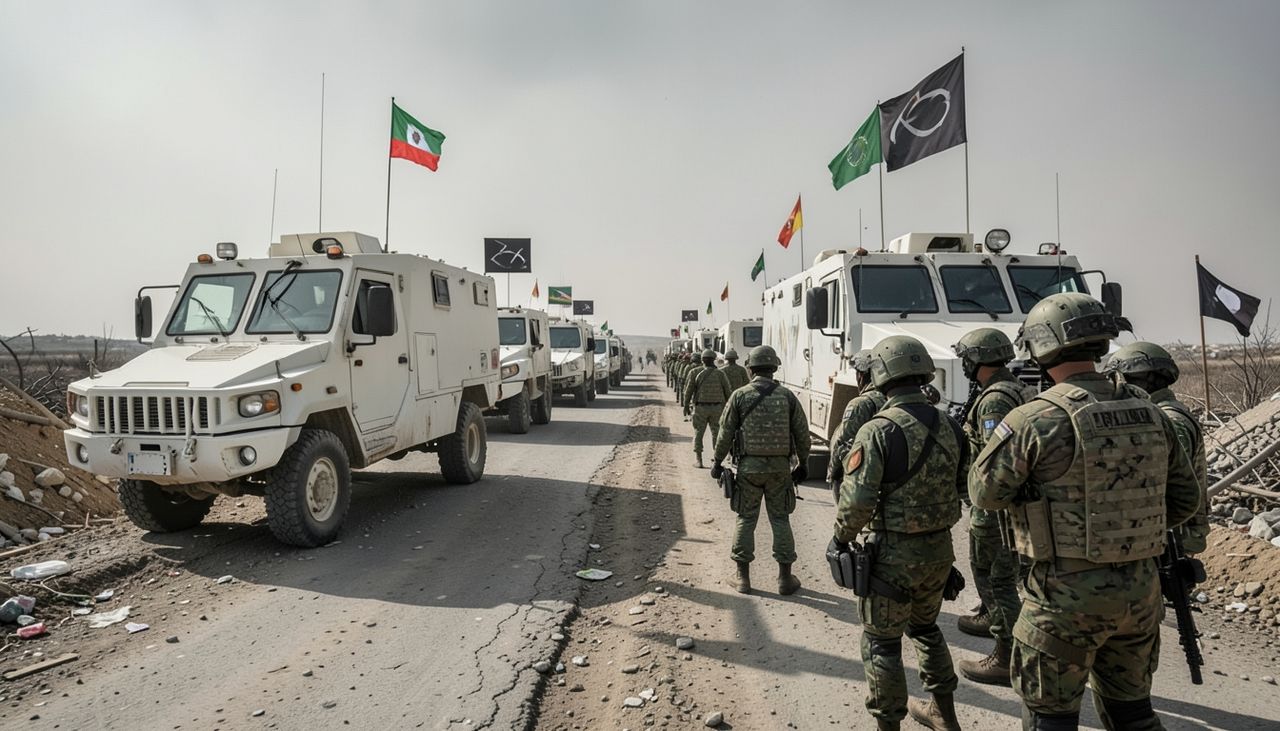
AI-generated illustration
Lebanon and Ireland agreed that an international presence should remain in southern Lebanon once the mandate of the UN Interim Force in Lebanon (UNIFIL) expires at the end of this year, warning that a pullout could leave a security vacuum.
Lebanese Foreign Minister Youssef Rejji and Ireland's Minister for Foreign Affairs, Trade and Defence Helen McEntee reached that understanding during talks in Beirut, according to a statement from the Lebanese Foreign Ministry.
Talks in Beirut
Rejji and McEntee discussed the steps to be taken after UNIFIL's mandate ends. The two ministers voiced concern about the security gap that would follow a withdrawal of the peacekeeping force from southern Lebanon, and agreed that an international presence should remain in Lebanon's border area.
McEntee asked for the other side's views on the role the European Union could play in the process, Ireland currently holding the bloc's rotating presidency. Rejji thanked Ireland for its role in the peacekeeping force and for the sacrifices of its soldiers.
Lebanon's security concerns
Drawing attention to the delicacy of the situation in Lebanon, Rejji conveyed concern about the possibility of "a new war prepared at Iran's request" by Hezbollah. Rejji repeated that Israel should withdraw from the country and halt its attacks.
Rejji also referred to government decisions on placing weapons under the state's monopoly and banning Hezbollah's military and security activities, stressing the role of the Lebanese army and the importance of supporting it to carry out its duties.
UNIFIL and resolution 1701
Israel entered Lebanon in 1978, after the civil war in the country began, and occupied the south. The UN Security Council called on Israel that year to withdraw its forces, and set up UNIFIL on March 19, 1978 at Lebanon's request to confirm the withdrawal, restore peace and security, and help the Lebanese government re-establish its authority in the south.
The Security Council adopted resolution 1701 by unanimity on Aug. 11, 2006, calling for an end to the heavy fighting that began between Lebanon and Israel on July 12, 2006. The resolution provides for Israel to withdraw behind the Blue Line and for the area between that line and the Litani River in Lebanon to be cleared of weapons, allowing only arms and military equipment of the Lebanese army and UNIFIL.
UNIFIL has served in southern Lebanon for close to half a century, and its mandate expires at the end of this year.
Key takeaways
- Lebanon and Ireland agree an international presence should remain in southern Lebanon after UNIFIL's mandate ends at the close of this year.
- Lebanese Foreign Minister Youssef Rejji and Irish minister Helen McEntee met in Beirut to discuss the follow-up to the peacekeeping force's departure.
- Rejji voiced concern about a possible "new war prepared at Iran's request" by Hezbollah and repeated that Israel should withdraw and stop its attacks.
- UNIFIL was established in 1978; Security Council resolution 1701 calls for the area between the Blue Line and the Litani River to hold only Lebanese army and UNIFIL weapons.

Join the conversation
Share your thoughts on this story.
Comments
Post a Comment