
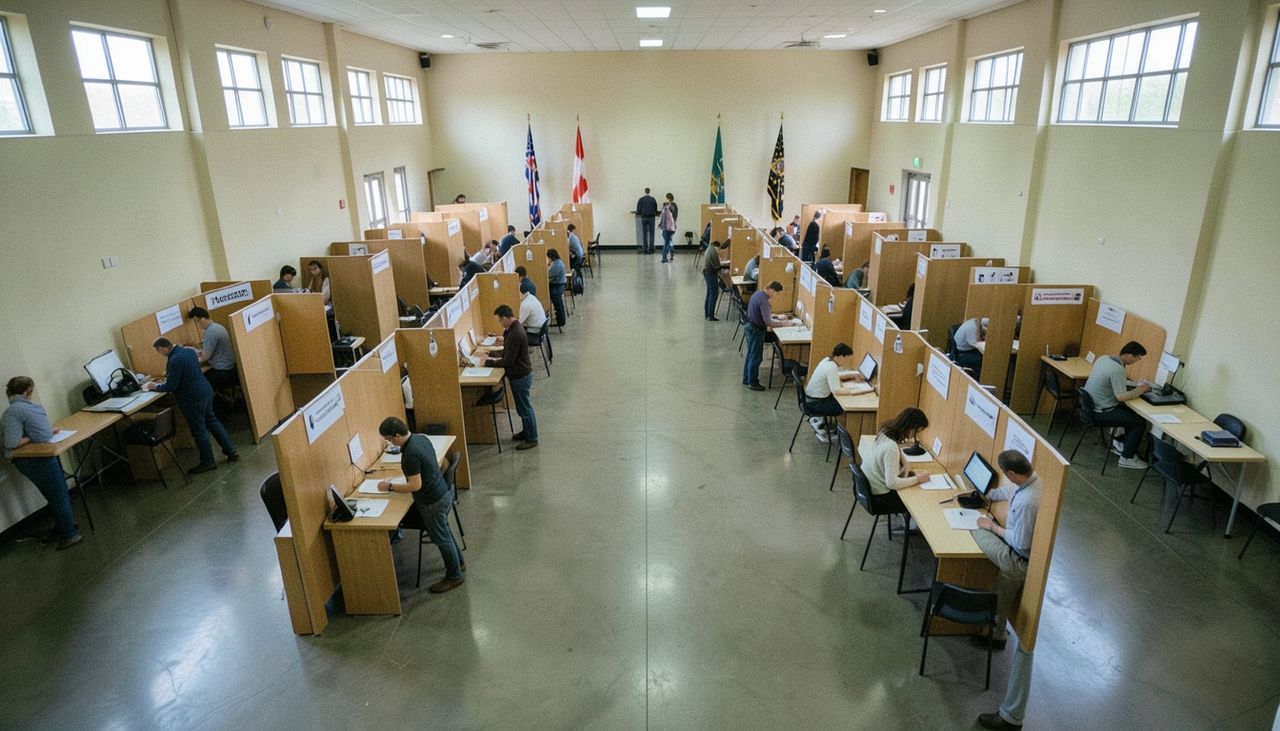
AI-generated illustration
Voters across the United States will head to the polls on November 3 for midterm elections that could reshape Congress and determine how much of President Donald Trump's legislative agenda can advance in the final two years of the term.
All 435 seats in the House of Representatives and 35 of the 100 Senate seats are being contested. With Republicans holding 53 Senate seats and the opposition bloc at 47, Democrats need a net gain of four seats to take the majority, and a handful of states are drawing the closest attention.
Senate arithmetic drives the campaign
Republicans currently hold 53 Senate seats. The opposition bloc has 47, including two independents who align with the Democrats. Democrats must net four seats to secure a majority in the chamber.
Public opinion polls show tight races in several states held by Republicans, while Democrats are working to protect seats in states that Trump carried. The outcome will shape the legislative agenda during the final two years of Trump's presidency.
Michigan and Maine offer early tests
In Michigan, Democrat Abdul El-Sayed, a former public health official, faces former Republican congressman Mike Rogers for the seat being vacated by retiring Democratic Senator Gary Peters. A Detroit News/WDIV-TV poll of 600 likely voters conducted October 19-22 put El-Sayed at 51.4 percent and Rogers at 45.1 percent, with 3.6 percent undecided and a margin of error of 4 points.
More than 5.5 million votes were cast in Michigan's previous Senate race, in which Democrat Elissa Slotkin defeated Rogers for the state's other seat by about 19,000 votes. El-Sayed would be the first Muslim elected to the US Senate and has pushed back sharply at claims that his religious faith implies divided loyalty, pointing to the criticism John F. Kennedy faced as a Catholic presidential candidate in 1960.
In Maine, five-term Republican Senator Susan Collins faces Troy Jackson, a Democrat and former president of the Maine Senate. A Marist survey conducted October 22-25 found 49 percent backing Jackson and 47 percent Collins, with a margin of error of 6.6 percent. Collins won reelection in 2020 with 51 percent against Democrat Sara Gideon's roughly 42 percent, even though Democrat Kamala Harris carried Maine with 52.4 percent in the 2024 presidential race to Trump's 45.5 percent.
Collins presents herself as an influential figure who has delivered for Maine, while Jackson argues that she has largely backed Trump's agenda.
Texas and Ohio draw heavy spending
In Texas, Republican state attorney general Ken Paxton faces Democrat James Talarico for the seat being opened by the planned retirement of Republican Senator John Cornyn. A Democratic win in Texas would be a major upset; the party has not won a US Senate race in the state since 1988. A Univision/YouGov poll of 1,000 registered voters conducted October 13-21 showed Talarico at 50 percent and Paxton at 45 percent, with a margin of error of 3.8 percent.
Talarico has placed his Christian faith at the center of his campaign and accused Paxton of corruption, while Paxton has highlighted the support of Trump. Large campaign expenditures by billionaire Elon Musk, whose companies are based in Texas, have drawn attention. The state has more than 19 million registered voters, up 2.2 percent from the 2024 presidential election. In that race, Republican Senator Ted Cruz defeated Democrat Colin Allred with 53.1 percent to Allred's 44.6 percent.
In Ohio, former Democratic Senator Sherrod Brown is trying to return to Congress against Republican Senator Jon Husted, who won the seat vacated when JD Vance became vice president. An InsiderAdvantage poll of 1,200 likely voters conducted October 21-22 showed Brown at 47 percent and Husted at 44 percent, with a margin of error of 2.8 percent. A Fox News poll of 1,592 likely voters from October 15-19 had Brown ahead 52 percent to 47 percent.
Brown lost his seat in 2024 to Republican Bernie Moreno, who took 50.1 percent to Brown's 46.5 percent, in a race Trump carried by about 11 points. Brown has made opposition to the construction of new data centers a pillar of his campaign, while Husted attacks Democratic energy and immigration policies in strong terms.
Close surveys in Alaska, Iowa and Kansas
In Alaska, where ranked-choice voting is used, Republican Senator Dan Sullivan faces Democratic former House member Mary Peltola. A Data for Progress poll of 694 likely voters conducted October 8-16 put Peltola at 47 percent and Sullivan at 44 percent. A Public Policy Polling survey of 578 registered voters on October 14-15 had Peltola at 48 percent and Sullivan at 47 percent, with a margin of error of 4.1 percent. Sullivan was reelected in 2020 with about 54 percent against independent candidate Al Gross.
Support for Republicans in Alaska has traditionally been strong, but gasoline and diesel prices have risen further since attacks on Iran began, squeezing many households and potentially leading some voters to reconsider their choices.
In Iowa, Republican House member Ashley Hinson faces Democratic state representative Josh Turek for the seat being vacated by Republican Senator Joni Ernst. An InsiderAdvantage poll of 1,200 likely voters conducted October 21-22 showed Hinson at 47 percent and Turek at 45 percent, while a Marist poll conducted October 8-11 had Turek at 48 percent and Hinson at 45 percent. Ernst won reelection in 2020 with 51.8 percent against Democrat Theresa Greenfield's 45.2 percent, and Trump carried Iowa by about 13 points in 2024. Farmers make up a significant share of the electorate, and many who backed Trump two years ago have voiced dissatisfaction with the effect of tariffs and high fuel prices on their budgets.
In Kansas, which has not elected a Democratic senator since 1932, Republican Senator Roger Marshall faces Democratic candidate Adam Hamilton, a pastor. An InsiderAdvantage poll of 1,200 likely voters conducted October 13-14 showed Marshall at 48 percent and Hamilton at 47 percent, while an earlier YouGov poll from September 24 to October 4 had Hamilton ahead 48 percent to 45 percent. Trump carried the state by about 16 points in 2024. According to the Associated Press, both sides are investing heavily, and political ad spending planned for the race is estimated to total $71 million.
North Carolina and other contests to watch
In North Carolina, former Democratic governor Roy Cooper faces Michael Whatley, a former chairman of the Republican National Committee, for the seat opened by Republican Senator Thom Tillis. A Quantus Insights poll of 722 likely voters conducted October 24-25 showed Cooper at 51.4 percent and Whatley at 42.8 percent, with 3.4 percent undecided. A Harper Polling survey on October 20 had Cooper ahead 49 percent to 39 percent. National Republicans recently pulled back campaign spending in the state, a move interpreted as treating the seat as lost. The state was closely contested in the 2024 presidential race, with Trump at 50.86 percent and Harris at 47.65 percent. More than 5.7 million votes were cast, equal to 73.7 percent of registered voters.
In Georgia, a state Trump won in 2024, Democratic Senator Jon Ossoff faces Republican Representative Mike Collins. An Atlanta Journal-Constitution/University of Georgia poll of 1,000 likely voters conducted October 7-15 showed Ossoff ahead 48 percent to 40 percent, with 12 percent undecided. Ossoff has campaigned hard against what he calls corruption and is viewed as a possible future Democratic presidential candidate.
In New Hampshire, Democratic Representative Chris Pappas faces former Republican senator John Sununu for the seat being vacated by Democrat Jeanne Shaheen. A Rasmussen Reports poll conducted October 20-23 had Pappas ahead 50 percent to 44 percent. In Nebraska, Republican Senator Pete Ricketts faces independent candidate Dan Osborn, who led 46 percent to 45 percent in a GBAO poll of 800 likely voters conducted October 18-22. Osborn has not pledged to align with either major party, which could complicate calculations for Senate control.
Key takeaways
- All 435 House seats and 35 of 100 Senate seats are up for election on November 3, with Democrats needing a net four seats for a Senate majority.
- Polls show tight Senate races in Michigan, Maine, Texas, Ohio, Alaska, Iowa and Kansas.
- Former Democratic governor Roy Cooper leads in North Carolina, where national Republicans have cut campaign spending.
- Independent Dan Osborn's strong showing in Nebraska could complicate Senate control math.

Join the conversation
Share your thoughts on this story.
Comments
Post a Comment