
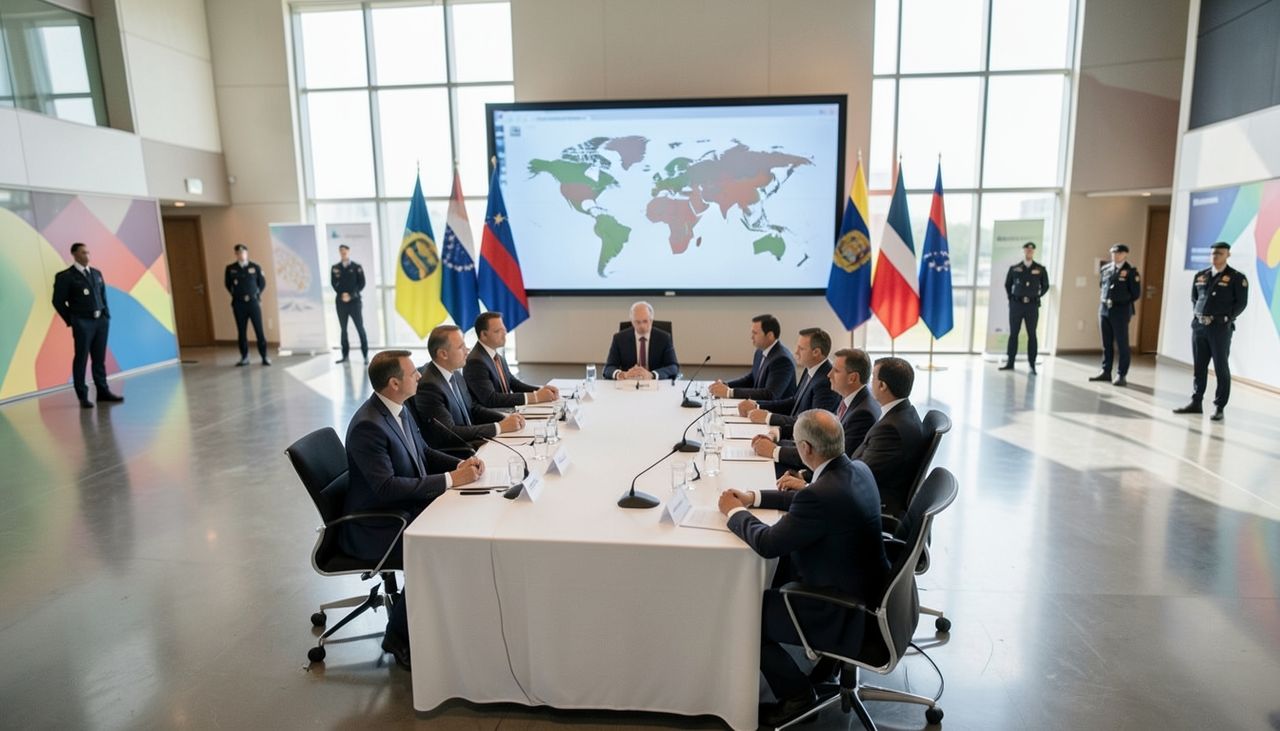
AI-generated illustration
Canadian Prime Minister Mark Carney said Canada is working with the European Union on a new partnership model that would make the country the bloc's first "associate member," with negotiations due to be completed in June. Carney spoke at the close of an EU-Canada summit in Montreal alongside European Council President Antonio Costa and European Commission President Ursula von der Leyen.
Von der Leyen said the proposal amounts to partnership without full membership, since the EU treaties do not permit a country outside Europe to join. A joint declaration issued after the summit announced an "Alliance for the Future" and set the goal of defining the new model by the 2027 Canada-EU summit.
Partnership without full membership
Carney said Canada's geographic position rules out full EU membership, and that the two sides are working toward "the deepest partnership possible short of membership, which would result in Canada becoming the EU's first associate member." He said he accepted Costa's invitation to attend European Council meetings in June, where the aim is to conclude negotiations on the new relationship model.
Von der Leyen said one of the main topics at the summit was the idea of Canada becoming an "associate member." She said the concept was straightforward: "Our idea is simple, partnership without full membership. Because the treaties are clear and do not allow it: a country outside Europe cannot join the European Union. But we can build a partnership that comes closer to membership than anything we have done so far."
She said the model is meant to give citizens more opportunities, raise prosperity on both sides of the Atlantic and strengthen common security. The partnership, she added, would rest on three pillars: policies, programmes and institutional cooperation.
Policy alignment and wider programme access
Von der Leyen said the two sides want to shape policies more closely together in areas including climate, energy, artificial intelligence, innovation and security, and to consult each other at every stage from preparation to implementation. She also said the aim is to widen Canada's participation in EU programmes.
Canada already takes part in the EU's SAFE defence industry programme, and von der Leyen said the two sides want to increase cooperation under Horizon Europe and to include Canada fully in Erasmus+. Institutional ties will also draw closer, with a meeting to be held in the spring between the Canadian government and members of the European Commission.
Von der Leyen described the associate membership idea as "uncharted territory," adding: "But we have the ambition, the trust and the creativity to shape it together." She said the partnership is not directed against any other actor but is intended to increase the parties' shared strength.
Digital trade, investment and support for Ukraine
Von der Leyen announced that negotiations on a digital trade agreement had been completed, calling it the "digital arm" of the EU-Canada Comprehensive Economic and Trade Agreement (CETA). The two sides are also close to finalising an agreement between Canada and the European Investment Bank on investment in critical raw materials, and European supercomputing infrastructure is to be opened up for Canadian use.
Cooperation is to deepen on trustworthy AI and secure satellite links, and the two sides are assessing Canada's participation in the Galileo and IRIS programmes. They also reached agreement on Canada joining the EU's 90 billion euro support loan for Ukraine. "This sends a strong message to Ukraine. Together we are increasing our support for Ukraine," von der Leyen said.
Costa calls for the closest form of partnership
Costa said the EU wants to open a new era in its relations with Canada. "Our relationship is so special that we want to create something new, to go beyond a simple partnership. A partnership that covers everything short of full EU membership. This will be the closest, deepest and most original example of its kind," he said. Costa recalled that the first bilateral agreement between Canada and the European Communities was signed in 1976, and that CETA, signed 10 years ago, strengthened economic and political ties.
Since CETA began to be applied, trade between the EU and Canada has risen by roughly 80 percent, Costa said, adding that the two sides aim to develop relations further in digital trade, mutual investment, recognition of professional qualifications, competitiveness and economic security. He said the partnership must deliver concrete results for citizens, companies and workers, meaning fewer trade barriers, more investment and closer cooperation on critical raw materials.
Costa said the two sides want to deepen research and innovation cooperation on the basis of Canada's success in the Horizon Europe programme, and to act together to protect citizens against health crises and natural disasters. He also announced a new youth mobility partnership designed to make it easier to study and work on both sides of the Atlantic.
On political and institutional ties, Costa said contacts at the highest political level will become closer, joint priorities will be set and responses to shared problems will be coordinated. He welcomed the spring meeting between the Canadian government and the European Commission and said he would be glad to host Carney at the European Council meeting in June. Costa noted that Canada is the first non-European country to join the SAFE programme, welcomed its contribution to the Ukraine support loan, and said that at a time when the international rules-based order is under pressure, the EU and Canada share a responsibility to defend it, with their alliance meant to guide other democracies as well.
Joint declaration sets 2027 target
A joint declaration issued after the summit announced the launch of an "Alliance for the Future" to create an area of shared prosperity and economic security. It said relations would be carried further on the basis of the existing Strategic Partnership Agreement, and that a partnership model falling short of full membership is to be defined by the 2027 Canada-EU summit. Greater economic, technological and strategic alignment is intended to strengthen prosperity, economic security and strategic autonomy on both sides.
The declaration said the alliance would follow the principle of reciprocity in the industrial sectors where deeper strategic cooperation is agreed. The two sides will work closely on economic security measures and seek to limit their negative effects on each other where possible, with cooperation run sector by sector and covering critical supply chains and technologies as well as the prevention of technology leakage. Plans include reducing barriers to bilateral trade, strengthening regulatory and standards cooperation and exploring cooperation opportunities in future industrial policy financing. A business council is to be set up to bring together companies from Canada and the EU.
The declaration said negotiations on the substance of the Digital Trade Agreement had been concluded, with the deal designed to ease cross-border data flows and increase legal predictability for companies and consumers. The parties will also support work to link instant payment systems so that cross-border transactions are faster and cheaper. On the Middle East, the declaration said the two sides will work more closely on de-escalation, meeting humanitarian needs and achieving a comprehensive, just and lasting peace based on a two-state solution.
Key takeaways
- Canada is negotiating a partnership model that would make it the EU's first "associate member," with talks targeted for completion in June.
- EU leaders say the treaties bar full membership for a country outside Europe, but describe the proposed tie-up as the closest partnership to date.
- Negotiations on a digital trade agreement were completed, and Canada agreed to join the EU's 90 billion euro support loan for Ukraine.
- A joint declaration sets the goal of defining the new model by the 2027 Canada-EU summit under an "Alliance for the Future."

Join the conversation
Share your thoughts on this story.
Comments
Post a Comment