
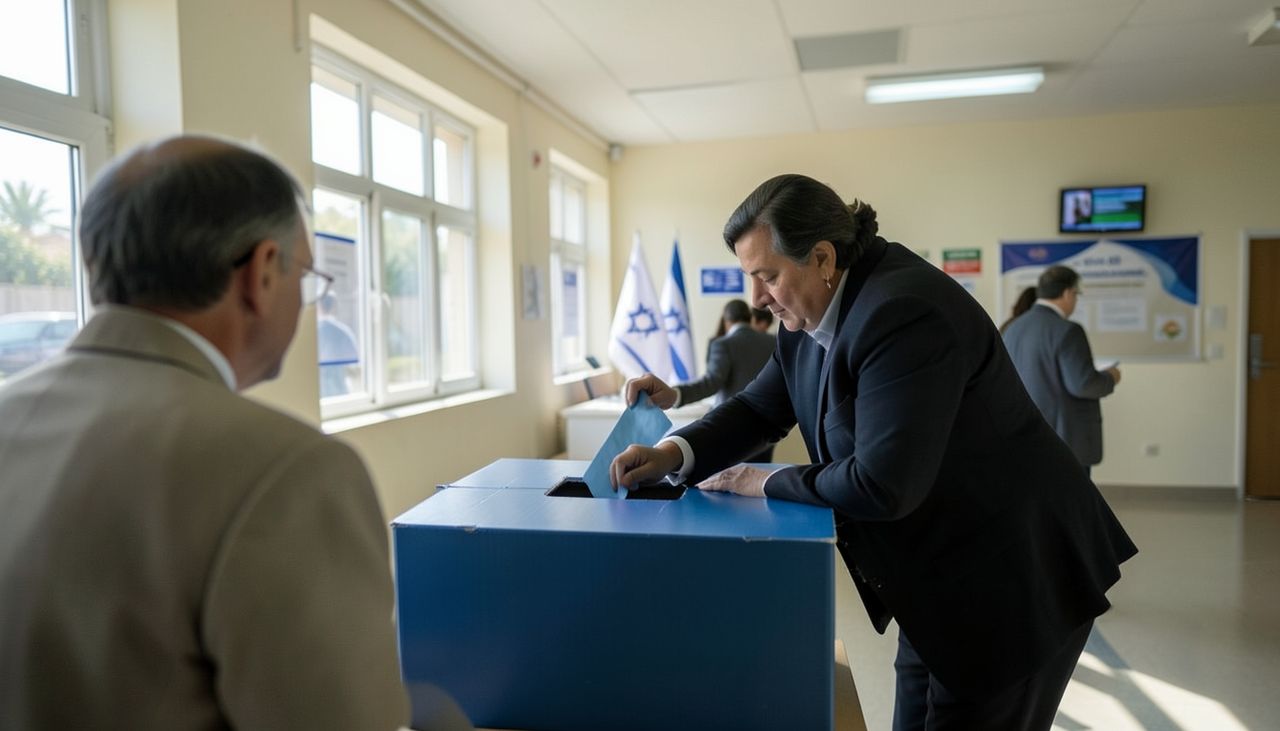
AI-generated illustration
Political parties representing Palestinian citizens of Israel are poised to send 19 lawmakers to the Knesset after elections held on 27 October, putting Raam and the Joint List in a decisive position in coalition arithmetic and making them the target of attacks by the Israeli government.
With more than 90 percent of ballot boxes opened, neither the governing nor the opposition camp reached the 61 seats needed for a majority in the 120-seat parliament, leaving the two Arab-led lists as potential kingmakers.
High turnout reshapes the Knesset map
Palestinian citizens of Israel, often called "1948 Arabs", largely stayed away from the previous elections, saying they did not believe Israel was a democracy and did not want to lend legitimacy to that claim. Participation this time was heavy across Arab communities.
According to partial official results that are not yet final, Raam, led by Mansur Abbas, is set to win seven seats and the Joint List, an alliance of three parties, 12. That combined total of 19 lawmakers is being recorded as a historic achievement and has moved both lists into a central role in coalition calculations. With more than 90 percent of boxes counted, neither bloc has reached the 61 seats required to govern.
Pressure policies drove voters to the polls
The government led by Prime Minister Binyamin Netanyahu, described as the most radical in Israel's history and including far-right figures such as Ben-Gvir and Finance Minister Bezalel Smotrich, completed four years in power during which Palestinians endured a war in Gaza described as amounting to genocide and intense attacks in the West Bank.
Discriminatory policies also reached Palestinian citizens of Israel. In the Negev region in the south, rising home demolitions displaced thousands of people, while Ben-Gvir repeatedly posted in praise of the demolitions. Under a policy of harsher police force, even minor cases drew collective punishment, raids and the sealing off of villages.
Beyond the south, many Palestinian citizens were prosecuted over social media posts that contained no criminal content after 7 October 2023, removed from jobs and schools, and subjected to discrimination. Crime rates in Palestinian areas rose to record levels under the police force answerable to Ben-Gvir, and residents held mass protests alleging the increase was deliberate. Smotrich, meanwhile, made the "Judaization" of northern areas inside Israel's 1948 borders a centerpiece of the campaign, and Israelis who seized Palestinian land set up outposts around northern Palestinian towns.
The pressure and the attempts to bar the parties pushed Palestinians to vote in force to remove the far-right government. Turnout exceeded 80 percent in several areas, including Rahat, a southern town home to Palestinian Bedouins.
The Prime Minister's Office used its Arabic account on the US-based platform X to share footage of Bedouins in Rahat heading to vote on camels and horses, arguing that Arabs vote, enter the parliament and hold administrative posts and that Israel is therefore "not an apartheid regime".
Racist posts on election day
Netanyahu and his allies sought to provoke their own supporters to the ballot box with posts containing racist language about Palestinians.
In posts on X, Netanyahu, Ben-Gvir and Smotrich presented Arab turnout as a threat and invoked the phrases "Muslim Brotherhood", "Arab parties" and "left-wing government" to rally right-wing voters. Netanyahu and the far-right ministers also resorted at times to fabricated images.
Key takeaways
- Raam is set to win seven seats and the Joint List 12 in partial results, giving Palestinian citizens of Israel 19 lawmakers and a central role in coalition talks.
- The Supreme Court reversed the Central Elections Committee's ban on Arab parties and candidates, except the decision on Joint List candidate Sami Abu Shehadeh.
- Turnout passed 80 percent in places such as Rahat after years of demolitions, prosecutions and police pressure.
- Likud's claim that Arab parties stole the vote was rejected as baseless by Israeli police, while foreign funding allegations are now being examined by Shin Bet.

Join the conversation
Share your thoughts on this story.
Comments
Post a Comment